
Audience interaction theatre: a practical guide for practitioners

Audience interaction theatre invites spectators to act on or with a performance rather than simply observe it. Where conventional staging places the audience behind an invisible fourth wall, interactive work deliberately dissolves that boundary, asking people to respond, choose, advise, or co-create in real time. The result is a form of live performance in which the audience's agency shapes what happens next.
If you are designing a piece and asking yourself whether interaction suits your project, two signals point towards yes: your artistic goal depends on the audience's perspective or choice mattering to the outcome, and you want measurable evidence of engagement or learning. Before choosing any device, plan three things first: the central question your piece is asking, the audience contract (what you are inviting people to do and what they can refuse), and a clear opt-out route so no one feels coerced.
Common outcomes of well-designed interactive work include:
- Heightened emotional engagement and personal resonance with the material
- A felt sense of agency that deepens cognitive investment
- Collective experience and shared meaning-making among strangers
- Ethical risk when participation is poorly framed or consent is unclear
Key takeaways
Effective audience interaction theatre is built on a clearly defined question, an explicit audience contract, and measurement that goes beyond instinct.
| Point | Details |
|---|---|
| Define the question first | Every interactive moment must serve a stated artistic or research question before any device is chosen. |
| Write the audience contract | State what is invited, what is never required, and how to opt out, verbally and in writing, before the show begins. |
| Rehearse refusals as thoroughly as interactions | Performers must honour a participant's refusal with the same warmth as an acceptance, and this requires specific rehearsal. |
| Measure with combined methods | Use AEF survey templates alongside at least one qualitative method to capture both immediate and reflective audience impacts. |
| Sofiavicedomini for interactive casting | Sofiavicedomini brings theatrical depth and live facilitation skills to interactive and participatory performance projects. |
Table of Contents
- What does audience interaction theatre actually mean?
- A practical typology: what modes of audience agency can you design?
- Historical precursors and the practitioners who shaped interactive work
- Design principles for meaningful, safe interactive moments
- Practical techniques and devices for enabling interaction
- UK case studies: how interactive work plays out in practice
- How do you measure the effects of audience interaction?
- Ethics, consent and audience etiquette in interactive work
- Common risks and how to mitigate them before they derail a production
- A practitioner's perspective: what interactive work actually demands
- Key takeaways for planning interactive theatre
- What interactive theatre actually demands: an honest editorial take
- Sofiavicedomini: interactive performance from the inside out
- Sources
- FAQ
What does audience interaction theatre actually mean?
The term "audience interaction" describes performances that intentionally invite spectators to become active participants: through roles, suggestions, voting, or plot steering, their input influences what unfolds on stage. Interactive theatre breaks the fourth wall by design, not by accident.
The confusion with neighbouring forms is worth untangling carefully, because the distinctions carry real design consequences.
Interactive theatre centres on agentive acts. The audience does something that changes the performance: they call out a suggestion, step onto the stage, vote on an outcome, or redirect a scene. Agency is the operative word.
Immersive theatre is primarily spatial and environmental. Companies such as Punchdrunk build 360-degree worlds that audiences move through freely, but movement through a space is not the same as influencing its narrative. You can be fully immersed and entirely passive. As one widely cited guide puts it, interactive theatre emphasises the act of participation, which can occur from a seat or on stage, whereas immersive theatre foregrounds spatial experience.
Participatory theatre is broader still: it includes devised work, community co-creation, and long-term collaborative processes where the audience may have shaped the piece before it opened. The audience's contribution is real, but it often happens upstream of the performance rather than within it.
Devised theatre refers to a creation process, not a performance mode. A devised piece may or may not be interactive once it reaches an audience.
The canonical interactive form is Augusto Boal's Forum Theatre, part of his Theatre of the Oppressed methodology. In Forum Theatre, a scene depicting oppression is replayed and audience members, called "spect-actors," intervene to try alternative solutions. The interaction is structural, not decorative: the piece cannot function without it.
Key distinctions at a glance:
- Interactive: audience agency changes the performance in real time
- Immersive: spatial freedom without necessarily changing narrative
- Participatory: co-creation that may precede or extend beyond performance
- Devised: a making process, not a performance mode
A practical typology: what modes of audience agency can you design?
Thinking in modes helps you match the right mechanism to your artistic goal. Categorise your options by four dimensions: what the audience does, how agency is expressed, who is invited to participate, and where the interaction happens.
What the audience does:
- Respond (applaud, call out, react): lowest barrier, highest inclusivity
- Vote or advise (choose between options, direct a character): democratic but tends to flatten nuance
- Act (step on stage, take a role, speak as a character): deep engagement, high performer load
- Co-create (contribute text, objects, or narrative over time): richest outcomes, most logistical complexity
How agency is expressed:
- Physical: movement, gesture, touch
- Verbal: spoken response, call-and-response, direct address
- Digital: SMS, app input, QR-triggered choices
Who is invited:
- Everyone simultaneously (whole-house voting)
- Volunteers (self-selecting individuals)
- Selected participants (cast by the company in advance or in the moment)
Where it happens:
- In the seat (low disruption, high accessibility)
- On stage (high visibility, potential anxiety)
- Site-specific (interaction woven into the environment itself)
Design decision checklist:
Before locking in a mode, ask yourself: What is the artistic aim of this moment? How much risk (emotional, physical, logistical) can the production absorb? Are all participation modes accessible to the full range of likely audience members? Does the venue permit the physical configuration the mode requires? And how much rehearsal time does the interaction demand from performers?
Short pros and cons worth weighing:
- Voting: democratic and inclusive, but binary choices can strip away the moral complexity you may be trying to surface
- Role-play: produces the deepest individual engagement, but places significant facilitation demands on performers and can isolate participants who feel exposed
- Call-and-response: easy to execute and energising, but risks feeling tokenistic if it does not genuinely alter anything
- Digital input: reaches the whole house simultaneously and generates data, but introduces technical failure risk and can break theatrical atmosphere
Pro Tip: Limit each piece to one clear interactive question or mechanism. Two competing interaction systems in the same show almost always confuse audiences about what they are being asked to do, and dilute the impact of both.
Historical precursors and the practitioners who shaped interactive work
Interactive theatre did not emerge from nowhere. Its roots reach back through agit-prop performance of the early twentieth century, Brechtian alienation techniques, and the Living Theatre's confrontational audience address in the 1960s. Each tradition chipped away at the passive spectator model.
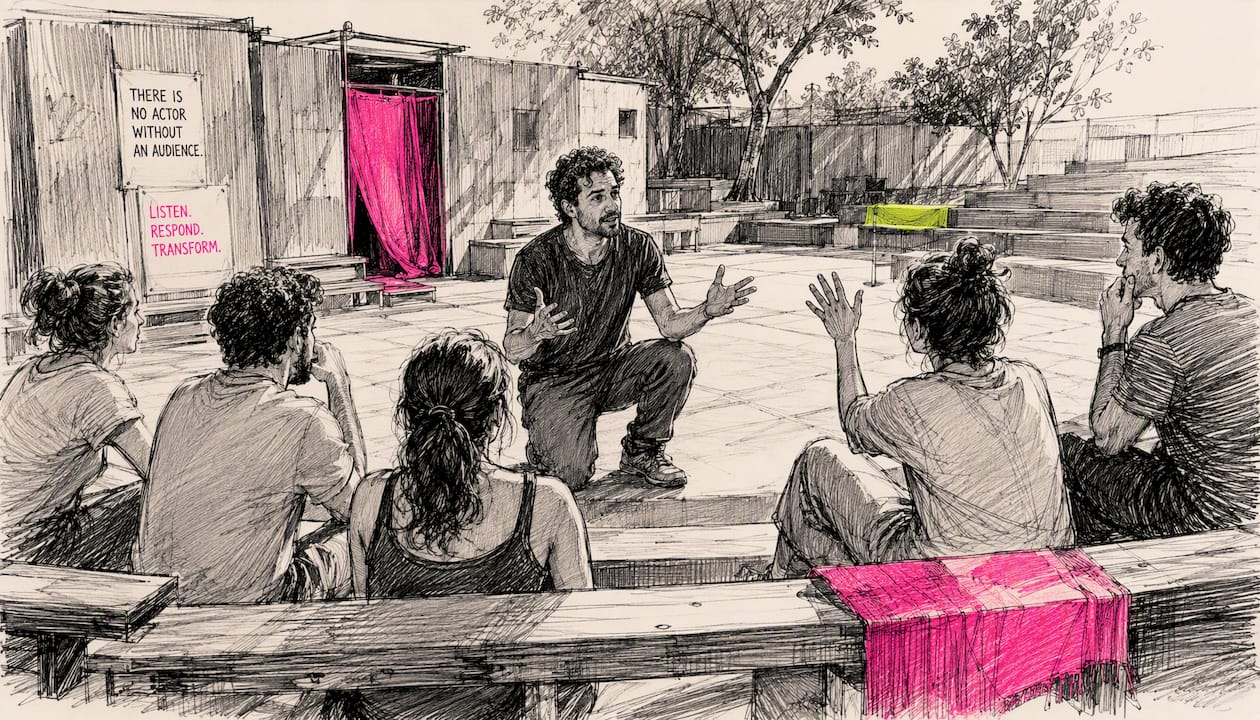
The decisive theoretical and practical leap came with Augusto Boal and his Theatre of the Oppressed, developed in Brazil from the late 1960s and documented in his 1974 book of the same name. Boal's core argument was that the separation between actor and spectator was itself a political act: keeping people in their seats kept them passive citizens. Forum Theatre, his most widely adopted method, stages a scene of oppression and then replays it, inviting spect-actors to stop the action and try alternative interventions. The joker (facilitator) holds the space, ensures the intervention is theatrically honest, and prevents easy or magical solutions.
Forum Theatre spread rapidly through community and educational settings. In the UK, it became a staple of theatre-in-education companies and community health projects, used to rehearse responses to real-world dilemmas ranging from workplace bullying to sexual health decisions.
Punchdrunk, founded by Felix Barrett in 2000, took a different path. Their work, most famously Sleep No More (first staged in London before its celebrated New York run), places audiences inside vast, multi-room environments where they follow performers, open drawers, and piece together narrative fragments. The interaction is spatial and investigative rather than agentive in the Forum Theatre sense: you choose where to go, but you do not change the script.
The National Theatre in London has explored interactive and participatory formats across its platforms, including digital commissions and community engagement projects that invite audiences into the making process. Their NT Learning programme has long used Forum Theatre and role-play techniques in schools and community settings.
Gareth White, whose scholarship is collected in Audience Participation in Theatre: Evolutions of the Invitation, argues that participation should be theorised as a core artistic practice rather than a technical gimmick. Invitations to participate require conceptual rigour: they must be carefully designed and valued, not added decoratively. White's framing has become a touchstone for academic study of the field.
Key influences each practitioner brought to current practice:
- Boal: the spect-actor concept; the joker/facilitator role; the ethical imperative of agency
- Punchdrunk: spatial dramaturgy; the audience as investigator; non-linear narrative
- National Theatre: institutional legitimacy for participatory work; scale and accessibility
- Gareth White: theoretical rigour; the invitation as artistic unit of analysis
Research into live performance measurement has added a physiological dimension to this lineage. Studies using inter-subject correlation of facial expressions can measure synchrony as a proxy for collective engagement, with findings suggesting synchrony varies across demographic groups, though results are context-dependent and should be interpreted cautiously.
Design principles for meaningful, safe interactive moments
The most common mistake in interactive design is choosing the device before defining the purpose. Gareth White's scholarship makes the case plainly: participation needs conceptual rigour, not decoration. That means starting with a question, not a mechanism.
Numbered design principles:
- Define the central question first. What do you want the audience to grapple with, decide, or feel? HowlRound's guide to the audience contract argues that specificity of the question materially changes audience responses: a vague invitation produces vague participation.
- Establish an explicit audience contract. Tell audiences, before the show begins, what they are being invited to do and what they are not obliged to do. This can be a pre-show announcement, a note in the programme, or a brief facilitated warm-up. An explicit contract significantly reduces participation anxiety and clarifies permissible behaviours.
- Build in opt-out routes. Tiered participation means offering multiple levels of involvement: watching is always valid. Performers should be trained to read reluctance and never single out individuals who have not volunteered.
- Design for accessibility from the start. Consider sensory needs (hearing loops, audio description, lighting sensitivity), cognitive accessibility (clear and simple instructions, predictable structure), and mobility (ensuring interactive zones are reachable by wheelchair users). Retrofitting accessibility after the design is fixed almost always produces compromises.
- Address safeguarding and data privacy. If you are recording audience members, collecting SMS data, or using facial-recognition technology, you need explicit informed consent under UK data protection law. Physical interactions between performers and audience members require a safeguarding policy, particularly when working with young people or vulnerable adults.
Pro Tip: Run a "participation rehearsal" with a test audience before opening night. Ask them to try every opt-out route and report back on whether the invitation felt genuinely optional. Adjust the contract language based on what they tell you.
The Audience Experience Framework identifies five dimensions of audience experience, including engagement, personal resonance, shared experience, and well-being outcomes, that can serve as design targets as well as evaluation measures. Naming which dimension your interaction is designed to activate helps you evaluate whether it worked.
Practical techniques and devices for enabling interaction
The range of available tools runs from a performer simply asking a question to sensor-driven branching narratives. Matching the device to the design principle is what separates purposeful interaction from novelty.
Low-tech options:
- Applause or silence as a vote (immediate, zero setup, but binary)
- Call-and-response structures built into the script
- Direct questions from performers to named or unnamed audience members
- On-stage volunteers invited to take a role or make a choice
- Written prompts on cards placed on seats before the audience enters
Medium-tech options:
- Show-of-hands or coloured card voting (cheap, visible, slightly more nuanced than applause)
- SMS or text-to-stage systems, where audience messages appear on a screen or are read aloud by a performer
- QR codes on programmes or seat-back cards that trigger a choice or reveal narrative content
- Live polling platforms projected onto a screen
High-tech options:
- Dedicated apps that allow real-time voting, narrative branching, or collective storytelling
- Augmented reality overlays triggered by the audience's physical position
- Wearable sensors (heart rate, galvanic skin response) that feed data into the performance in real time
- Facial expression tracking for post-show synchrony analysis
ACM proceedings research shows that integrating text messages or app input into performances produces both immediate, in-the-moment participation and reflective, post-show engagement, making digital devices particularly useful for mixed-method evaluation. For a broader look at how digital tools are reshaping creative practice, the discussion of AI animation techniques for artists offers useful context on the technical trade-offs practitioners face when adopting new tools.
| Device | Cost | Reliability | Privacy risk | Performer training needed |
|---|---|---|---|---|
| Applause / call-and-response | None | Very high | None | Minimal |
| Coloured card voting | Very low | High | None | Low |
| SMS / text-to-stage | Low to medium | Medium | Medium (data stored) | Medium |
| Live polling app | Low to medium | Medium | Medium | Medium |
| Wearable sensors | High | Variable | High (biometric data) | High |
| AR / branching app | High | Variable | Medium to high | High |
Pro Tip: Rehearse every technical device to failure. Run the show as if the app has crashed, the SMS feed is down, and the clickers have no batteries. Your performers need a fallback narrative that feels intentional, not panicked, so the audience never knows something went wrong.
UK case studies: how interactive work plays out in practice
Abstract principles land differently once you see them in a real rehearsal room or on a real stage. The following examples draw on publicly documented UK practice.
Punchdrunk and the immersive-interactive spectrum
Punchdrunk's productions, including their long-running The Burnt City at the Woolwich Arsenal site in London, place audiences inside vast, multi-floor environments. Participants wear white masks, move freely, and choose which performers to follow. The interaction is investigative: you open a drawer, you follow a character into a room, you witness a scene others may miss entirely. Opt-out is structural rather than announced: the mask signals your status as observer, and performers are trained to read whether an audience member wants to be drawn into a closer encounter or left alone. The lesson here is that opt-out can be embedded in the design itself rather than stated verbally.
National Theatre: forum and community engagement
The National Theatre's NT Learning programme has used Forum Theatre extensively in schools and community settings, particularly around themes of identity, belonging, and social pressure. In these projects, a trained joker facilitates the replay, and participants are briefed before the session that they can stop the action at any point by calling "Stop!" The audience contract is explicit and verbal, delivered at the start of every session. The lesson: a clear, spoken contract delivered by a trusted facilitator is often more effective than written pre-show notes, particularly with audiences unfamiliar with interactive conventions.
"The moment an audience member stands up and changes the scene, the room changes. You can feel it. Everyone becomes more alert, more invested, because they know they could be next." Practitioner reflection on Forum Theatre facilitation, widely reported in theatre-in-education literature
Forum Theatre in community health settings
Theatre-in-education companies across the UK have used Forum Theatre to help young people rehearse responses to real-world dilemmas, from peer pressure to mental health crises. One recurring finding from these projects is that the quality of the joker's facilitation determines whether the interaction produces genuine insight or simply validates the audience's existing assumptions. A skilled joker challenges "magical" solutions (ones that would never work in reality) and keeps the exploration honest.
Key lessons from these case studies:
- Opt-out can be structural (Punchdrunk's mask) or verbal (NT Learning's spoken contract): both work, but they suit different contexts
- The facilitator or joker role is as demanding as any performing role and requires specific training
- Audience contracts work best when they are delivered in the same register as the rest of the experience
How do you measure the effects of audience interaction?
Evaluation is where many interactive productions fall short. A post-show feeling that "it went well" is not evidence. Robust measurement combines subjective self-report with behavioural or physiological markers and qualitative debriefs.
| Method | What it measures | Cost / complexity | When to use |
|---|---|---|---|
| Pre/post survey (AEF templates) | Engagement, resonance, well-being | Low / low | Every production |
| Focus group / reflective debrief | Meaning-making, emotional arc | Low / medium | Pilot and R&D phases |
| ISC of facial expressions | Collective synchrony as engagement proxy | High / high | Research contexts |
| Wearable sensors (HR, GSR) | Physiological arousal | High / high | Research contexts |
| SMS / app log data | Participation rate, response patterns | Low / medium | Digital-device productions |
| Observation / video coding | Behavioural engagement, opt-out rates | Medium / medium | Evaluation and training |
The Audience Experience Framework handbook provides ready-to-use survey templates organised around five dimensions: engagement and concentration, personal resonance, shared experience, and well-being outcomes. These templates can be inserted directly into evaluation budgets and tender documents, which makes them particularly practical for companies working within Arts Council England funding frameworks.
Research using inter-subject correlation of facial expressions during live theatre performances has found that synchrony in emotional expression can serve as a non-invasive proxy for collective engagement. Findings suggest synchrony is more pronounced among younger audience members, female-identifying participants, and those with higher self-reported empathy, though these results are context-dependent and should not be generalised without replication.
Sample survey questions practitioners can adapt from the AEF framework:
- "During the performance, how absorbed did you feel in what was happening on stage?" (1–7 scale)
- "Did the performance connect with something in your own life or experience?" (yes / no / partly, with open follow-up)
- "Did you feel part of a shared experience with the other people in the audience?" (1–7 scale)
- "How did you feel at the end of the performance compared to how you felt at the start?" (open response)
For a cross-disciplinary perspective on measuring live engagement in spatial settings, the discussion of what makes a sculpture exhibition engaging offers useful parallels, particularly around facial-expression synchrony and visitor engagement metrics.
Ethics, consent and audience etiquette in interactive work
Interactive theatre carries ethical responsibilities that conventional staging does not. When you invite someone to act, you are asking them to be vulnerable in public. That responsibility is not discharged by a line in the programme.
Consent and informed participation checklist:
- Include a clear participation notice on tickets, booking confirmation emails, and at the venue entrance.
- Deliver a pre-show facilitator briefing that names what will be asked of the audience and what is never required.
- Establish a visible, easy opt-out signal (a raised hand, a coloured card, moving to a designated "observer" area).
- Brief all performers on how to read reluctance and how to redirect attention away from an unwilling participant without drawing further attention to them.
- For any production involving physical contact, obtain explicit consent from individual participants before the contact occurs.
Sample house rules language (adapt for your production):
"Tonight's performance invites you to participate. You are always welcome to watch, and no one will be singled out or pressured. If at any point you would like to step back, simply [raise your hand / move to the side aisle / place your card face-down]. Your comfort matters to us."
On data and privacy: if your production uses SMS input, app data, or any form of recording, you are collecting personal data under the UK GDPR. Participants must be informed of what data is collected, how it is stored, and how long it is retained. A brief data notice on the booking page and in the pre-show announcement covers most productions. For biometric data (facial recognition, wearables), you need explicit, written consent from each participant.
"Participation that is not freely chosen is coercion with a theatrical frame around it. The invitation must be genuine, and the refusal must be equally honoured." Principle widely articulated in participatory theatre ethics literature
Pro Tip: Brief your front-of-house team as thoroughly as your performers. Audience members who feel anxious often speak to an usher before they speak to a performer. Your FOH team needs to know the opt-out routes, the emergency contacts, and the language to use.
Accessibility etiquette deserves equal weight. Performers should be briefed never to assume a participant's capacity: do not presume that a wheelchair user cannot or does not want to participate physically, and do not presume that a participant with a visible cognitive difference needs a simplified version of the invitation. Ask, do not assume.
Common risks and how to mitigate them before they derail a production
Every interactive production carries failure modes that purely scripted work does not. Knowing them in advance is the difference between a contingency plan and a crisis.
Common failure modes:
- A participant takes the interaction in a direction that is harmful, offensive, or legally problematic
- Technical failure mid-show (app crash, SMS feed down, clickers out of battery)
- Performer overwhelm when the audience does not respond as expected or responds too aggressively
- Unclear outcomes: the interaction happens but no one, including the performers, knows what it was for
- Safeguarding lapses when working with young people or vulnerable adults
- Venue constraints that make the planned interaction physically impossible on the night
Mitigation checklist:
- Write a fallback narrative for every interactive moment: if the audience does not respond, the performer has a scripted path that feels intentional.
- Rehearse technical failure explicitly. Run a full dress rehearsal with every device switched off.
- Assign a designated escalation contact (stage manager or producer) who can intervene if a participant's behaviour becomes harmful, and brief all performers on the escalation signal.
- Define the interaction's purpose in writing before rehearsals begin. If you cannot write one sentence explaining what the interaction is for, it is not ready to be staged.
- For productions involving young people, ensure all performers and facilitators hold current DBS checks and that a safeguarding lead is present at every performance.
- Visit the venue in the configuration you plan to use before finalising any interaction that depends on movement or spatial arrangement.
When to scale back: if a technical device is unreliable in testing, cut it before opening night rather than gambling on a live performance. If a role-play moment is producing performer anxiety in rehearsal, that anxiety will be amplified in front of an audience. Scale back to a lower-risk mode and build back up in a future production.
A practitioner's perspective: what interactive work actually demands
The most honest thing I can say about interactive theatre is this: it asks more of performers than almost any other form, and most training programmes do not prepare you for it.
In rehearsal for interactive work, I have found that the most useful exercises are not about improvisation in the conventional sense. They are about listening. Specifically: listening to what an audience member is communicating through their body before they have said a word. Are they leaning forward or pulling back? Are they making eye contact or avoiding it? That reading happens in real time, and it determines everything about how you extend or withdraw the invitation.
Practical tips for performers working in interactive contexts:
- Practice "active neutrality": the ability to hold attention on an audience member without projecting expectation onto them
- Develop a repertoire of facilitation phrases that invite without pressuring ("You're welcome to join us if you'd like" rather than "Come on, don't be shy")
- Rehearse the moment of refusal: what do you do when someone says no? The answer should feel as natural and warm as the original invitation
- Work with a movement director on how to physically open space for a participant rather than inadvertently closing it through your own body language
Pro Tip: Record a rehearsal in which a colleague plays a reluctant or disruptive audience member. Watch it back and identify the moment your body language shifted from invitation to pressure. That moment is what you need to train out.
Performers who thrive in interactive work tend to share one quality: genuine curiosity about the audience as individuals. The technical skills can be taught. The curiosity has to be real.
Key takeaways for planning interactive theatre
Effective interactive theatre design comes down to five strategic principles, each of which should be confirmed before a production moves into rehearsal.
- Define the question before the device. Every interactive moment should serve a clearly articulated artistic or research question. If you cannot state the question in one sentence, the interaction is not ready.
- Write the audience contract explicitly. State what you are inviting, what is never required, and how to opt out. Deliver this verbally, in writing, and through the design of the space itself.
- Rehearse exits and refusals. Every opt-out route must be rehearsed as thoroughly as every interactive moment. Performers need to honour a refusal with the same warmth as an acceptance.
- Measure with more than one method. Combine the AEF survey templates with at least one qualitative method (focus group, reflective prompt, observation) to capture both immediate and reflective impacts.
- Iterate from evidence. Treat the first run of any interactive device as a pilot. Collect data, debrief performers and facilitators, and adjust before the next performance.
A one-line planning checklist to pin in the rehearsal room:
Question defined. Contract written. Opt-out rehearsed. Measurement planned. Fallback scripted.
What interactive theatre actually demands: an honest editorial take
The conventional advice on interactive theatre tends to cluster around two poles: either it celebrates participation as inherently democratising and transformative, or it dismisses it as gimmickry that undermines the integrity of the work. Both positions miss the point.
What the evidence and practice actually support is more specific and more demanding. Participation is neither good nor bad by nature. It is good when it is designed with rigour, when the invitation is genuine, when the opt-out is real, and when the outcome is measured and iterated. It is bad when it is added to a production because someone thought it would be "engaging," with no question behind it and no contract around it.
The piece of conventional advice I find most misleading is the idea that interactive work is primarily about the audience's freedom. It is not. It is about the quality of the invitation. A poorly designed invitation produces anxiety, confusion, or tokenistic compliance. A well-designed one produces the thing that makes interactive theatre worth doing at all: the moment when a person in the audience realises that their action, their choice, their voice, has actually changed something. That moment is rare, and it requires enormous craft to create.
What practitioners should prioritise first is not the technology, not the format, and not the theoretical framework. It is the question. Write the question. Test it. Rewrite it. The rest follows.
Sofiavicedomini: interactive performance from the inside out
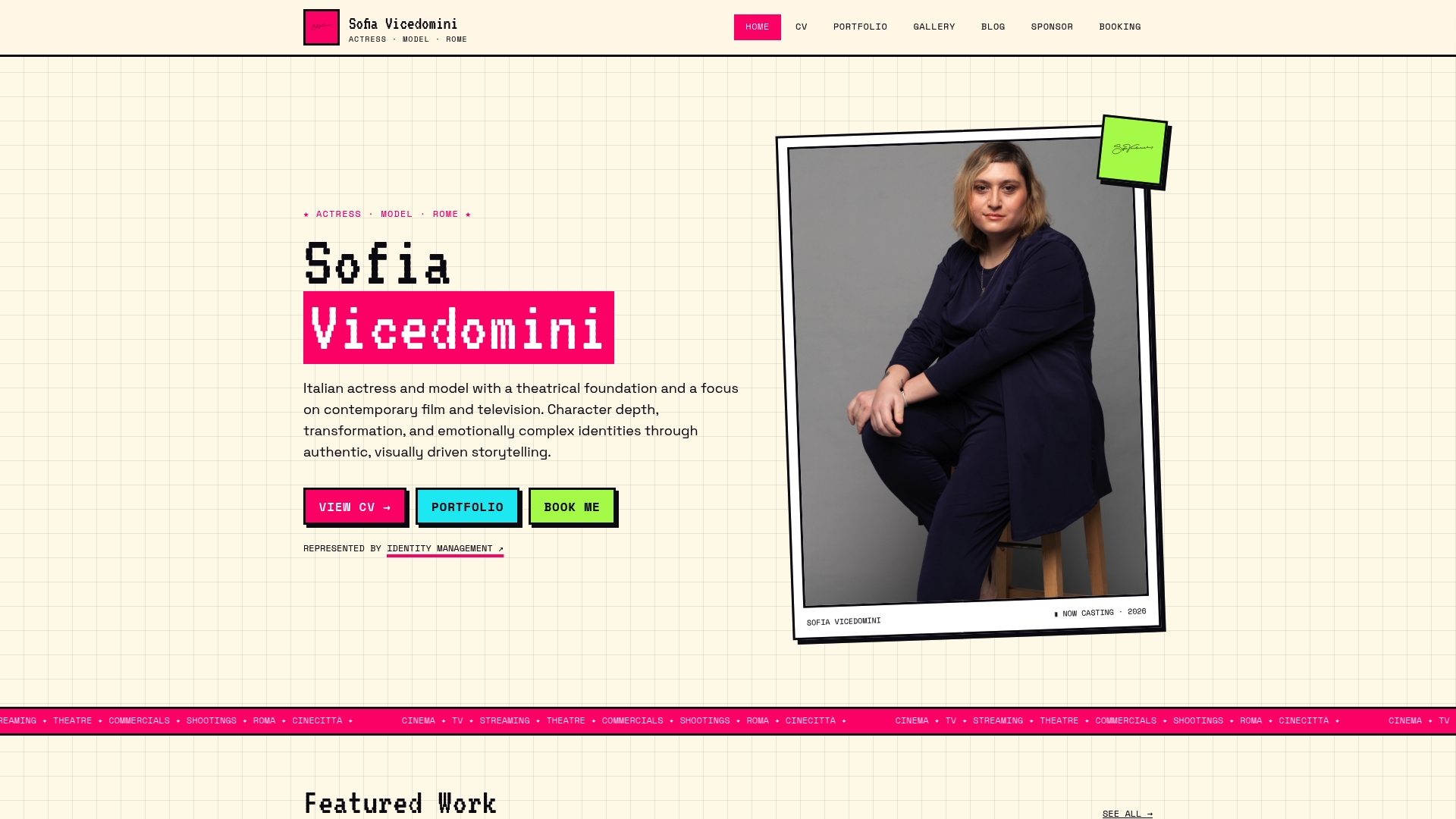
There is a particular kind of performer that interactive theatre genuinely needs: someone who can hold a room's attention, read an audience member's hesitation in real time, and extend an invitation that feels warm rather than pressuring. That is a specific skill set, and it is one that Sofiavicedomini has built across film, television, theatre, and live event work.
For casting directors and theatre companies looking to bring interactive or participatory work to life, Sofiavicedomini offers something that is genuinely rare: a performer with a strong theatrical foundation, trained in emotionally complex character work, who is equally at home in scripted drama and in the live, unscripted moments that interactive performance demands. Her portfolio spans contemporary theatre, commercial work, and interactive live events, with a track record of adapting to the specific demands of each format.
If your next production needs a performer who can hold the space when the audience does the unexpected, visit Sofiavicedomini to view her portfolio and get in touch about availability.
Sources
A short annotated list of core texts and resources for practitioners and academics who want to go further:
- Audience participation in theatre: evolutions of the invitation | Springer Nature
- Understanding audience participation in an interactive theater performance | ACM proceedings
- Actors and Audience Members During Live Theatre Performance (ISC study)
- What is interactive theatre? Your guide to interactive and immersive ...
FAQ
What is audience interaction in theatre?
Audience interaction in theatre refers to performances that deliberately invite spectators to act on or with the performance in real time, through choices, roles, voting, or direct address, so that their input shapes what unfolds on stage.
How does interactive theatre differ from immersive theatre?
Interactive theatre centres on agentive acts that change the performance; immersive theatre foregrounds spatial and environmental experience, which audiences move through but do not necessarily alter. You can be fully immersed and entirely passive.
What are the key rules of theatre audience etiquette in interactive work?
The core principles are: participation is always optional, opt-out routes must be visible and easy to use, no individual should be singled out or pressured, and any use of personal data (SMS, app input, recording) requires clear prior notice and consent.
Which type of theatre most actively promotes audience interaction?
Forum Theatre, developed by Augusto Boal as part of his Theatre of the Oppressed methodology, is the canonical form: audience members, called spect-actors, stop and redirect scenes of oppression, making their agency structurally central to the work.
Can you give examples of interactive theatre in the UK?
Punchdrunk's site-specific productions (such as The Burnt City in London) embed investigative interaction through spatial freedom, while the National Theatre's NT Learning programme uses Forum Theatre and role-play in schools and community settings to rehearse responses to real-world dilemmas.