Call sheet etiquette: the professional's complete guide

Call sheet etiquette means issuing accurate, confidential, and timely production documents, distributed to the right people by 20:00 the night before the shoot, and treated with the same respect as a binding operational contract. That single rule, send it on time and keep it private, is the foundation of every professional set.
Late delivery is not a minor inconvenience. When a call sheet arrives after 20:00, crew members lose the planning window they need to arrange transport, confirm childcare, and calculate turnaround compliance under union agreements. For performers working under Equity or BECTU agreements, a late call sheet can make it genuinely impossible to verify that minimum rest periods have been observed before the next call. That is a legal exposure, not just a courtesy failure.
Privacy matters just as much. Every call sheet carries personal contact details, home addresses for transport pickups, and location information that could compromise a high-profile production if it reached the wrong hands. Label every call sheet CONFIDENTIAL, DO NOT POST in the header and footer. Under UK GDPR, cast and crew contact data is personal data; distributing it beyond the production team without a lawful basis is a compliance breach, not merely bad form.
The 2nd AD or production coordinator drafts the call sheet under the 1st AD's oversight, and the production manager signs off before distribution. The full crew, all cast, department heads, transport, and catering must receive it. Drivers and caterers are often forgotten, and that omission creates morning chaos.
Pro Tip: Keep one master version in a controlled cloud folder with a clear version number (v1, v1.1) and a short change log at the top. Every amendment goes through that single file, so nobody is working from a superseded PDF at 06:00.
Table of Contents
- What must a UK call sheet include?
- How do you create and distribute a call sheet?
- Call sheet dos and don'ts for everyone on set
- How do you read call sheet codes and abbreviations?
- UK legal, health, safety and privacy essentials
- Which tools and templates help you produce a UK-ready call sheet?
- Key takeaways
- Why call sheet etiquette matters more than you might think
- Useful sources
- FAQ
What must a UK call sheet include?
The call sheet is the operational backbone of the shoot day, and every field earns its place. Missing a single item, whether the nearest A&E or a walkie channel, can cascade into real delays.
Header and project information
The top of the call sheet carries the production title, episode or project number, shoot day out of total days (DOOD), date, and general crew call. Below that: the production company name, the 1st AD's contact, the production office number, and the producer or production manager's details. These are the escalation contacts when something goes wrong before anyone reaches set.
Location grid
Full street addresses for the main unit location, basecamp, and any secondary units are non-negotiable. Include parking instructions, a map link or what3words reference, shuttle times and pickup points, and the address of the nearest 24-hour A&E. Confirm the hospital is genuinely open around the clock before the sheet goes out; not every listed A&E operates overnight.
Scene schedule and cast grid
| Required field | Who confirms it |
|---|---|
| Scene numbers and INT./EXT. | 1st AD against shooting script |
| Set name and story day/night | Script supervisor |
| Estimated page count per scene | 1st AD |
| Cast ID numbers and character names | Production coordinator |
| HMU/costume call times | Relevant department heads |
| Set call and transport/pickup times | 2nd AD and transport captain |
| Nearest A&E address | Production coordinator (verified) |
| Walkie channels per department | 1st AD |
| Meal break and turnaround times | 1st AD against union rules |
The cast grid is where actors check their personal call times, not the general crew call at the top. Hair, makeup, and wardrobe calls are listed separately and must be treated as distinct mandatory booking times. Missing your HMU call by twenty minutes can delay the entire shooting day.
Operational and safety sections
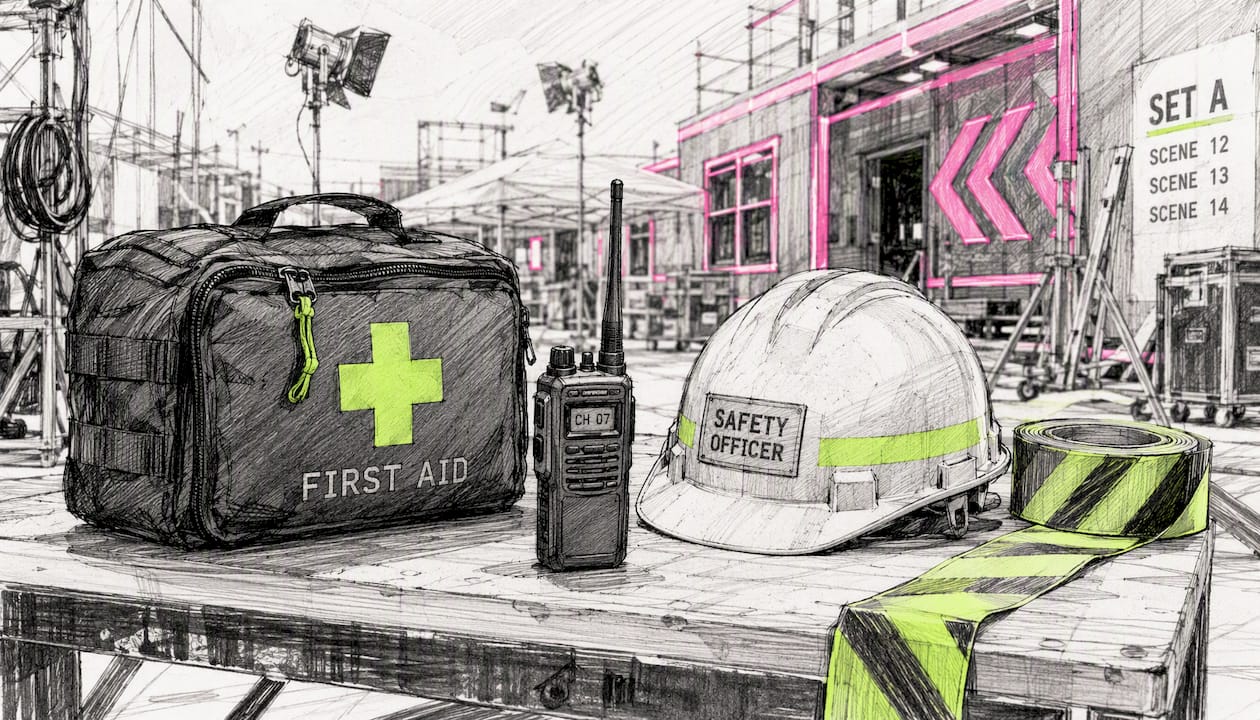
The safety section must name the first aider, the safety officer, and reference the relevant risk assessment. Include COVID or health-protocol notes if applicable, a no-photography clause, and any special instructions (stunts, animals, pyrotechnics). The footer carries the advance schedule for the following day, tow-zone warnings, and production insurance references.
Pro Tip: Bold every individual's personal call time in their row. A reader scanning quickly should never have to hunt for their own number.
How do you create and distribute a call sheet?
The workflow runs from mid-afternoon to 20:00 the night before. Compress that window and errors multiply.
- Confirm cast and crew calls: Cross-reference with transport, HMU, and costume departments. Actors' HMU and wardrobe calls are separate bookings and must be listed accurately.
For distribution, StudioBinder's actor call sheet templates include tracking features and formatted cast grids that speed the build considerably. A controlled cloud link alongside the PDF gives the production office a single source of truth if recipients need to access the latest version.
Confirm receipt through read receipts, a PA follow-up call for key cast, or a Slack/WhatsApp message to department heads. Bounced emails must be caught before 22:00 so an alternative contact method can be used.
Pro Tip: Use one canonical file name for every version (e.g. TITLE_ShootDay04_v1.pdf) and never rename the file when issuing an update. Increment the version number only. This prevents the "which PDF is current?" confusion that derails early mornings.
Call sheet dos and don'ts for everyone on set
Good call sheet best practices split neatly by role. Here is what each side of the production needs to get right.
For the production office
Do:
- Proofread every address, call time, and contact number before distribution.
- Confirm the nearest A&E is open 24 hours.
- Label the document CONFIDENTIAL, DO NOT POST in the header and footer.
- Use version control (v1, v1.1) and include a brief change log in the email body.
- Send by the industry standard distribution time in the evening without exception.
- Include walkie channels and department head contacts.
Do not:
- Post call sheets in public channels, shared drives without access controls, or on social media.
- Bury personal call times in dense text; bold them.
- Send unverified addresses or placeholder hospital details.
- Issue an updated call sheet without clearly marking what has changed.
For cast and crew
Do:
- Read the entire call sheet, not only your line. The advance schedule, vehicle positions, and special instructions live in the bottom third, and missing them is a common newcomer error.
- Confirm your transport or pickup time directly with the transport captain.
- Respect your personal call time and the turnaround rules that protect your rest.
- Ask clarifying questions through your department head or the 2nd AD, not by calling the 1st AD directly.
Do not:
- Photograph your call sheet and post it on social media. This is a serious breach of production confidentiality and can have contractual consequences.
- Assume the general crew call at the top of the sheet is your call. It almost certainly is not.
- Rely on memory for HMU or costume calls. Write them down, set an alarm, and confirm with the department.
Handling last-minute changes
When a location changes, a scene is dropped, or a call time shifts after the sheet has gone out, issue an amended version immediately. Mark it clearly in the subject line (AMENDED, v1.1), highlight the changed fields in the body of the email, and instruct all recipients to delete the previous version. Set etiquette training consistently identifies poor change communication as one of the leading causes of on-set confusion.
Pro Tip: For no-shows or late arrivals, the escalation path is: department lead contacts the 2nd AD, who contacts the production coordinator, who contacts the 1st AD. Only the 1st AD decides whether to hold the schedule or move to a standby scene. Never bypass that chain.
How do you read call sheet codes and abbreviations?
Common call-sheet terminology is a shorthand language. Misreading it costs time and money.
Cast numbers reflect billing order: #1 is the lead, #2 the second lead, and so on. This ordering determines how the cast grid is presented and, on union productions, can affect contractual obligations around first call and travel.
| Code / abbreviation | Meaning | Where it appears |
|---|---|---|
| W | Work (actor is required on set) | Cast grid |
| WF | Work finish (last day of engagement) | Cast grid |
| SWHF | Start work, hold, finish (single-day booking) | Cast grid |
| H | Hold (actor on standby, not confirmed on set) | Cast grid |
| INT. / EXT. | Interior / exterior | Scene schedule |
| DOOD | Day out of days | Cast grid header |
| HMU | Hair and makeup call | Cast grid |
| COST | Costume call | Cast grid |
| OT | Overtime | Department notes |
| ETA | Estimated time of arrival | Transport section |
| WRAP | End of shooting day | Scene schedule / footer |
UK legal, health, safety and privacy essentials
UK productions carry specific obligations that the call sheet must both reflect and evidence.
Union turnaround and timing: Equity and BECTU agreements specify minimum rest periods between wrap and the following day's call. The call sheet is the primary document used to demonstrate compliance if a dispute arises. Distributing it by 20:00 gives crew the time to calculate whether their turnaround is legal and to raise concerns before they arrive on set. The six-hours-to-lunch rule (no performer should work more than six hours without a meal break) must be visible in the scene schedule.
Health and safety: The nearest 24-hour A&E address is mandatory, not optional. Alongside it, name the first aider and the safety officer with their contact numbers. Reference the relevant risk assessment by title and version number. For shoots involving stunts, heights, water, or pyrotechnics, the specific hazard notes belong in the special instructions section, not in a separate document that half the crew never reads.
GDPR and privacy: Cast and crew contact details, home addresses for transport, and medical notes (e.g. allergies relevant to catering) are personal data under the UK GDPR. The call sheet must be distributed only to those with a legitimate production need. Avoid CC-ing external parties, and never send a version containing personal transport details to a public or unsecured channel. When a production involves high-profile talent, consider issuing a redacted version for wider distribution and a full version only to heads of department.
Audit trail: Log the time each version was sent and to whom. If a performer later disputes whether they received adequate notice of a call change, that distribution record is your evidence. Email timestamps and read receipts serve this function; a call-sheet platform with built-in tracking does it more reliably.
For binding union rules, consult Equity and BECTU directly. Their member-facing guidance is the authoritative source, and production managers should seek legal advice for any situation where compliance is genuinely unclear.
Which tools and templates help you produce a UK-ready call sheet?
A well-structured template does most of the heavy lifting. The goal is a single-page header with the project details and general call, followed by the cast grid, crew grid, scene schedule, and a footer with the advance schedule and safety contacts. Readable typography matters: a 10pt or 11pt sans-serif font, bold personal call times, and clear section dividers reduce the morning scramble considerably.
StudioBinder's actor call sheet templates are widely used across UK and international productions. They include formatted cast grids, import features for schedules, and tracking options that confirm when recipients have opened the document. For productions that prefer a lighter-weight approach, a well-structured Google Docs or Word template exported to a flattened PDF works equally well, provided the distribution is controlled through a secure link rather than an open share.
Distribution checklist before 20:00:
- Final proofread of all call times, addresses, and contact numbers.
- Confirm nearest A&E is 24-hour and the address is correct.
- Confirm any special requirements (stunts, animals, child performers) are noted.
- Export to flattened PDF (no editable fields).
- Attach a one-line change log if this is an amended version.
- Send to full distribution list; BCC sensitive recipients if personalised notes are included.
- Activate read receipts or open-tracking.
- Follow up with department heads by 22:00 if no confirmation received.
Appendices worth attaching: a location pack with map and parking detail, a transport sheet with individual pickup times, and a one-page risk assessment summary. Keep the main call sheet clean; push supplementary detail to appendices so the critical information stays visible.
Key takeaways
Proper call sheet etiquette requires accurate, confidential documents distributed by 20:00 the night before, with clear version control, union-compliant times, and mandatory safety contacts included every time.
| Point | Details |
|---|---|
| Send by 20:00 | Distribute the finalised call sheet no later than 8pm the night before to protect crew planning and union turnaround compliance. |
| Label and protect | Mark every call sheet CONFIDENTIAL, DO NOT POST and treat contact data as personal data under UK GDPR. |
| Include safety essentials | Always name the nearest 24-hour A&E, the first aider, and the safety officer with contact numbers. |
| Use version control | Number every version (v1, v1.1) and include a change log so recipients always know which document is current. |
| Read the whole document | Personal call times, HMU/costume calls, and advance schedule details are spread across the sheet; stopping early means missing critical information. |
Why call sheet etiquette matters more than you might think
There is a tendency in production to treat the call sheet as administrative paperwork, something the office handles while the creative work happens elsewhere. That framing misses the point entirely.
The call sheet is the one document every single person on a production reads before the day begins. It sets the tone. A clear, accurate, confidential sheet signals that the production is organised, that it respects its crew's time, and that it takes its legal obligations seriously. A chaotic, late, or incomplete one tells everyone the opposite, before a single frame is shot.
What I find underestimated, particularly by newer productions, is the cumulative effect of small etiquette failures. A missing hospital address feels trivial until someone needs it. A general call mistaken for a personal call costs twenty minutes of shooting time. A call sheet posted on Instagram by an excited cast member can compromise a location agreement or a talent's privacy. None of these are dramatic failures on their own; together, they erode the trust that makes a set function.
The most professional productions I have worked on share one habit: the call sheet is treated as a promise. It says, "We have planned this day carefully, we respect your time, and we have thought about your safety." When that promise is kept consistently, it creates the kind of set culture where people arrive prepared, focused, and ready to do their best work. That is worth far more than any individual scheduling efficiency.
If you are a performer, the most respectful thing you can do with a call sheet is read it fully, confirm your HMU and costume calls separately, and arrive with time to spare. If you need to escalate an urgent issue before your call, contact your department head or the 2nd AD directly, not the 1st AD, and do it the evening before rather than the morning of. That small act of consideration for the production's workflow is what separates a professional from someone who is still learning.
You can explore more about professional performance and production standards at Sofiavicedomini.
Useful sources
The following resources are worth bookmarking for ongoing reference.
- Free call sheet template — Need A Crew
- Call sheet terminology — StudioBinder
- What Is a Call Sheet in Film? — FilmLocal
- What is a call sheet and how do you read one? — Backstage
- How to build a call sheet — Tools for Film
- Set etiquette and call sheets — ACTRA Toronto Education
- Actor call sheet template — StudioBinder
- Call sheet do's and don'ts — How to Film School
When using any template, export to a flattened PDF before distribution. Remove editable fields and, if sharing externally for any reason, strip personal contact data from the version being shared.
FAQ
What should be on a call sheet?
A call sheet must include the production title, shoot date, general crew call, full location addresses, nearest 24-hour A&E, scene schedule, cast and crew grids with personal call times, HMU and costume calls, walkie channels, meal break times, safety officer and first aider contacts, and an advance schedule for the following day.
When should a call sheet be sent out?
The industry standard is no later than 20:00 (8pm) the night before the shoot day. Sending later than this prevents crew from verifying turnaround compliance and planning transport in time.
What does #1 on the call sheet mean?
Cast number #1 identifies the lead performer, reflecting their billing order. On union productions, this ordering can carry contractual implications regarding first call and travel arrangements.
Who is responsible for issuing call sheets?
The 2nd AD or production coordinator drafts the call sheet using the 1st AD's shooting schedule. The 1st AD or production manager approves the final version before the production office distributes it to the full crew, cast, and relevant departments.
Can cast and crew share call sheets on social media?
No. Call sheets are confidential production documents containing personal contact data and location information. Sharing them publicly, including on social media, breaches production confidentiality agreements and can constitute a UK GDPR violation.