Casting for commercials: the UK practitioner's guide

Send a casting brief with role, usage rights, shoot dates and a fee indication, then request self-tapes with a two-day turnaround. That single sequence, grounded in Equity and IPA guidance, covers the first move for any UK commercial booking.
Your immediate checklist:
- Role description, age range and tone notes
- Media, territory and usage duration (or buyout intention)
- Shoot dates, call times and location
- Fee indication or rate range
- Accessibility and reasonable adjustment notes
- Request for self-tape or agent contact details
- Template documents to ask for: Form of Engagement and Artists' Declaration (ADR)
Key takeaways
A complete commercial casting process requires a detailed brief, documented usage rights, and a signed Form of Engagement before the shoot date.
| Point | Details |
|---|---|
| Brief first, always | Send role, usage, dates and a fee indication before requesting any self-tape or recall. |
| Two-day self-tape minimum | The Code of Best Practice recommends a two-day minimum turnaround for self-tape submissions in commercials; recall fees are payable for live or Zoom sessions as specified in the Code. |
| No enforceable collective agreement | UK commercials do not have a single, enforceable collectively bargained agreement; industry guidance relies on the IPA/Equity Agreed Document and recommended minimum terms, and your contract is the binding document. |
| Form of Engagement and ADR | Both documents must be signed before the shoot; request them at offer stage, not after. |
| Sofiavicedomini | Available for commercial bookings; contact via Sofiavicedomini with brief and usage details. |
Table of Contents
- What should your casting brief include?
- How do you set and document fees and usage rights?
- What are the self-tape and recall rules for commercials?
- What working conditions should you confirm before booking?
- How do you move from shortlist to signed contract?
- Should you book through an agent or hire directly?
- What actually makes a commercial casting succeed?
- Sofiavicedomini: available for commercial bookings
- Sources
- FAQ
What should your casting brief include?
The IPA casting brief template, developed with the APA, Equity and ISBA, sets the standard. A well-built brief reduces unnecessary recalls and draws more authentic, diverse submissions.
Checklist for every commercial casting brief:
- Role description: character type, age range, ethnicity guidance where relevant
- Tone and style: mood, energy, references (director's vision in two sentences)
- Wardrobe notes: colour palette, formality, any exclusions
- Shoot dates and call times: confirmed or provisional, with location(s)
- Rehearsal or fitting requirements: half-day, full-day, remote or in-person
- Travel and expenses policy: who covers what, and how
- Accessibility and reasonable adjustments: ask upfront, record the answer
- Fee and usage preview: media, territory, duration, buyout or usage-based
Worked example (condensed):
Role: Parent, 30s–40s, any ethnicity. Warm, slightly chaotic energy — think school-run realism, not catalogue perfection. Wardrobe: casual, muted tones. Shoot: one day, London studio, mid-March. Usage: UK linear TV and owned social, 12 months. Fee: session fee plus usage payments per IPA/Equity recommended minima. Accessibility: please advise of any requirements at submission stage.
That is three sentences of director's notes, one usage line and one accessibility prompt. Practical wording like this materially improves the authenticity of auditions and lowers the need for recalls.
Pro Tip: Being specific about tone at brief stage does more for diversity than any generic inclusion statement. When performers understand the real character, they self-direct rather than default to a safe, generic read.
How do you set and document fees and usage rights?
The UK commercial sector has no single enforceable collectively bargained agreement. Industry practice draws on the IPA/Equity Agreed Document and recommended minimum terms. That means the contract you write is the agreement — so write it carefully.
Usage dimensions to specify in every contract:
- Media: linear TV, video-on-demand, online display, social, out-of-home, radio
- Territory: UK only, EU, global
- Term: 12 months, 24 months, perpetuity
- Exclusivity: product category, sector, or full exclusivity
- Renewals: option periods and the fee uplift attached to each
- Buyout vs usage payments: a buyout pays one sum for all use; usage payments accrue per airing or platform
The UK advertising industry is considered a significant economic sector. The fee a performer receives should reflect the scale of the campaign reaching that market — not just the day rate.
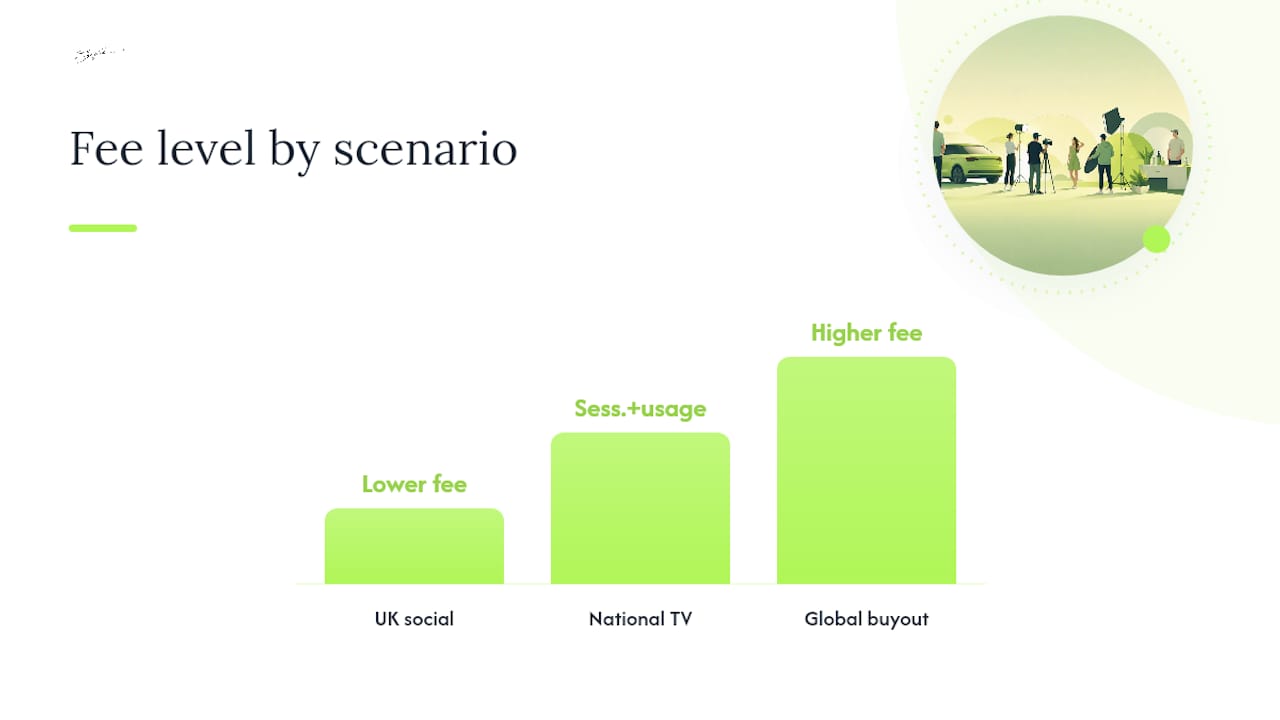
Three practical scenarios:
National linear TV campaign: Session fee plus usage payments calculated by airings or a negotiated flat usage fee for the term. Exclusivity in the product category is standard.
UK-only social campaign: Lower session fee is common, but usage still applies. Specify platform (Meta, TikTok, YouTube) and whether the content can be boosted as paid media, which changes the rate.
Global digital buyout: A single fee covering all territories and platforms in perpetuity. Expect a significantly higher session fee to reflect that scope. Equity advises performers to push back on buyout offers that do not match the campaign's actual reach.
Capture all of this in the Form of Engagement and ADR. For complex international licensing, confirm terms with legal counsel or Equity's commercial team.
What are the self-tape and recall rules for commercials?
The Code of Best Practice for self-tape and Zoom auditions for commercials, developed by the CDG, CPMA, PMA and Equity, sets the practical floor. Following it protects both producers and performers.
Self-tape checklist:
- Minimum two-day turnaround from request to submission deadline
- Maximum two pages of script per self-tape request
- No requests for fully or partially nude self-tapes
- Provide tone notes and reader guidance with the brief
- State preferred file format (MP4), resolution (1080p minimum) and naming convention (Surname_Firstname_Role)
- Request a slate (name, agent, role) at the start of the clip
- Ask for headshot and CV separately, not embedded in the video file
- Include an accessibility query: "Please let us know if you need any adjustments to submit"
Recall expectations:
| Recall type | Fee payable? | Typical notice |
|---|---|---|
| Live in-person recall | Yes | Minimum 24 hours |
| Zoom recall | Yes | Minimum 24 hours |
| Additional self-tape round | No fee, but turnaround rules apply | Two-day minimum |
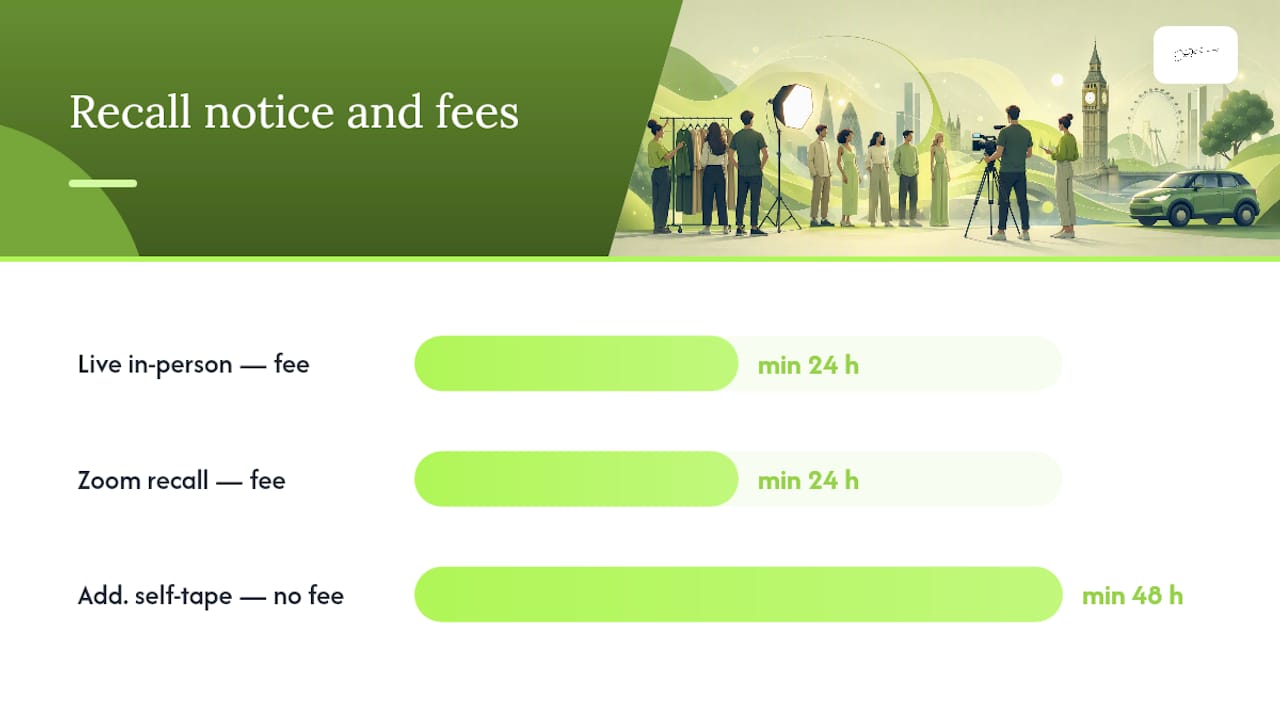
The 2022 Code launch made recall fees explicit: if you call a performer back for a live or Zoom session, a recall fee is payable. Budget for it from the start.
Pro Tip: Phrase your self-tape request as: "We welcome submissions from performers of all backgrounds, abilities and experiences. Please let us know if any adjustments would help you submit." One sentence. It costs nothing and broadens your pool.
What working conditions should you confirm before booking?
Confirming conditions before the shoot day prevents disputes and protects everyone on set. Equity's self-tape and audition guidance stresses reasonable deadlines and clear communication as baseline expectations — the same principle carries through to the shoot itself.
Confirm in writing before booking:
- Maximum working day (typically 10 hours) and overtime rate beyond it
- Anti-social hours definition and uplift (early mornings, evenings, weekends)
- Rest breaks, catering provision and welfare facilities
- Chaperone arrangements where minors are involved
- Travel, accommodation and expense reimbursement policy
- Any health or safety protocols specific to the shoot location
Red flags to act on immediately:
- Usage terms described as "TBC" or "standard" with no specifics
- No written Form of Engagement issued before the shoot date
- Requests for unpaid recalls or "chemistry reads" without a fee
- Unclear or absent travel and expense policy
Accessibility needs should be asked at brief stage and confirmed again at booking. Record how each adjustment will be met and who is responsible for delivering it.
How do you move from shortlist to signed contract?
Equity's commercials guide contains the Form of Engagement template and ADR that make this sequence legally clean.
- Shortlist and internal approvals — confirm the shortlist with the agency and client before any recall is called.
- Recall auditions — pay recall fees; confirm Zoom or in-person at least 24 hours ahead.
- Verbal offer — state the session fee, usage terms and shoot date clearly. Follow up in writing within 24 hours.
- Prepare the Form of Engagement — include: performer name, role, shoot date(s), session fee, usage (media, territory, term), exclusivity, overtime rates, cancellation terms and payment schedule.
- Issue the Artists' Declaration (ADR) — the performer or their agent completes this for tax and payment purposes. Request bank details and any tax documentation at this stage.
- Signatures — the producer or production company signs the Form of Engagement; the performer or agent countersigns. Both parties retain a copy.
- Invoice and payment — the performer or agent invoices against the Form of Engagement. Payment terms should be stated in the contract (30 days is standard).
The agent typically handles the ADR and invoice. For direct hires, you manage this yourself — which is why documentation discipline matters more on that route.
Should you book through an agent or hire directly?
Booking via an agent gives you a clear negotiation channel, someone who handles the ADR and invoice, and a representative who understands the performer's contractual interests. It is the lower-risk route for any campaign with complex usage, exclusivity or repeat bookings.
Direct hire is faster for simple, short-term projects, but the documentation burden falls entirely on you. You must draft the Form of Engagement, manage the ADR, confirm usage rights in writing and handle payment terms without an intermediary.
Five questions to decide your route:
- Does the campaign involve exclusivity or multi-territory rights? (Agent route strongly preferred)
- Is this a repeat booking or ongoing relationship? (Agent route)
- Is the usage straightforward and UK-only with a short term? (Direct hire may work)
- Does the performer already have an agent? (Always go through the agent)
- How quickly do you need to book? (Direct hire is faster; agent route is safer)
On fees: agents typically charge commission to the performer, not the buyer. The performer or their agent invoices you. For direct hires, the performer invoices directly and you are responsible for ensuring the ADR is completed correctly.
What actually makes a commercial casting succeed?
The briefs that produce the best auditions are the ones that trust the performer. When you share a genuine director's note, a real usage breakdown and a fair turnaround, you get performances that surprise you — not safe, generic reads designed to avoid rejection.
I have seen casting calls that run to three pages of restrictions and one line of creative direction. The result is a pool of cautious, identical submissions. Flip that ratio. Give the performer the emotional truth of the scene, confirm the usage honestly, and let them bring something real. The IPA/Equity framework exists precisely to make that exchange fair and efficient for both sides.
Clear briefs, fair usage terms and proper documentation are not administrative overhead. They are what separate a smooth, creative booking from a disputed invoice and a mediocre campaign.
Sofiavicedomini: available for commercial bookings
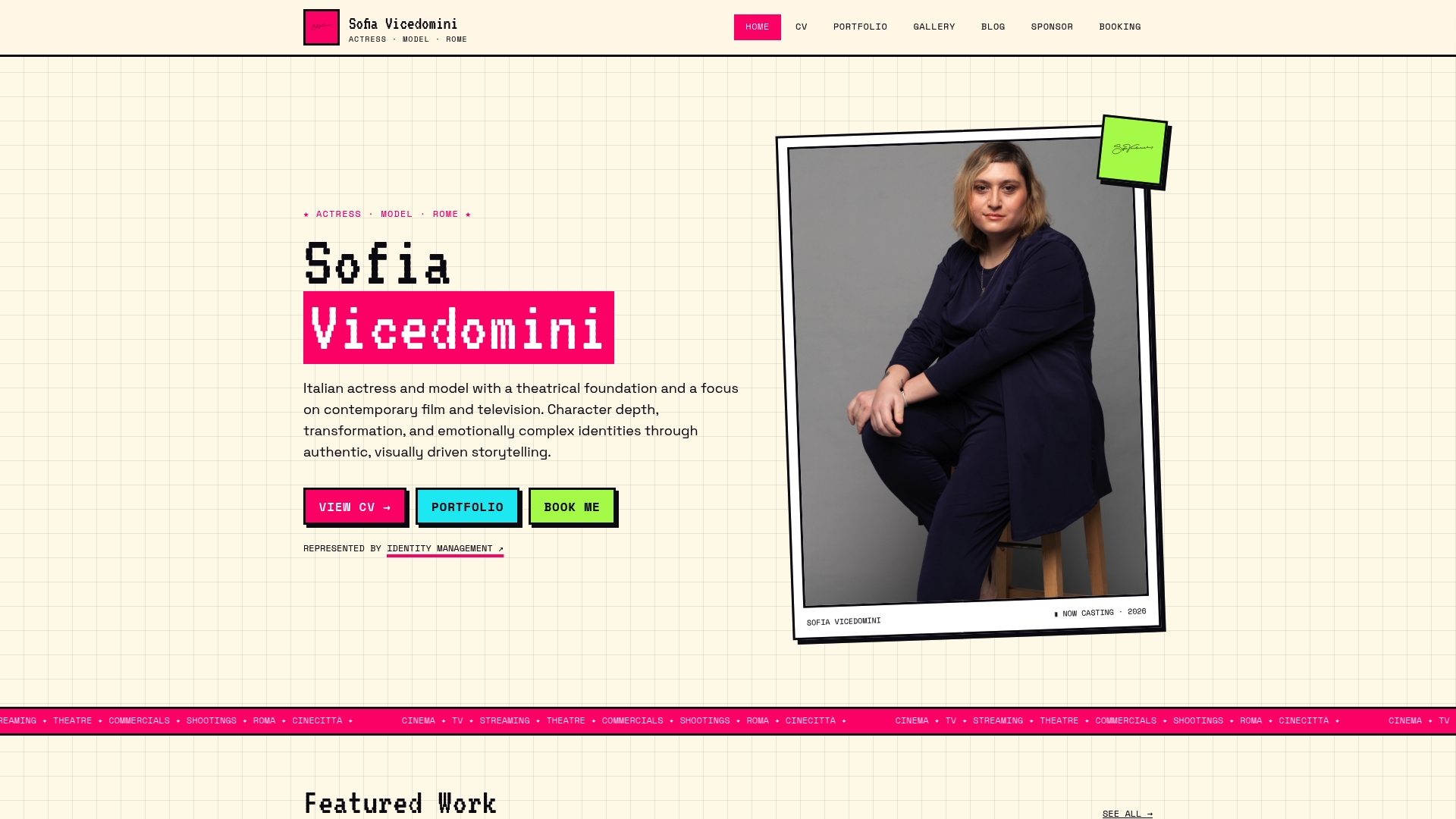
Sofiavicedomini is a professional actress and model with experience across film, television, interactive theatre and commercial shoots. Her range covers emotionally grounded character work and high-energy on-camera presence — the kind of versatility that serves both dialogue-led commercials and visual-first brand campaigns.
To enquire about availability, visit Sofiavicedomini to view her showreel, credits and contact details. When you get in touch, include your shoot dates, role brief and usage outline so she can respond with availability and a self-tape or agent contact immediately.
Sources
Template names to request in correspondence: Form of Engagement; Artists' Declaration (ADR); IPA/Equity Agreed Document for Employment of Artists Working in Commercials; Code of Best Practice for self-tape and Zoom auditions for commercials.
This article is general information, not a substitute for advice from a qualified lawyer. Consult a qualified legal professional about your own circumstances before acting on anything here.
FAQ
What must a UK commercial casting brief include?
Role description, age range, tone notes, shoot dates, location, usage details (media, territory, term) and a fee indication. The IPA casting brief template covers all required fields.
Is there a minimum turnaround time for commercial self-tapes?
The Code of Best Practice recommends a minimum two-day turnaround for self-tape submissions in commercials, with a maximum of two pages of script per request.
Are recall fees compulsory for UK commercials?
Recall fees are payable for live in-person and Zoom recalls under the Code of Best Practice. Budget for them from the outset.
What is the difference between a buyout and usage payments?
A buyout is a single fee covering all agreed uses for the contract term; usage payments accrue per airing or platform. The right choice depends on campaign scale and territory — confirm the approach in the Form of Engagement before the shoot.
Do I need a Form of Engagement even for a short commercial shoot?
Yes. The Form of Engagement is the binding contract for any commercial booking, regardless of shoot length. It records the session fee, usage rights, payment terms and cancellation conditions for both parties.