Close-up acting: how to make small choices read large

Shrink your external delivery, keep your inner life at full intensity, and let micro-expressions do the work. That is the single adjustment that separates an actor who disappears on camera from one who commands it. Stage technique rewards size; the lens rewards truth, and it finds truth in the smallest muscles on your face.
Focus on three things when the camera pushes in close:
- Eyes — they carry the scene before your mouth says a word.
- Breath — steady, low, and used to shape thought rather than volume.
- A soft face — jaw released, tongue unclenched, chin very slightly down.
Before the take, do this one thing: exhale slowly for four counts, drop your shoulders, and silently think the line's true intention rather than its words. Ninety seconds of this, done quietly at your mark, changes everything that follows.
Key Takeaways
The most effective close-up performances scale down external expression while keeping internal truth and micro-expression work at full intensity.
| Point | Details |
|---|---|
| Shrink, don't switch off | Keep 100% internal truth and reduce external delivery to roughly 40% of stage scale. |
| Let the eyes lead | Eyeline precision and micro-expressions carry more weight than gesture in tight framing. |
| Breathe before, not during | Settle breath before "action" so nerves don't read as character choices. |
| Match the framing | Adjust scale and stillness to whether the shot is an ECU, MCU, reaction, or over-the-shoulder close-up. |
| Protect continuity | Track small physical details, hands, hair, props, so takes match on cut. |
Table of Contents
- Why close-ups matter in storytelling
- What are the main types of close-up shots?
- What goes wrong for actors in close-up work?
- How do you adapt your acting technique for close-ups?
- What exercises build reliable close-up skills?
- What should actors do on set during a close-up?
- What are the most common close-up mistakes?
- What are some famous examples of close-up acting?
- Sofia's pre-take checklist for close-up work
- What actors underestimate about performing small
- Where to go deeper on close-up technique
- Sources
- FAQ
Why close-ups matter in storytelling
Directors reach for a close-up when they want the audience to feel something a wide shot can't deliver. The frame fills with your face, or with one detail the story needs you to notice, and that framing draws the eye straight to subtle emotion and inner life. Nothing competes with you for attention. That is a gift and a trap in equal measure.
Three things a close-up does that a wide shot cannot: it emphasises emotion the audience might otherwise miss, it manufactures intimacy between character and viewer, and it reveals subtext the dialogue is deliberately hiding. Think of the moment a character says "I'm fine" while their eyes say the opposite. A wide shot shows the room; a close-up shows the lie.
Consider how differently three genres use the same tool. A thriller holds on a face to build dread before a reveal. A romance lingers on a glance to let the audience feel the pull between two characters before either says a word. A courtroom drama cuts to a witness's face on a lie, because the muscles around the eyes tell the jury, and the audience, more than the testimony does.
The technical side matters just as much as the emotional one. A close-up shot fills most or all of the frame with your face or a single important object, which means the camera and microphone are now doing the job your voice and body did on stage. You no longer need to project across a room. You need to trust that a flicker at the corner of your mouth will read from three metres away.
What are the main types of close-up shots?
Not every close-up asks the same thing of you. An extreme close-up on your eyes demands almost total stillness, because even a small movement becomes enormous. A medium close-up, framing your face and shoulders, gives you slightly more room for natural head movement and gesture. A reaction close-up is entirely about listening, since you're rarely the one speaking. An over-the-shoulder close-up asks you to stay grounded and present for your scene partner, even though the camera favours the other actor's face.
| Framing | What it captures | Actor's adjustment | When directors use it |
|---|---|---|---|
| Extreme close-up (ECU) | Eyes, or a single detail like a hand or object | Near-total stillness; all expression through eyes and micro-movements | Emotional reveals, tension peaks |
| Medium close-up (MCU) | Face and shoulders | Slight scaling down; natural small gestures still read | Dialogue scenes, general coverage |
| Reaction close-up | Your face while another character speaks or acts | Active listening, thought visible without words | Building tension, showing consequence |
| Over-the-shoulder close-up | Your partner's face, with you as foreground presence | Stay emotionally engaged even when off-focus | Two-person scenes, dialogue rhythm |
The practical lesson is simple: ask the camera operator or director which framing is coming, or check the shot list, before you commit to a scale of performance. Playing an ECU with medium-shot energy reads as overacting within seconds.
What goes wrong for actors in close-up work?
Close-ups punish habits that never registered on stage. Overacting is the obvious one, but the subtler failures do more damage: jaw and face tension that makes you look stiff rather than composed, uncontrolled blinking that reads as nervous energy, losing your eyeline between takes, and breathing patterns that broadcast effort instead of feeling.
- Overacting — expressions calibrated for a 200-seat theatre look like mugging at 4K resolution.
- Jaw and facial tension — concentration tightens the jaw, lips and tongue without you noticing, which stiffens your whole face.
- Uncontrolled blinking — nerves speed up blink rate, and a fast blink pattern undercuts a line meant to land as calm or certain.
- Losing eyeline — drifting even a few degrees off your mark breaks the illusion for the editor cutting between angles.
- Showy breath — audible inhales or visible chest-heaving reads as performed rather than felt.
Continuity compounds all of this. You might play the same forty seconds of dialogue eight or nine times across different angles, and the emotional truth has to match take to take, even as your energy naturally dips. What a director, assistant director or camera operator notices first is rarely the line reading. It's the eyes: whether they're alive, whether they're where they should be, and whether the stillness around them feels inhabited or simply frozen.
How do you adapt your acting technique for close-ups?
Scale everything down, but don't switch off. A useful working rule from stage-to-screen coaching: keep 100% of your internal truth, but externalise only around 40% of what you would on stage.

Rehearse your micro-expressions like blocking. A tightening around the eyes before a hard truth, a half-second hesitation before a lie, a barely-there tremor in the lower lip. Try this on a simple line: "I already knew." Say it once with full stage projection, then again with almost no facial movement at all except a fractional narrowing of the eyes. The second version, on camera, will feel more devastating.
Use breath to carry subtext, not volume. A held breath before an admission, a slow release after a decision, tells the audience what the character is thinking before the line does. This works because the microphone picks up the smallest catch in your breathing, so you can use pace and depth of breath the way you'd once used volume and gesture on stage.
Keep your inner life running even when your body is still. Stillness isn't emptiness. Give yourself a continuous internal monologue, a private thought thread the character is having, even during silences. That thread is what stops a still face from looking blank on screen.
Choose one eyeline and commit to it. Decide precisely where you're looking, whether it's your scene partner's eyes, a mark taped near the lens, or an imagined point just off-camera, and rehearse hitting that exact spot repeatedly. Any drift confuses the editor and breaks the emotional line for the viewer.
Pro Tip: Actors often clench the jaw, lips and tongue without realising it when they concentrate for a close-up. Consciously soften those muscles and drop your chin very slightly. It helps the camera find your eyes and removes the small, fussy movements that read as tension rather than feeling.
What exercises build reliable close-up skills?
Start with a short warm-up before any close-up-heavy day. Spend two to three minutes releasing tension: roll your jaw gently side to side, massage your temples, and take five slow breaths that drop into your stomach rather than your chest. This resets your face to neutral before you ask it to do anything subtle.
- Mirror micro-shifts (5 minutes). Sit close to a mirror and practise shifting only your eyes and eyebrows through a sequence of emotions, suspicion, relief, dawning realisation, without moving your mouth or jaw. This trains isolation, so your face doesn't move as one block.
- Recorded reaction runs (10 minutes). Film yourself listening to a monologue or a scene partner's lines, reacting only through your face. Reviewing this teaches you what actually reads versus what you merely felt while performing it.
- Stillness holds with internal narrative (5 to 8 minutes). Sit still for sixty seconds while running a detailed internal story silently, then repeat with a different, opposing internal story. Watch the footage back and see whether the two versions look different, even though your body barely moved.
Recording yourself and reviewing the footage is the fastest way to close the gap between what you feel and what the camera actually captures. When you play it back, watch specifically for blink rate, jaw tension, and eyeline drift, the three culprits that undo more close-ups than any dramatic choice ever does.
What should actors do on set during a close-up?
Marks exist for a reason far more practical than most actors assume: focus pullers need you within centimetres of a fixed point, or your face falls out of sharp focus in a shot where softness is instantly visible. Find your mark early, walk it once quietly before the take, and note any small props or furniture that help you feel it without looking down.
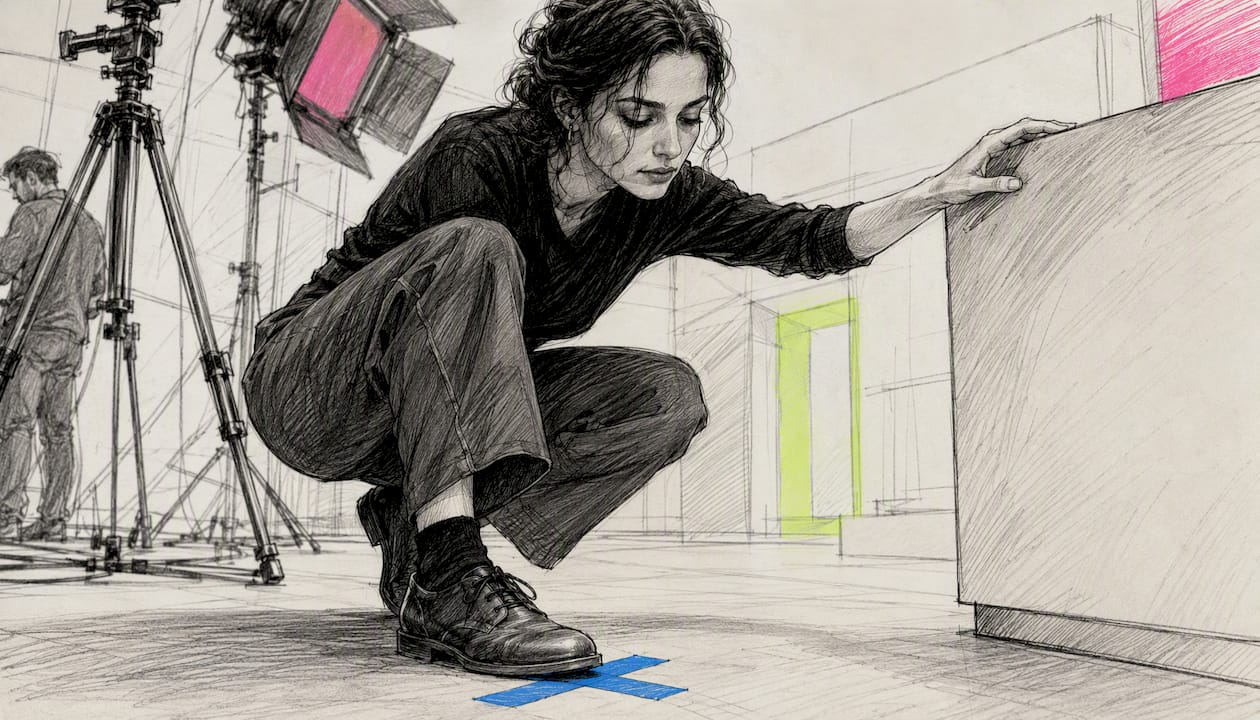
Your eyeline needs the same precision. If your scene partner has been swapped for a stand-in, or if you're playing to a tennis ball taped near the lens, ask exactly where the eyeline should sit relative to the lens height, because a few degrees of difference changes whether your gaze looks intimate or distracted. Camera height and eye position both shape how confident and present you appear on screen, which matters as much for dramatic work as it does for any on-camera presenter.
When the director calls for a close-up, enter the frame quietly, settle your breath before the first line rather than during it, and hold your emotional state between takes rather than dropping it entirely. Small continuity details matter more here than in a wide shot: the exact way you hold a cup, which hand touches your face, whether your hair fell the same way last take. A script supervisor will catch mismatches, but you save everyone time by tracking these details yourself.
What are the most common close-up mistakes?
- Over-blinking under nerves — fix it by exhaling slowly through your nose for a few seconds before "action," which naturally settles blink rate.
- A clenched jaw — fix it with a silent, soft yawn stretch right before the take to release tension without moving your face visibly.
- Talking directly to the lens instead of your eyeline — fix it by re-fixing your gaze on the exact mark or partner's eyes before each new take, not just the first one.
- Exaggerated gestures in tight frames — fix it by cutting any gesture down to roughly half its size; smaller, slower gestures in close framing read with more weight than broad movement.
On playback, the tell is almost always in the eyes and jawline before it's in the line reading. If your eyes look glassy or unfocused, you likely rushed the breath before "action." If your jaw looks set, you were probably thinking about the line instead of feeling it.
What are some famous examples of close-up acting?
A handful of scenes are worth studying frame by frame, not to copy, but to see the mechanics of restraint in action.
The final moments of Marriage Story rely almost entirely on close-ups of Scarlett Johansson and Adam Driver's faces during their argument scene. Watch for the moment the anger cracks into grief. The actors barely move; the eyes do everything, and the breath audibly changes before the emotional shift lands.
The interrogation scenes in No Country for Old Men use extreme stillness from Javier Bardem. His face stays almost entirely neutral, which is precisely what makes it unsettling. Nothing about his expression tells you what he's thinking, and that absence of readable emotion is the performance.
The final shot of The Godfather, on Michael Corleone's face as the door closes, is a masterclass in subtext through inaction. His expression doesn't change dramatically, yet the audience understands everything has changed inside him. Notice how little his mouth moves compared with how much his eyes seem to carry.
Study these for eye focus, breath timing, and the discipline of doing less. Each maps directly to the mirror and recorded-reaction drills above. If a scene in a project you're working on echoes any of these dynamics, that's your cue to reach for restraint rather than expansion.
Sofia's pre-take checklist for close-up work
Before the camera rolls on a close-up, I run through the same five checks every time, regardless of how many takes we've already done or how tired I am by hour nine.
- Voice — soft and low, warmed up but not projected.
- Breath — three slow exhales, chest quiet, stomach moving.
- Face — jaw released, chin fractionally down, tongue unclenched.
- Eyeline — confirmed with the camera operator, not guessed.
- Intent — one clear thought running underneath the line, held silently before "action."
Pro Tip: I keep a single sentence in my head just before each take, something like "she already knows the answer", even if the line itself says nothing of the sort. That private thought does more work than any facial choice I could plan in advance.
Pro Tip: When a scene runs long across multiple angles, I anchor my emotional continuity to a physical sensation rather than a memory, a held breath, a tightness in my hands, because sensations are easier to recreate identically take after take than feelings are.
| Check | Why it matters |
|---|---|
| Voice warmed, not projected | Prevents your first line from sounding stagey against a quiet lav mic |
| Breath settled before "action" | Stops audible nerves from reading as character choices |
| Jaw and chin softened | Lets the camera read your eyes instead of facial tension |
| Eyeline confirmed | Protects continuity across cuts and angles |
| One silent intent held | Gives your stillness something alive underneath it |
If you're preparing for a booking that involves heavy close-up coverage, whether a feature, a commercial, or an interactive theatre piece filmed for archive, Sofia Vicedomini's portfolio and booking details show this checklist applied across film, television, and live event work.
What actors underestimate about performing small
The moment I feel most exposed on set isn't the big emotional scene, it's the quiet reaction shot where nothing is meant to happen on the surface. Early in my career, I would fill that silence with something, a raised eyebrow, a tightened mouth, anything to feel like I was working. Directors kept asking for "less," and I misunderstood that note for years. Less doesn't mean absent. It means the thought has to be so specific and so alive underneath that your face doesn't need to advertise it.
The trick I use now is deceptively simple: I give myself one private, concrete image or memory to hold onto during a still moment, never the emotion itself, always something that produces the emotion as a side effect. That distinction changes everything about how a close-up reads, because manufactured emotion looks manufactured, and the camera is unusually good at telling the difference. My checklist above is the working ritual that gets me there before every take, not a theory I reach for afterwards.
Where to go deeper on close-up technique
The Acting Coach Scotland guide on close-up performance is worth reading in full for its breakdown of rehearsing with an actual camera rather than a mirror alone. Backstage's explainer on close-up shots is a solid primer if you want the filmmaker's side of why a director chooses this framing over coverage. Acting Magazine's piece on close-ups is useful for understanding how casting directors read subtlety in submitted footage.
For camera literacy beyond acting technique specifically, BIGVU's guide to looking confident on camera covers framing and lighting fundamentals that apply directly to self-tapes and audition footage. If you work in shorter formats, Iguanify's breakdown of faceless drama channels is an interesting look at how tight framing carries an entire story when a face or figure barely appears at all.
Watch the interrogation sequence in No Country for Old Men for stillness discipline, and the closing minutes of Marriage Story for how breath timing signals an emotional shift before the dialogue catches up. Both reward a second viewing once you know what you're looking for.
Sources
- What is a Close-Up in Acting? — Acting Magazine
- What is a Close-Up Shot? A Guide for Filmmakers and Actors — Backstage
- How to adapt your performance for close-ups in screen acting — Acting Coach Scotland
- Stage to screen: how to adapt your performance for the camera — Topher Keene
- How to look confident on camera — BIGVU
FAQ
What are some examples of close-up cinematic techniques?
Extreme close-ups on the eyes, reaction close-ups during dialogue, and over-the-shoulder framing are the most common techniques, each asking the actor to adjust scale and stillness differently.
Why would a filmmaker use a close-up?
Filmmakers use close-ups to emphasise emotion, build intimacy with a character, and reveal subtext that dialogue alone can't carry, all by filling the frame with the actor's face or a key detail.
What is a close-up in filmmaking?
A close-up is a camera framing where most or all of the shot is filled by the actor's face, or by a single important object, used specifically to focus audience attention on emotion or detail.
What are some films known for powerful close-up acting?
Marriage Story, No Country for Old Men, and The Godfather all contain widely studied close-up scenes where stillness, eye work, and breath timing carry more meaning than dialogue or movement.