Four commercial acting techniques that actually book jobs

Four things separate actors who book commercials from actors who almost book them: reading copy correctly in the first five seconds, controlling a performance for the camera rather than the room, staying loose enough to improvise three genuinely different takes, and behaving like someone a production wants to hire again. Everything else, wardrobe, demo reels, voice tone, sits underneath those four pillars.
Roughly 60% of UK auditions are for commercial projects, and featured roles can pay upwards of £2,000, so this isn't a side skill to pick up eventually. It's the skill.
Start practising with these before your next self-tape:
- Identify problem→solution versus solution-only copy within five seconds
- Hit your mark without stiffening your body
- Keep your face alive in reaction shots, even silent ones
- Deliver three distinct, truthful takes in one session
- Slate your name with the same energy as your read
- Match your energy to the frame size, not the room
- Convert vague direction ("throw it away") into a physical adjustment
- Treat every take as your only chance, then reset completely for the next
Pro Tip: Pick one bullet above and drill it for ten minutes today. Mastery of commercial acting techniques comes from repetition under mild pressure, not from reading about them.
Key Takeaways
Booking commercials consistently comes down to categorising copy correctly within seconds, calibrating performance for the camera rather than the room, and proving range through improvisation and professional consistency.
| Point | Details |
|---|---|
| Categorise copy first | Decide customer versus professional read within five seconds before choosing tone or pacing. |
| Scale energy to frame size | Reduce gestures and facial intensity for close-ups; commit slightly more for wide or mid shots. |
| Submit three distinct takes | Vary warmth, pace, or attention across takes rather than repeating one safe read three times. |
| Keep reactions alive | Maintain engaged micro-reactions during partner lines so silent frames still read as truthful. |
| Match genre to delivery | Humour needs restraint, emotional appeals need understatement, direct address needs sustained warmth. |
Table of Contents
- How do you cold-read commercial copy correctly?
- What on-camera techniques matter most in a 30-second spot?
- What should a commercial self-tape and demo reel include?
- How do you build improvisation skills for commercial auditions?
- What professional behaviour do casting directors expect on set?
- How Sofia Vicedomini prepares for a commercial audition
- What voice-over techniques work for commercial reads?
- How do you stay authentic while selling a product on camera?
- How is commercial acting different from film or theatre acting?
- How do genre and tone change a commercial performance?
- An honest opinion on what commercial acting technique training gets wrong
- Sources
- FAQ
How do you cold-read commercial copy correctly?
Cold-reading fundamentals for commercials start with a single question: are you the customer or the professional? Problem→solution copy puts you in the customer's shoes, you have a headache, a stained shirt, a slow broadband connection, and the copy walks you towards relief. Solution-only copy skips the problem entirely; you're the expert, the friend, the brand voice who already knows the product works and simply shares it.

Get that wrong and everything else collapses. Play a professional read with customer-level neediness and you'll sound desperate. Play a customer read with professional detachment and you'll sound cold.
Run this four-step check the moment you see the page:
- Scan for a problem statement. If the first line names a frustration (mess, cost, time, embarrassment), you're the customer.
- Check for expert language. Ingredient names, statistics, or brand confidence in the opening line signal a professional read.
- Note the tone of the tag line. Punchy and casual usually means conversational; formal phrasing invites a more presentational delivery.
- Decide your pacing before you speak. Customer reads breathe more; professional reads move with quiet certainty.
When a casting director says "make it more conversational," they mean drop the sales energy and talk like you would to a friend over coffee. "More presentational" means the opposite, open up, address camera with slightly more polish. Casting directors now favour a grounded, approachable tone over the old announcer voice, so when in doubt, lean conversational.
Pro Tip: Before any audition, cold-read three lines from a cereal box or shampoo bottle out loud, once as the customer, once as the professional. It takes sixty seconds and resets your instincts.
What on-camera techniques matter most in a 30-second spot?
Energy that reads perfectly on stage will look manic in a close-up. Lens distance changes everything: tight framing exaggerates every micro-expression, so a raised eyebrow that felt subtle can look theatrical on playback. Wide or mid shots need slightly more physical commitment to register at all.
A few habits keep this under control:
- Scale your gestures down for close-ups; let your eyes and mouth carry the work instead of your hands
- Find your mark with your feet before the take starts, then commit to it without glancing down
- Hold eyeline steady, whether that's to a fixed point off camera or directly to lens for direct address
- Stay reactive during someone else's line; a dead face in a reaction shot reads as disengagement, not calm
- Breathe before "action" is called, not after, so your first word doesn't land on a held breath
Whether a script leans on humour, warmth, or hard information changes how much energy you commit to a beat, and matching delivery to the ad's persuasive approach, thinking-led versus feeling-led, is worth deciding before you even hit your mark.
Pro Tip: Run a thirty-second technical check before every take: confirm your frame size with the camera operator, locate your mark, take one full breath, then start. Skipping this step is the single most common cause of a technically ruined but well-acted take.

What should a commercial self-tape and demo reel include?
Casting directors judge technical competence before they judge talent, because a badly shot tape hides good work. Get the fundamentals right and your performance actually gets seen.
For your self-tape:
- Set the camera at eye height, roughly six feet away, framed from mid-chest up
- Run a two-minute lighting and sound test before you start recording takes
- Slate your name clearly, state your union status if applicable, then pause a beat before starting the copy
- Record three variations of the read without stopping the camera between them
- Watch the playback once before submitting, checking for framing and audio clarity only, not performance
Your demo reel should stay under two minutes and show varied looks and tones rather than five versions of the same energetic pitch. Open with your strongest, most castable clip; casting directors often stop watching after the first fifteen seconds.
Your headshot needs to match how you actually look on a Tuesday, not how you looked at a photoshoot three years ago. Commercial casting is built on type recognition, so an out-of-date or over-retouched headshot works against you before you've said a word. List special skills briefly and specifically (accents, dialects, sports, instruments) rather than as a generic catalogue, and state your union status plainly near the top of your resume where it's easy to find.
How do you build improvisation skills for commercial auditions?
Casting professionals repeatedly cite improv training as a decisive differentiator for actors booking commercials with little or no scripted dialogue. Spots increasingly rely on reaction shots, glances, and wordless charm, so if your only tool is line delivery, you're missing half the job.
Try this five-minute exercise before your next audition:
- Read the copy once, straight, no adjustment
- Read it again as if you're mildly amused by the product working so well
- Read it a third time as if you're genuinely relieved, almost surprised, that it worked
- Compare the three: they should feel like the same person on different days, not three different characters
- Keep whichever two feel most truthful and offer both if given the chance
For a wordless product moment, build a short scene using three questions: where am I? who am I talking to? what do I want? A silent reaction to a product can carry more story than a full paragraph of dialogue if those three answers are clear in your head before the camera rolls.
Practise solo by recording yourself, or with a partner reading opposite lines off-camera. Either way, the goal is the same: proving you can generate range without needing a director to spell it out for you.

What professional behaviour do casting directors expect on set?
Technical skill gets you booked once. Professional behaviour gets you booked again. Casting directors and production teams value reliability as much as raw talent, because a difficult or inconsistent actor costs a shoot day, and day rates aren't cheap.
Keep these habits sharp:
- Take a note the first time it's given; asking for the same correction twice reads as not listening
- Repeat your best take's rhythm and blocking closely enough that editors can cut between angles cleanly
- Arrive camera ready, protect your wardrobe between takes, and never assume "it's just a T shirt" means it doesn't matter
- Ask one clear question if a direction is ambiguous ("smaller, or slower?") rather than guessing and burning a take
- Treat crew and background actors with the same warmth you'd show the director; sets are small worlds and word travels
Common mistakes and quick fixes for commercial reads
- Over-selling the product. Fix: drop your volume by a third and speak to one person, not a room.
- Theatrical, stage-scaled gestures. Fix: keep your hands below shoulder height unless the copy demands otherwise.
- Going dead in reaction shots. Fix: keep a small, specific thought running even when you're not speaking.
- Treating "make it bigger" as louder. Fix: it usually means faster and more committed, not louder.
- Repeating the exact same take three times. Fix: change one variable each time, pace, warmth, or where your attention lands.
How Sofia Vicedomini prepares for a commercial audition
Before any tape or callback, I run the same short ritual: three slow breaths to drop my shoulders, a few lines of tongue-twisting nonsense to wake my mouth up, and one read of the copy purely to categorise it, customer or professional, before I think about performance at all.
My two-step rehearsal is simple:
- Categorise first. Decide the read type before touching tone, pacing, or blocking.
- Record three variations. Never submit a single take when three genuinely different, truthful options exist.
Type is real, and fighting it wastes energy better spent elsewhere. Lean into how you naturally read, warm, sceptical, bright, and let truthfulness do the selling rather than performance tricks.
Pro Tip: Film your slate and your first line together. Casting directors often decide whether you're "right for the room" before the copy even starts.
What voice-over techniques work for commercial reads?
Voice work for commercials runs on a tighter leash than voice work for animation or audiobooks. You're usually selling warmth, clarity, or urgency in under thirty seconds, and the microphone picks up every hesitation your camera performance might disguise with a smile.
Breath control matters more here than almost anywhere else in commercial acting. Plan your breath points before recording, ideally at natural punctuation, so you're never gasping mid-sentence for a tagline that needs to land smoothly. Pacing should mirror the visual cut of the ad even when you can't see it: fast-cut lifestyle spots want brisk, energetic reads, while a single-shot product demo wants a slower, more deliberate rhythm.
Diction needs to stay crisp without becoming an announcer voice. The over-enunciated "radio voice" that dominated decades of commercial voice work now reads as dated; a natural, slightly warmer register books more work today. Record yourself and listen back with your eyes closed. If you can picture a specific person you're talking to, a friend, a parent, a colleague, your read almost always improves.
Match your vocal energy to the same customer-or-professional decision you'd make on camera. A voice-only read still needs that categorisation first; skipping it produces the same tonal mismatch it would in an on-camera audition.
How do you stay authentic while selling a product on camera?
Every commercial script exists to sell something, and pretending otherwise makes your performance feel evasive rather than honest. The actors who book consistently aren't the ones who hide the sell; they're the ones who believe it enough that the audience doesn't feel sold to.
That belief starts with finding a real personal connection to the product's function, not its marketing copy. A coffee brand's script might promise "the perfect morning," but your job is finding what a perfect morning genuinely feels like to you, then letting that specific memory drive the read rather than a generic idea of happiness.
Brand messaging usually arrives as a one-line brief: friendly, premium, energetic, trustworthy. Treat that word as a colour, not a costume. A "trustworthy" read doesn't mean stiff and formal; it means steady eye contact, unhurried pacing, and a voice that doesn't oversell. Layer the brand's tone onto your own natural instincts rather than replacing them entirely, and the read stays believable instead of generic.
Authenticity also means resisting the urge to comment on the product ironically, even when the copy feels dated or cheesy. Casting directors notice when an actor is subtly mocking the material, and it reads instantly as disrespect for the job, not cleverness.
How is commercial acting different from film or theatre acting?
Commercial acting and theatrical acting solve entirely different problems. Theatrical work, film and stage alike, prioritises deep character arc and narrative truth built over scenes, acts, or an entire runtime. Commercial acting has none of that time. You have somewhere between six and thirty seconds to be likeable, clear, and memorable, with no second scene to build on the first.
That compression changes almost everything about technique. A film performance can afford subtlety that only pays off in retrospect; a commercial performance has to communicate instantly, because there's no act two where the audience catches up. Theatrical training teaches you to live inside a character's full psychology. Commercial work asks you to access a version of yourself, quickly, warmly, and specifically, rather than construct someone else entirely.
Energy calibration differs too. Stage acting is built for distance and scale; camera acting for film pulls that scale right down; commercial acting pulls it down further still, especially in close-up-heavy edits where a single raised eyebrow can carry an entire beat. Actors coming from a theatrical background often over-project into commercial copy without realising it, which is one of the fastest ways to lose a callback.
None of this makes commercial acting a lesser discipline. It's a different craft with its own rigour, closer to sprinting than marathon running, and it rewards actors who can trust economy over expansion.
How do genre and tone change a commercial performance?
Not every commercial wants the same energy, and misreading genre is one of the fastest ways to lose a callback. A humour-based spot needs comic timing built on truth, not mugging; the joke should land because the situation is real, not because you're winking at the camera. Overplaying comedy is the single most common note casting directors give on funny scripts.
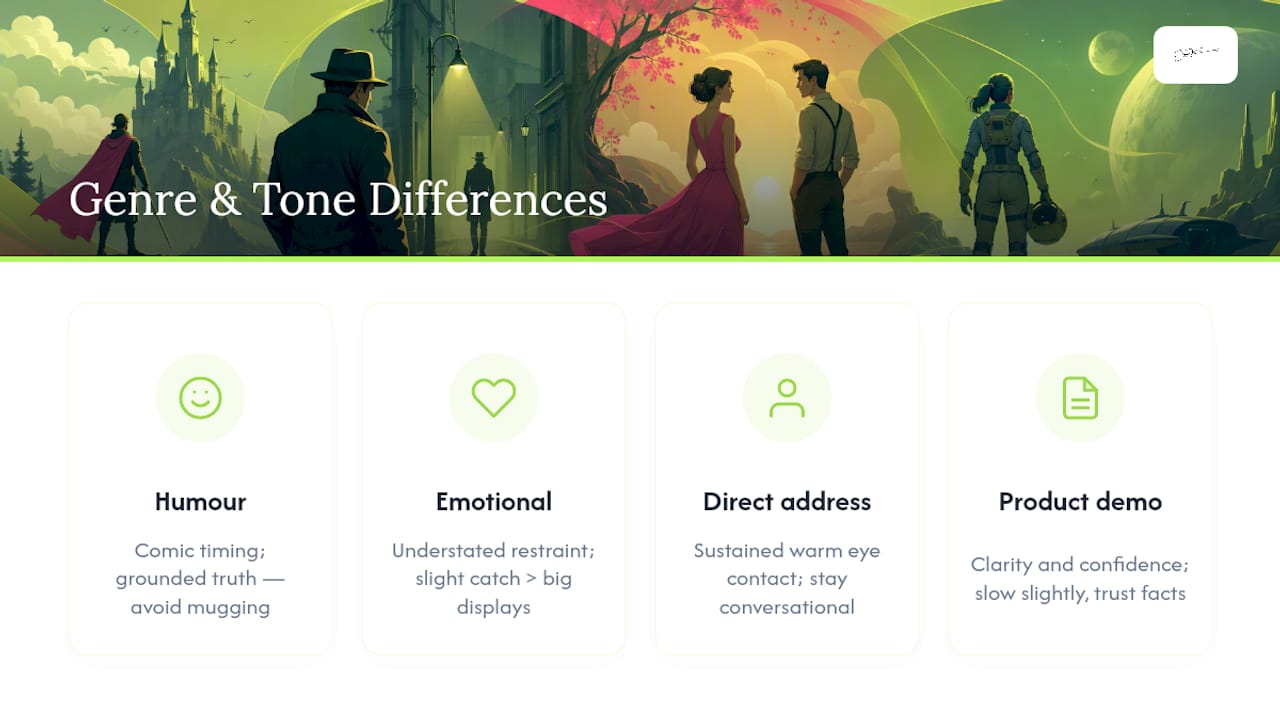
Emotional-appeal commercials, charities, insurance, family products, ask for restraint rather than intensity. The temptation is to cry or swell with feeling; the more effective choice is usually understatement, letting a single held breath or a slight catch in the voice carry more weight than an obvious display. Emotionally driven advertising works because it engages feeling over cognition, and that only works if the performance feels unforced.
Direct-address spots, where you speak straight to camera as though to a single viewer, demand a different skill entirely: sustained, warm eye contact without becoming static or announcer-like. Treat the lens as a person, specifically, someone you like, and the read stays conversational rather than performed.
Product-demonstration and information-led commercials want clarity and confidence over charm. Your job there is to make complex information sound simple, which means slowing down slightly and trusting the facts to do some of the work for you.
An honest opinion on what commercial acting technique training gets wrong
Most commercial acting advice treats the audition like a performance problem when it's usually a decision problem first. Actors spend hours polishing delivery on copy they've fundamentally misread, customer energy on a professional line, warmth where the brief actually wants restraint. Technique refinement without correct categorisation is polish on the wrong shape.
The other overrated piece of conventional wisdom is the demo reel as decoration. A reel stuffed with every job you've ever booked, rather than a tight sixty to ninety seconds of your most castable range, tells casting directors you don't know how to edit yourself, which is precisely the skill they need from you on set.
If you take one thing from this, prioritise the five-second decision over everything else. Camera technique, improv range, and professional polish all matter, but they're built on top of a correct read of what the copy is actually asking you to be. Get that wrong and no amount of charisma fixes it.
Ready to apply this on a real project? Visit Sofia Vicedomini's profile to see this approach in practice across film, commercial, and live event work.
Sources
- How to get work in commercials: a beginner’s guide — Spotlight
- Commercial vs theatrical acting: key differences — The Playground
- Cold reading copy fundamentals for commercials — Hey, I Saw Your Commercial
- How to get into commercials — Backstage
- What casting directors look for in commercial actors — J. Casablancas
FAQ
What are the five main acting techniques?
The most commonly taught approaches are Stanislavski's system, Method acting, Meisner technique, Practical Aesthetics, and Classical or presentational technique. Commercial work tends to borrow most heavily from Meisner's emphasis on truthful reaction and listening.
How do you do commercial acting well?
Categorise the copy as customer or professional within seconds, calibrate your energy to the frame size, and deliver several truthful variations rather than one polished take. Professional consistency and quick adaptation to direction matter as much as the performance itself.
What are the three C's of acting?
Definitions vary by coach, but a common version refers to Character, Conflict, and Circumstance, the who, what's-at-stake, and where/when that ground any performance. In commercial work, these compress into type, want, and setting, decided almost instantly.
What acting method does Johnny Depp use?
Public reporting on his process points to an eclectic, character-immersive approach drawing on observation and transformation rather than one single codified method. It isn't a technique commonly taught for commercial auditions, which reward economy over deep immersion.