Contract terms for talent: what performers need to check

Every UK talent agreement must cover ten non-negotiable areas: scope of services, payment structure (day rate and buyout separately itemised), intellectual property and usage rights, term and termination, exclusivity and availability, authority to sign (including PSC arrangements), confidentiality and GDPR compliance, indemnities and insurance, commission structures, and dispute resolution under English law. If any of these is missing or vague, ask for a redraft before you sign.
Before you sign, scan for these on page one:
- Scope: exact services, shoot days, delivery formats, and approval steps
- Payment: BSF/day rate listed separately from any buyout or usage fee, with payment dates and payee named
- IP/usage: media, territory, duration, and whether it is a licence or assignment
- Term and termination: fixed or rolling, notice period, and post-term commission or usage rights
- Exclusivity: category, territory, and duration clearly bounded
- Authority: who signs, whether a PSC is involved, and whether an inducement letter is required
- Confidentiality and GDPR: data-handling obligations and cross-border transfer safeguards
- Indemnities and insurance: scope, cap, and who bears the cost
- Commission: rate, what it covers, and sunset provisions
- Dispute resolution: English law, courts or arbitration
Equity publishes rate benchmarks and buyout guidance that give you a concrete floor to negotiate from. Lewis Silkin sets out the drafting points that most commonly require negotiation under English law. If any item above is absent or ambiguous, request a redraft or book a 30-minute review with your agent or a specialist solicitor before proceeding.
Key takeaways
A well-negotiated talent contract separates the BSF from the buyout, limits usage to named media and territory, caps liability at fee value, and includes audit rights and a sunset clause on commissions.
| Point | Details |
|---|---|
| Separate BSF from buyout | Always list the day rate and usage fee as distinct line items; bundling them obscures what each payment covers. |
| Define usage precisely | Name the media, territory, and duration; reject "all media, worldwide, in perpetuity" without a substantial premium. |
| Cap your liability | Propose a liability cap at the total fee paid; insist on reciprocal indemnities from the commissioning party. |
| Sunset commission clauses | Commission should apply only to contracts concluded during the agency term, or within an agreed short window after expiry. |
| Check GDPR and SCCs | Where EU/EEA personal data is involved, confirm that the European Commission's modernised SCCs are referenced in the agreement. |
Table of Contents
- Scope of services: what are you actually agreeing to do?
- Payment, day rates and buyouts: how to itemise your fees
- Intellectual property and usage rights: licences, buyouts and what to assign
- Term, renewal and termination: what to check before you commit
- Exclusivity and availability: what to accept and what to push back on
- Who signs and why inducement letters matter
- Confidentiality, data protection and cross-border transfers
- Indemnities, liability caps and insurance: limiting your exposure
- Agent and manager commissions: protecting your earnings
- Approvals, credits and brand-safety protections
- Dispute resolution and governing law: courts or arbitration?
- Practical negotiation checklist: what to ask for before you sign
- Typical UK fees and usage rates
- Short sample clauses you can propose
- An actress's perspective: what I check first when a contract arrives
- Sources
- FAQ
Scope of services: what are you actually agreeing to do?
Scope is the most consequential clause in any performer's contract, because it defines the outer boundary of your obligations. A vague scope clause can be stretched to demand additional shoot days, reshoots, promotional appearances, and social-media content that you never priced into your fee.
A well-drafted scope clause names the specific services (e.g. "two shoot days for a 30-second television commercial and one 60-second online cut"), the call times and turnaround expectations, any rehearsal or fitting days, the delivery format, and the acceptance criteria. Without acceptance criteria, a producer can reject a deliverable indefinitely and withhold payment.
Short-form option you can propose:
Stronger option:
Negotiate who supplies wardrobe, make-up, and travel. If the contract is silent, you may be expected to cover costs that should sit with the production. Overtime and penalty rates for overruns should be set out explicitly, and audit rights for usage reporting (so you can verify that the agreed media and territory limits are being observed) should be included from the outset.

Payment, day rates and buyouts: how to itemise your fees
Always separate the Basic Studio Fee (BSF) from any usage or buyout fee, and list payment timing and the named payee. Bundling them into a single figure makes it almost impossible to challenge underpayment later, and it obscures what you are actually being paid for your time versus what you are being paid for the commercial use of your image or performance.
Fee components to insist on in writing:
- BSF or day rate: compensation for services rendered on set, distinct from any usage payment
- Usage/buyout fee: a separate line item specifying media, territory, and duration (see below)
- Exclusivity premium: an additional fee if you are restricted from working with competing brands
- Travel and expenses: reimbursed at cost or at an agreed rate, with receipts required
- VAT/tax handling: confirm whether fees are quoted inclusive or exclusive of VAT, and name the payee entity
- Late-payment interest: reference the Late Payment of Commercial Debts (Interest) Act 1998 as the default
Statistic callout: Equity guidance indicates the BSF benchmark is most likely around £350, with a recommended minimum of £300. For internet usage, Equity's best practice sets the minimum at 400% of the BSF for one website for one year. On a £350 BSF, that equates to at least £1,400 for a single-site, one-year internet run.
As Mandy explains, a buyout is a one-off payment for use of an actor's image or performance and is distinct from the day rate. It must specify media, territory, and duration. Without those three parameters, a producer can argue the buyout covers all uses, everywhere, forever.
Pro Tip: When a producer asks for "all media" or a "worldwide" buyout, request a tiered usage schedule instead. Structure it as: Tier 1 (digital/social, UK, 12 months), Tier 2 (broadcast, UK, 12 months), Tier 3 (international extension, per territory, per year). Each tier carries its own fee, and extensions require a new payment rather than being assumed.
Intellectual property and usage rights: licences, buyouts and what to assign
Prefer a limited licence over a full assignment. For most commercial and campaign work, you should grant the commissioning party a time-bound, media-specific licence rather than transferring copyright or image rights outright. Assignment is permanent and extinguishes your ability to control or benefit from future use; a licence preserves those rights and lets you charge for extensions.
Three options, in order of preference for featured performers:
-
Limited licence: grant rights for named media (e.g. broadcast TV and the brand's own website), a defined territory (e.g. United Kingdom and Republic of Ireland), and a fixed term (e.g. 12 months from first broadcast). Any use outside those parameters requires a new agreement and a new fee.
-
Tiered buyout schedule: a one-off payment that covers a defined bundle of rights, with extension options priced in advance. This gives the producer certainty while giving you a clear path to additional income if the campaign runs longer or wider.
-
Narrow assignment: only appropriate when the compensation is substantial and the creative contribution is genuinely work-for-hire in character. If you accept an assignment, insist on a reversion clause if the work is not used within an agreed period, and price the assignment at a significant premium over a licence.
Managers and their clients understand that IP controls are not just legal formalities; they are the mechanism by which a performer retains long-term commercial value. Vague or open-ended grants erode that value quickly.
Usage scope and what to expect on fees:
| Usage scope | Typical territory | Duration | Exclusivity expectation | Fee relative to BSF |
|---|---|---|---|---|
| Local/regional | One city or region | 3–4 months | Low or none | 50–100% of BSF |
| National | UK only | 12 months | Moderate | 100–300% of BSF |
| International | Named territories | 12 months | Higher | 300–500% of BSF |
| Global | All territories | 12 months | High | 500% of BSF |
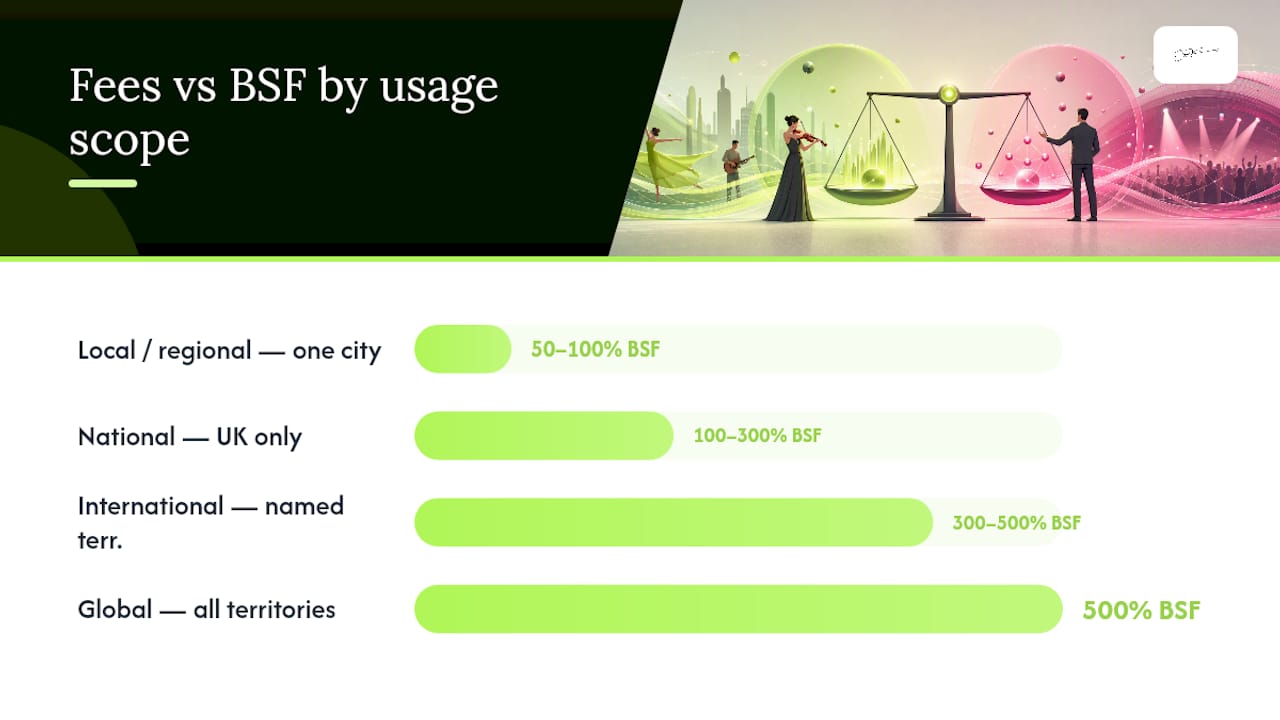
Figures represent indicative industry practice; always cross-reference with current Equity rate tables for union-minimum floors.
Term, renewal and termination: what to check before you commit
Talent agreements fall into three broad types: a fixed short-form job contract (one shoot, one campaign), a campaign-term agreement (covering a defined run period), and a rolling management agreement (ongoing, with notice provisions). Each carries different implications for your availability and your post-term entitlements.
Termination events to negotiate explicitly:
- Material breach by either party (with a cure period of at least 14 days before termination takes effect)
- Insolvency or administration of the commissioning party
- Force majeure events lasting beyond an agreed threshold (typically 30–60 days)
- Long-term incapacity of the performer (with a grace period and insurance backstop)
- Repudiatory conduct: a serious breach that goes to the root of the contract
Watch for automatic renewal clauses. A campaign contract that rolls over without notice can lock you into a second year at the original fee, even if your market rate has risen or the campaign has expanded. Request an explicit opt-out window (typically 30–60 days before the renewal date) or a cap on the number of permitted renewals.
Morality clauses deserve particular attention. Overly broad drafting can allow termination for any conduct that "brings the brand into disrepute" without defining what that means. A narrower version limits the trigger to conduct that results in a criminal conviction or a formal regulatory finding. A short example of tighter language:
Exclusivity and availability: what to accept and what to push back on
The default negotiating position is straightforward: avoid broad, undifferentiated exclusivity. Accept narrow exclusivity tied to a specific product category, defined territory, and a fixed time window, and only when the fee reflects the commercial restriction you are accepting.
Carve-outs to demand as standard:
- Pre-existing endorsements signed before this agreement
- Personal social-media content that does not feature competing products
- Non-conflicting product categories (e.g. a sportswear exclusivity should not prevent a food-brand deal)
- Regional exceptions where the brand does not actively trade
Red flags that should trigger immediate pushback:
- Perpetual brand bans after the contract ends
- "Conflicting product" defined so broadly it covers entire industry sectors
- Exclusivity periods that extend beyond the campaign's active run
- No compensation uplift for the exclusivity restriction
Pro Tip: Ask for the exclusivity clause to be tied to active use. If the brand is not running the campaign, the exclusivity restriction should lapse automatically. Propose: "Exclusivity shall apply only during periods in which the commissioned content is actively being broadcast or published."
Who signs and why inducement letters matter
The common commercial practice in UK production is that payments to a Personal Services Company (PSC) are acceptable, but the commissioning party will usually require a personal inducement statement from the named individual performer. This protects the producer if the PSC is dissolved or if a dispute arises over whether the individual is bound by the agreement.
Lewis Silkin's guidance confirms that PSC inducement statements, alongside IP and image controls, are among the most commonly negotiated points in talent agreements under English law.
Execution options:
- Individual signature: the performer signs directly; simplest but may have tax implications
- PSC signature plus director warranty: the company signs, and the director warrants authority to bind the PSC
- Agent signature with agent warranty: the agent signs on behalf of the performer, warranting authority
- Inducement letter from the performer: a short personal undertaking that the individual will perform the services and is bound by the key obligations
Limit warranties in any execution route. A warranty that the PSC has "full authority to enter into all obligations" is broader than necessary; narrow it to "authority to enter into this agreement on the terms set out herein." Cap any indemnity for breach of warranty at the value of the fee paid.
Pro Tip: A short inducement letter can reduce personal exposure significantly. Propose language that limits the individual's personal obligations to performance of the services only, and excludes personal liability for the PSC's commercial or tax obligations: "The Performer undertakes to perform the Services as described in Schedule 1 and acknowledges that the Commissioning Party may rely on this undertaking. This letter does not create any personal liability beyond the performance of the Services."
Confidentiality, data protection and cross-border transfers
Confidentiality and data-protection obligations are distinct, and conflating them in a single clause creates gaps. Confidentiality covers business-sensitive information (scripts, unreleased campaign materials, fee structures). GDPR governs the handling of personal data, including contact details, health records, and agents' data, and carries its own statutory obligations that cannot be contracted away.
For cross-border transfers of personal data from the EU or EEA to a non-adequate country (including, in many contexts, the UK for EU-originating data), the European Commission's modernised Standard Contractual Clauses (SCCs), published on 4 June 2021, are the primary contractual safeguard. If your contract involves a European production or an EU-based agency sending your personal data to a UK entity, the agreement should include a transfer rider referencing the applicable SCC module.
Sample data clause language:
Practical checklist for talent handling personal data:
- Confirm what personal data the commissioning party will hold about you (health records, bank details, agent contacts)
- Request a data-retention limit in writing (12 months post-term is a reasonable starting point)
- Ask whether your data will be shared with third-party sub-processors (post-production houses, media buyers)
- Where EU/EEA data is involved, confirm that SCCs or equivalent safeguards are in place
- Ensure the confidentiality clause has a carve-out for legally required disclosures
Indemnities, liability caps and insurance: limiting your exposure
Talent should accept limited, defined indemnities and avoid open-ended obligations. The standard position is that you indemnify the commissioning party for losses arising from your breach of the agreement (e.g. if you have granted conflicting rights to a third party), but you do not accept a blanket indemnity for all losses of any kind.
Common insurance types and negotiation positions:
- Public liability: the production should carry this; do not accept personal liability for on-set incidents caused by the production's own negligence
- Professional indemnity / errors and omissions (E&O): relevant for larger campaigns; the commissioning party typically holds this, but check whether you are named as an additional insured
- "Death and disgrace" cover: requested on major campaigns; confirm who pays the premium and whether the policy terms are proportionate to the fee
Propose a liability cap at the value of the fee paid under the agreement, or at a defined multiple (e.g. two times the fee for IP-related claims). Insist on reciprocal indemnities: if you indemnify the producer for your breach, the producer should indemnify you for theirs. Where additional insurance is required specifically because of the commissioning party's requirements (e.g. a high-value jewellery shoot), the cost should sit with the commissioning party, not with you.
Agent and manager commissions: protecting your earnings
The core principle is that an agent or manager earns commission on income they procure during the agency term.
The risk lies in commission on renewals and derivative deals. If a campaign is renewed two years after your management agreement ends, does your former manager still take a cut? Without a sunset clause, the answer may be yes.
Example calculation:
- Original booking: £5,000 fee, 15% commission = £750 to the agent
- Campaign renewal (year 2, same fee): if no sunset clause, another £750 may be owed even if the agent is no longer representing you
Clause language to propose:
Require clear accounting: the agent or manager should provide a written statement of all fees received and commissions deducted within 30 days of each payment. Audit rights (the right to inspect relevant financial records once per year) should be included as standard. Understanding the difference between talent agencies and management companies matters here, because commission structures, obligations, and legal duties differ between the two.
Approvals, credits and brand-safety protections
Approval rights should be narrow and time-limited. An open-ended approval right (where the producer must obtain your sign-off before any use) can be commercially impractical; a time-limited approval window (e.g. five business days, with deemed approval on silence) is more workable and still gives you meaningful control.
Approval and credit checklist:
- Approval window: five business days from receipt of the relevant materials, with a clear process for raising objections
- Reasonable grounds for refusal: limit refusal rights to material that misrepresents your likeness, associates you with content you did not agree to, or breaches the agreed usage scope
- Credit attribution: specify the exact credit form (e.g. "Featuring [Name]"), placement (opening or closing credits, on-screen lower third), and whether credit is required on all versions or only the primary cut
- Credit omission remedy: agree a financial remedy (not just a right to request correction) for failure to credit
For brand safety, negotiate carve-outs for previously public conduct that predates the agreement, and include a mutual termination option if either party's reputation is materially damaged by the other's conduct during the campaign. A narrowly framed morality clause (as set out in the termination section above) protects both sides without giving either an unrestricted exit.
Dispute resolution and governing law: courts or arbitration?
For UK talent deals, English law is the natural governing law. It is well-developed in commercial contract interpretation, widely understood by producers and talent representatives, and provides a clear framework for enforcement.
The practical trade-off between litigation and arbitration comes down to four factors: cost, speed, privacy, and enforceability.
Short-form options:
For talent (privacy preferred): For producers (courts preferred): Litigation vs arbitration for talent disputes:
- Cost: litigation in the English courts can be expensive for smaller claims; arbitration has its own fees but can be scaled to the dispute value
- Speed: the courts' commercial list can move quickly for urgent matters; arbitration timelines vary by institution and arbitrator availability
- Privacy: court proceedings are generally public; arbitration is confidential by default
- International enforceability: arbitration awards are enforceable in over 160 countries under the New York Convention; court judgments require separate enforcement proceedings in each jurisdiction
If you work across territories (UK and Italy, for example), arbitration with a London seat gives you an award that is enforceable in both jurisdictions without additional litigation. For smaller, domestic disputes, the English courts' small claims or fast-track procedures may be more proportionate.
Practical negotiation checklist: what to ask for before you sign
The negotiating mantra is simple: clarify use, limit grant, get paid, cap risk. Every clause you review should be tested against those four principles.
Negotiation checklist:
- Pay schedule: confirm payment dates, payee entity, and what triggers each payment (signature, delivery, broadcast)
- Usage: insist on named media, territory, and duration; reject "all media, worldwide, in perpetuity" as a starting position
- Exclusivity: limit to specific category, territory, and active campaign period; price the restriction separately
- Termination: agree cure periods, force majeure thresholds, and a narrowly drafted morality clause
- Indemnities: cap at fee value; insist on reciprocal obligations
- Insurance: confirm who holds each policy and who pays additional premiums
- Audit rights: one inspection per year, 30 days' notice, at the commissioning party's premises or via accountant
- Approvals: five-business-day window, deemed approval on silence, financial remedy for credit omission
- PSC/inducement: limit personal obligations to service performance only
- Governing law: English law, with dispute resolution matched to the deal size and territory
Red flags that demand immediate pushback or legal review:
- "All media, worldwide, in perpetuity" buyout language without a substantial premium
- Uncapped indemnities or indemnities that extend to consequential losses
- Vagueness on the payee entity (especially where a PSC is involved)
- Automatic renewal with no opt-out window
- Exclusivity that extends beyond the active campaign period
- No audit or accounting rights for usage fees
When presenting counter-language, keep your redline concise. One or two tracked changes per clause, each accompanied by a single explanatory sentence, is far more persuasive than a wholesale rewrite. Timing matters too: raise your mark-up within 48–72 hours of receiving the draft, before the production schedule creates pressure to sign quickly.
Typical UK fees and usage rates
The BSF benchmark, as Equity guidance indicates, is most likely around £350, with a recommended minimum of £300. Usage fees are then calculated as multiples of that BSF, scaled by reach, duration, and territory.
Statistic callout: Equity's best practice for internet advertising sets the minimum usage rate at 400% of the BSF for one website for one year. On a £350 BSF, that is at least £1,400 for a single-site, one-year internet run. A national broadcast campaign would typically attract a higher multiple.
Indicative UK fee ranges by usage type:
| Usage type | BSF multiple (indicative) | Example fee (£350 BSF) | Notes |
|---|---|---|---|
| Internet (1 site, 1 year) | 400% | £1,400 | Equity minimum guidance |
| National broadcast (1 year) | 300–500% | £1,050–£1,750 | Varies by channel reach |
| International (named territories, 1 year) | 500%+ % | £1,750+ | Per territory or bundled |
| Global buyout (all media, 1 year) | 500%+ | £1,750+ | Substantial premium expected |
These are indicative figures based on Equity guidance and general industry practice. Non-union deals may differ significantly. Always verify against current Equity rate tables or specialist union guidance before negotiating.
Variability is real. Union-minimum floors apply to Equity members and productions that have signed collective agreements; non-union productions may offer less. Experience, campaign scale, and the performer's profile all affect the achievable rate. For major national campaigns or global buyouts, multiples well above these indicative figures are both achievable and appropriate. Check Equity's rate tables and usefee.tv for current minimums before entering any negotiation.
Short sample clauses you can propose
Use these as starting points. Pick the short or strong variant, adjust the bracketed terms to fit your deal, and present them as tracked changes with a one-line explanation of why each change matters.
Scope limitation: Payment schedule: Buyout/licence: Morality clause (narrow): Exclusivity carve-out: PSC inducement statement: Data-processing rider: Liability cap: For contracts involving music or sync rights as part of a talent package, the licensing structure becomes more layered. A practical guide to music licensing for film and TV can help you understand how those rights interact with your performance rights.
ICC Model Contracts and Clauses provide editable, internationally-focused templates that can serve as balanced drafting benchmarks, particularly for cross-border deals where English law governs but the other party is based in another jurisdiction.
An actress's perspective: what I check first when a contract arrives
When a contract lands in my inbox, the first thing I look for is not the fee. It is the usage clause. A generous day rate means very little if the usage grant is "all media, worldwide, in perpetuity" with no additional compensation. That single clause can determine whether a single booking generates value for one year or for a decade, and whether I retain any control over how my image is used.
Three things I always do before responding to any offer:
-
Separate the numbers. I ask for the BSF and the usage fee to be listed as distinct figures. If the producer cannot or will not separate them, that tells me something important about how they view the deal.
-
Check the exclusivity window. I look at whether the exclusivity period extends beyond the active campaign. If it does, I ask for it to be tied to active broadcast or publication, and I price the restriction accordingly.
-
Confirm the payee and the payment trigger. Vagueness on who receives the payment and what event triggers it is one of the most common sources of delayed or disputed fees. I want both named explicitly before I agree to anything.
If you are working with UK or Italian productions and want to discuss how these principles apply to your specific bookings, I would love to connect. Visit Sofiavicedomini to explore my work and get in touch about collaborations.
This article is general information, not a substitute for advice from a qualified lawyer. Consult a qualified legal professional about your own circumstances before acting on anything here.
Sources
These are the core authoritative resources to check for rates, drafting notes, and cross-border data-transfer templates. Always consult the original sources for up-to-date tables and full model clauses.
- Equity
- Digital, Commerce & Creative 101: Talent Agreements
- Standard contractual clauses (SCC) — European Commission
- ICC Model Contracts and Clauses - ICC - International Chamber of Commerce
- What Is a Buyout? | Mandy
FAQ
What are the essential contract terms for talent in the UK?
Every UK talent agreement should cover scope of services, payment (BSF and buyout separately itemised), IP and usage rights (media, territory, duration), term and termination, exclusivity, authority to sign, confidentiality and GDPR obligations, indemnities and insurance, commission structures, and dispute resolution under English law.
How do I get out of a talent agency contract?
Check the notice provisions: most rolling management agreements require 30–60 days' written notice to terminate. If the agreement has been materially breached by the agency (e.g. failure to account for commissions), you may have grounds for termination for cause, seek legal advice before acting.
What is the difference between a buyout and a day rate?
The day rate (or BSF) is payment for your time on set; the buyout is a separate, one-off payment for the commercial use of your image or performance, and it must specify the media, territory, and duration it covers. Mandy's industry guide explains this distinction clearly.
What are the basic elements of a valid contract in English law?
A valid contract under English law requires offer, acceptance, consideration (something of value exchanged by both parties), intention to create legal relations, and certainty of terms. For talent agreements, the payee, fee, services, and usage scope must all be certain enough to be enforceable.
When do I need standard contractual clauses (SCCs) in a talent contract?
SCCs are required when personal data is transferred from the EU or EEA to a country without an adequacy decision. The European Commission's modernised SCCs (published June 2021) are the recommended contractual safeguard; include a transfer rider referencing the applicable module when your contract involves EU-based parties sending your personal data to a UK entity.