Film vs theatre acting: how to switch mediums

The core difference is scale. Theatre asks you to project outward to a live audience; film asks you to calibrate inward to a frame. Neither medium is inherently harder than the other, but each demands a distinct technical discipline. Before you read further, try these three things this week: record yourself delivering a monologue on your phone in close-up and watch it back without sound; practise hitting a piece of tape on the floor while keeping your eyeline fixed; and run a single emotional beat ten times in a row, starting cold each time. Those three drills will tell you more about where you need to grow than any theory.
The sections below map the technical demands, rehearsal processes, practical exercises, common crossover mistakes, and career steps you need to move confidently between stage and screen.
Key takeaways
Theatre and film acting demand distinct technical disciplines: calibrating to the frame is the defining skill for screen work, while sustained projection and physical clarity define stage performance.
| Point | Details |
|---|---|
| Calibrate to the frame | Adjust energy and physicality to the shot size, not just "smaller" or "bigger". |
| Map your continuity beats | Note your character's emotional state at the top of every scene before a shoot day. |
| Unlearn projection for camera | Natural mic delivery replaces stage projection; let the microphone carry the volume. |
| Build both mediums on your CV | Screen and stage credits together signal versatility to casting directors in the UK and Italy. |
| Rehearse marks as a habit | Hitting your mark precisely is a technical skill that requires deliberate, repeated practice. |
Table of Contents
- How do film and theatre acting really differ?
- What are the technical demands on set and on stage?
- How do rehearsal and performance schedules compare?
- Practical exercises to help you switch between stage and screen
- What mistakes do actors make when crossing between mediums?
- How do you build a career that spans both theatre and film?
- Sofia's approach: practical proof points from the craft
- Why the "just be natural" advice misses the point
- Useful resources for further training
- FAQ
How do film and theatre acting really differ?
The table below captures the seven axes where stage and screen diverge most sharply. Scan it first, then read the sections that follow for the practical detail.
| Dimension | Theatre | Film |
|---|---|---|
| Scale and intimacy | Broad, audience-facing energy; physicality read from distance | Calibrated to frame size; subtlety visible in close-up |
| Voice and projection | Full projection; diction shaped for the back row | Natural delivery; microphones capture breath and texture |
| Movement and physicality | Expansive gesture; choreographed for sightlines | Controlled, precise; marks and camera framing govern movement |
| Rehearsal and time commitment | Weeks of chronological, ensemble rehearsal | Limited rehearsal; non-linear shooting across days or weeks |
| Technical constraints | Blocking for audience; lighting rigs set in advance | Marks, eyeline, continuity, boom and lav placement |
| Feedback and audience | Live audience energy shapes performance in real time | Director and monitor feedback replace audience response |
| Auditions and career path | Script-in-hand recalls; rep seasons; stage agent | Self-tape; screen test; demo reel; screen agent |
Three differences matter most for working actors:
- Calibration over projection. On camera, adjusting energy to the frame size is the primary technical skill. What reads as truthful in a wide shot can look hollow in close-up, and vice versa.
What are the technical demands on set and on stage?
Hitting marks and framing
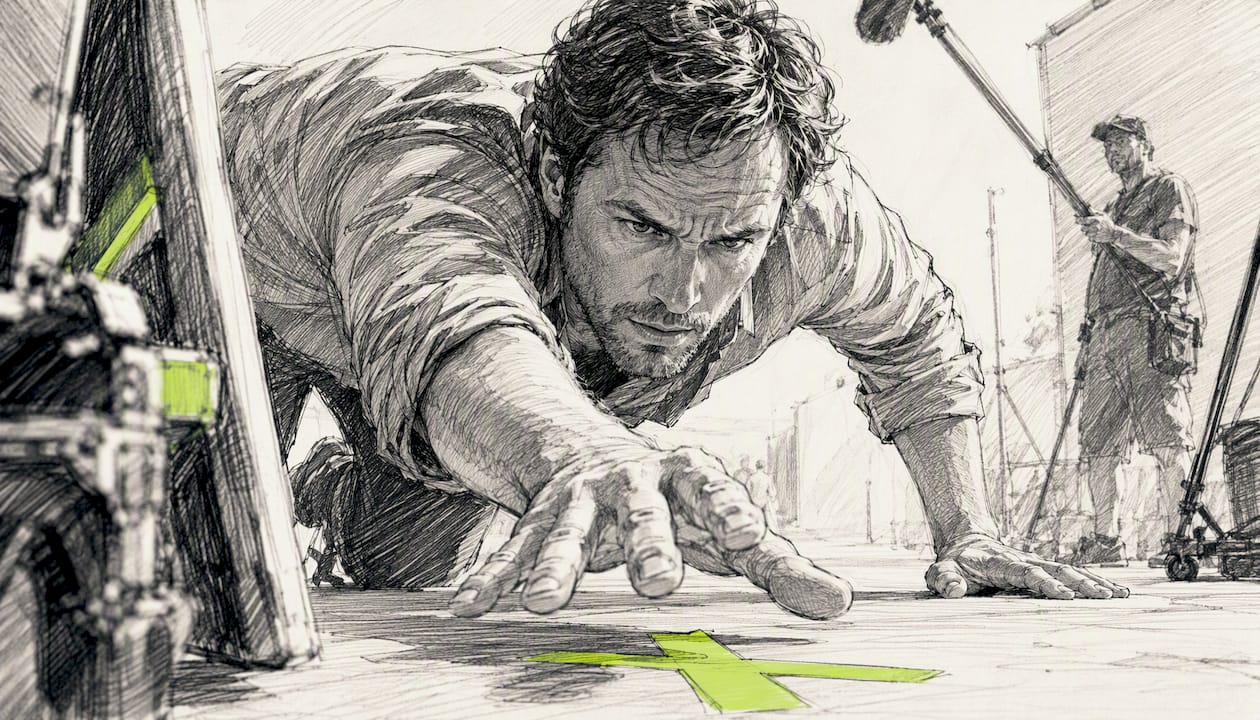
The camera replaces the live audience as your primary witness. Where stage blocking serves sightlines for the stalls, on-set blocking serves the lens. Hitting your mark precisely keeps you in focus and in frame; missing it by even half a step can pull you out of the shot entirely. Eyeline discipline matters just as much: where you look tells the camera, and ultimately the viewer, exactly what your character is experiencing.
Microphones and voice
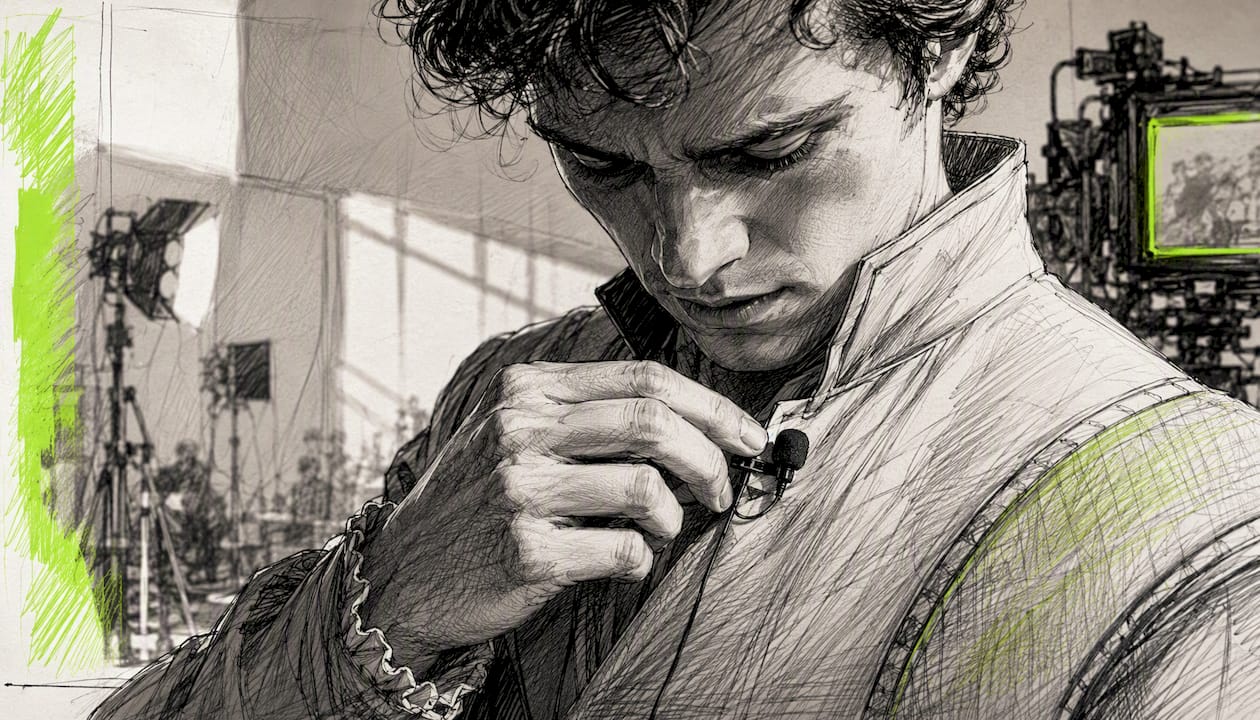
Stage projection is a trained skill built on breath support, resonance, and diction shaped to carry to the back row. On camera, a boom microphone or a lavalier clipped to your costume captures everything, including the catch in your throat and the barely-voiced thought. Projecting on set reads as shouting. The adjustment is not about being quieter; it is about letting the mic do the carrying while you focus on truth and texture.
Continuity and non-linear shooting
Film actors must master emotional continuity because scenes are rarely shot in story order. You might film the emotional peak of a scene on day one, then shoot the calm opening of that same scene three weeks later. Holding the internal logic of a character across that gap is a skill that requires deliberate practice.
On-set technical shorthand
Practical shorthand like "cheat to camera" and the three-actor rule govern blocking on set. Cheating to camera means angling your body slightly toward the lens even when the scene's naturalism would have you face away; the three-actor rule describes how multi-person scenes are staged to preserve camera visibility, sound capture, and eyeline simultaneously. These conventions prioritise the camera's line of sight over theatrical naturalism, and understanding them makes you a faster, more efficient collaborator on set. For a fuller picture of how camera, lighting, and sound departments interact, the guide to film production departments is worth reading before your first professional shoot.
Pro Tip: When you feel the urge to "push" your performance to make sure it lands, ask yourself: am I projecting for a back row that does not exist? On camera, the frame is your audience. Trust the lens.
How do rehearsal and performance schedules compare?
Theatre and film operate on fundamentally different timelines, and preparing for each requires a different mindset from day one.
Theatre rehearsal is typically chronological, ensemble-driven, and extended. A mid-scale production in the UK might rehearse for four to six weeks before the first preview, working through the script scene by scene, building relationships with the ensemble, and refining blocking and character arc in a shared room. The performance itself is a single live event, repeated night after night, where stamina and consistency are everything.
Film is almost the opposite. Rehearsal time is often minimal, sometimes limited to a brief read-through or a blocking walk-through on the morning of the shoot. Scenes are filmed out of story order, driven by location availability, lighting conditions, and budget. A shoot day typically runs from a call time in the early morning through multiple setups, with the actor moving between waiting, preparation, and short bursts of intense performance.
Before your first theatre rehearsal, prepare:
- A fully annotated script with character intentions and beats marked
- A physical and vocal warm-up routine you can run independently
- Research on the world of the play and your character's backstory
- An open, collaborative mindset for ensemble work and director notes
Before your first day on a film set, prepare:
- Your lines learned cold, including adjacent scenes for continuity
- A clear map of your character's emotional state at each scene's start
- Knowledge of the shooting schedule and which scenes you are covering that day
- Comfortable, mark-friendly footwear and a continuity note for costume and hair
Practical exercises to help you switch between stage and screen
Calibration is not simply playing smaller or bigger. It is choosing the right scale for the frame, and the best way to internalise that is through deliberate, repeated practice.
Frame calibration drill
- Set up your phone on a stable surface and record yourself delivering a two-minute monologue in wide shot (full body visible).
- Move closer so the frame shows from the waist up. Deliver the same monologue again without changing your internal intention.
- Move to close-up (head and shoulders). Deliver it a third time.
- Watch all three takes back. Notice where your face does the work the gesture was doing, and where you over-compensated.
- Repeat until the adjustment feels instinctive rather than mechanical.
Vocal calibration drill
Deliver a single speech twice: once with full stage projection, once at conversational volume as if speaking to someone a metre away. Record both. The second version should feel almost uncomfortably intimate. That discomfort is the calibration point.
Micro-expression and gesture control
Stand in front of a mirror and tell a story using only your face, with your hands clasped behind your back. Then tell the same story using only your hands, with your face neutral. Combining both with restraint is the on-camera skill.
Emotional continuity and jump-cut rehearsal
Write out five contrasting emotional states on separate cards (e.g. grief, joy, anger, calm, fear). Shuffle them. Draw a card, drop into that state for thirty seconds, then draw the next and switch immediately. This simulates the non-linear demands of a shoot day and trains the muscle of rapid emotional switching.
Pro Tip: When reviewing self-tape, watch the first take with the sound off. If your intention is not readable on your face alone, the performance needs more internal specificity before you record again.
What mistakes do actors make when crossing between mediums?
Most crossover errors fall into predictable patterns. Recognising them early saves you from repeating them on set or on stage.
- "Too big" on camera. Stage-trained actors often carry projection habits onto set: wide gestures, pushed vocal energy, eyebrows doing the work of the whole face. The fix is the frame calibration drill above, run weekly until restraint becomes your default.
- "Too flat" on stage. Screen actors who step onto a stage sometimes strip away all physical expressiveness, leaving the audience with nothing to read from row G onwards. Stage acting requires exaggerated physical clarity so that emotion reads at distance. Practise delivering a scene to an imaginary audience thirty metres away.
- Ignoring marks and microphones. Missing your mark or drifting away from the boom's sweet spot costs the production time and money. Rehearse hitting marks as a physical habit, not an afterthought.
- Poor continuity practice. Arriving on set without a clear map of your character's emotional state at the top of each scene leads to inconsistent coverage. Keep a continuity journal: note your character's physical state, energy level, and last action at the end of every scene.
- Over-reliance on audience energy. Theatre actors often draw fuel from the live audience's response. On a film set, that energy is absent. Build an internal source of momentum before the camera rolls, because the director and monitor replace the audience as your feedback loop.
Pre-shoot and pre-performance checklist:
- Lines secure and continuity mapped? ✓
- Marks rehearsed and eyeline fixed? ✓
- Vocal warm-up completed? ✓
- Physical scale calibrated to the medium? ✓
- Internal emotional starting point clear? ✓
How do you build a career that spans both theatre and film?
Moving between stage and screen is increasingly expected in the UK and Italian markets. Drama schools are integrating screen modules because casting directors want multi-platform fluency, and the actors who thrive are those who can speak both languages.
Adapting your CV and materials
- For stage casting directors: lead with theatre credits, list productions chronologically, and include the director's name and producing company.
- For screen casting directors: lead with screen credits, note the director and broadcaster or distributor, and keep the format clean and one page.
- Your cover letter should name the specific production and articulate why your range fits the role, not just the medium.
Building a demo reel
A strong screen reel shows range across shot sizes (wide, medium, close-up), emotional contrast, and at least one scene where you carry the frame alone. Keep it under two minutes. For theatre, a highlights reel or a recorded monologue filmed in close-up can demonstrate stage presence to a screen agent who has not seen your live work.
Approaching agents
Stage agents and screen agents operate differently. A stage agent focuses on rep seasons, touring productions, and West End casting; a screen agent prioritises self-tape submissions, screen tests, and television and film breakdowns. Pitching yourself as versatile, with evidence from both mediums, opens more doors than specialising too early.
Building screen credits from scratch
- Reach out to film schools in your city and offer to work on student short films.
- Submit to low-budget short film projects via Mandy.com or Casting Call Pro.
- Create a self-tape reel using monologues adapted for camera, referencing the frame calibration exercises above.
- Consider a dedicated on-camera course at a drama school or private studio before your first professional screen audition.
Understanding how television production workflows are structured will also help you navigate set etiquette and department expectations from day one.
Sofia's approach: practical proof points from the craft
Sofiavicedomini's work spans contemporary film, television, theatre, and interactive live events, which means the calibration question is not theoretical. It is a daily practice.
One of the most useful exercises from the Sofiavicedomini rehearsal kit is adapting a single monologue for both mediums in the same session. Take a speech you know well. Perform it standing, projecting to the back wall of the room, using full physicality. Then sit, place your phone at close-up distance, and deliver the same speech with no gesture at all, letting the face carry everything. The gap between those two performances is where your craft lives. Closing that gap, and being able to choose your position on that spectrum consciously, is what makes you castable across both mediums.
Sofiavicedomini's full portfolio, including film, television, and theatre credits, is available at sofiavicedomini.me.
Pro Tip: Before any audition or shoot, run your material once for the stage (full projection, full body) and once for the camera (close-up, minimal gesture). The contrast resets your calibration and reminds you which instrument you are playing.
Why the "just be natural" advice misses the point
There is a piece of advice that circulates endlessly in acting classes: "just be natural on camera." It sounds right, but it papers over the real work. Natural is not a setting you switch to. It is the result of technical mastery so thorough that the technique becomes invisible.
What I find genuinely exciting about moving between theatre and film is that each medium sharpens a different part of the craft. Stage work builds stamina, physical commitment, and the ability to sustain an arc over two hours. Screen work builds precision, internal specificity, and the discipline to be fully present in a thirty-second take with no audience and no momentum. Together, they make you a more complete actor than either alone ever could.
The psychological shift matters too. On stage, adrenaline has somewhere to go: the audience is there, the energy is live, and the performance builds. On set, you wait, then you perform, then you wait again. Managing that stop-start rhythm without losing internal heat is a skill worth training deliberately. A short breathing and grounding ritual before each take, something as simple as three slow breaths and a clear image of your character's last action, can anchor you when the set's technical demands threaten to pull you out of the moment.
Changing viewer habits and production trends are pushing the industry toward actors who can move fluidly between platforms. Dual training is not a nice extra; it is increasingly what the market expects.
Useful resources for further training
- Stage Vs Screen Training: Why You Need Both | Italia Conti
- How to Act for Film vs Theatre: A Complete Guide for Actors | StageMilk
- Stage vs Screen: What's the Difference? | NYFA
- Stage Acting vs. Film Acting: What's the Difference? | Backstage
- Stage vs. Screen: A Comparison of Acting Techniques | TheatreFolk
- Theatre acting vs film acting | Acting Magazine
FAQ
Is theatre acting harder than film acting?
Neither is objectively harder. Theatre demands sustained physical and vocal projection across a live performance; film demands precise psychological calibration and technical discipline across non-linear shooting days. Each challenges a different set of skills.
What are five key differences between theatre and film acting?
Scale and physicality, vocal projection versus mic delivery, rehearsal process (extended and chronological versus limited and non-linear), live audience feedback versus director and monitor feedback, and the technical demands of marks, eyeline, and continuity on set.
What is the three-actor rule in film?
The three-actor rule is an on-set blocking convention for multi-person scenes that staggers actors to preserve camera visibility, sound capture, and eyeline simultaneously. Unlike stage choreography, which faces the audience, it prioritises the camera's line of sight.
How do you transition from theatre to film acting?
Start by unlearning projection habits and practising frame calibration with a phone camera. Build screen credits through student films and short projects, create a demo reel showing range across shot sizes, and approach a screen agent with evidence of both stage and screen work.
Do drama schools teach both stage and screen acting?
Increasingly, yes. Leading UK institutions now integrate screen modules into their programmes because casting directors expect multi-platform fluency from working actors.