Improvisation for character: a 60-second template for actors

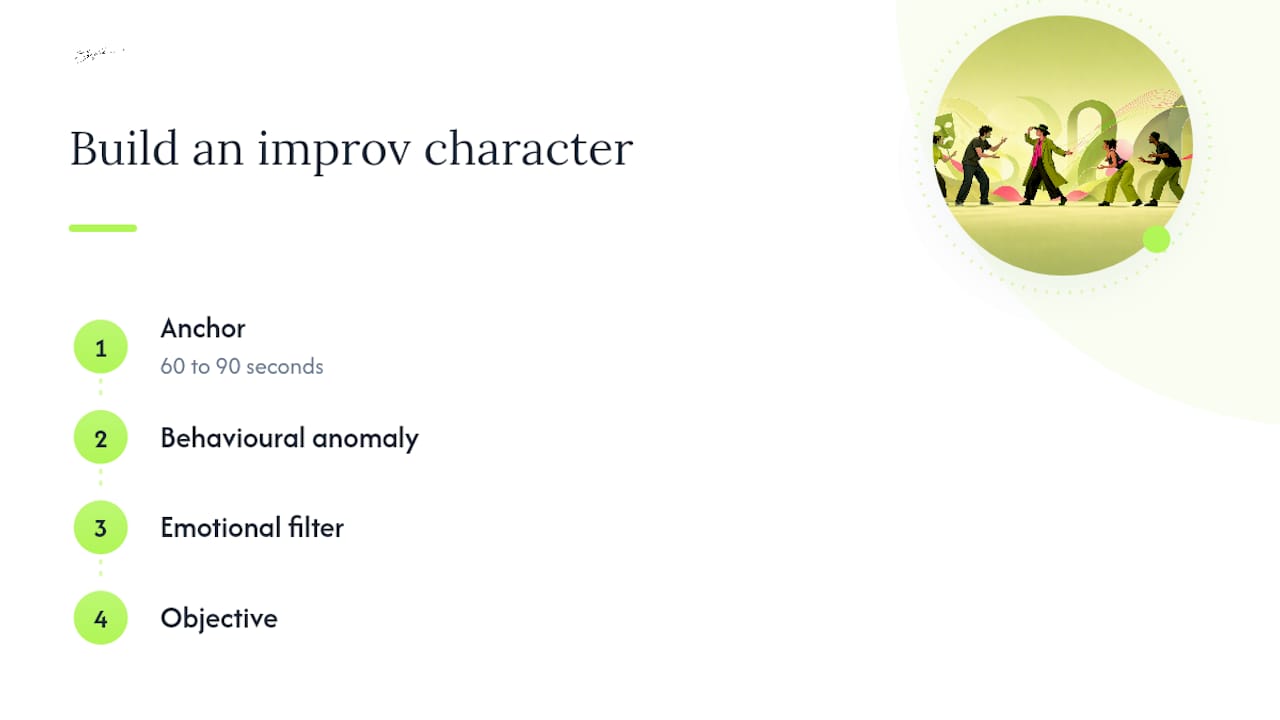
One sentence gets you there: pick a physical anchor, find the first unusual thing about how this person moves or speaks, run it through an emotional filter, and give them an objective. That is improvisation for character in its full working form, and you can be playing it in under ninety seconds.
Before you overthink it, change three things first:
- Posture — shift your weight, drop or lift your centre, let the spine tell the story before you speak a word.
- Breath — shallow and quick reads as nervous or excitable; slow and low reads as weary or in control.
- Tone — pick one vocal quality (nasal, breathy, clipped) and commit to it immediately.
Success isn't a clever line. It's a piece of behaviour you can repeat and a scene partner can react to.
Key Takeaways
A playable character comes from one physical anchor, one behavioural anomaly, and one clear objective, built and tested in under ninety seconds.
| Point | Details |
|---|---|
| Use the six-step template | Anchor, specificity, first unusual thing, emotional filter, relationship, then test in a short beat. |
| Lead with pattern, not backstory | Find one behavioural anomaly and escalate it rather than inventing detailed history. |
| Train physicality and voice separately | Isolate posture, breath, and tone in drills before combining them in a scene. |
| Build a character library | Save a one-line anchor, physical cue, and vocal tag after every rehearsal. |
| Fix flat characters by subtracting | Tighten to one strong choice instead of stacking new mannerisms. |
Table of Contents
- The fast character template: six steps in 60 to 90 seconds
- Core techniques: physicality, voice and point of view
- Why the 'first unusual thing' beats backstory every time
- Practical exercises and warm-ups to build the muscle
- Building a personal character library
- When characters feel flat: quick fixes
- Author's note: a quick view from a working actress
- Recommended reading and reputable resources
- Sources
- FAQ
The fast character template: six steps in 60 to 90 seconds
Actors who train regularly at structured improv programmes tend to lean on a repeatable sequence rather than inspiration alone. Here's the version that works under pressure:
- Anchor (10 seconds) — choose one physical trait: a limp, a raised chin, tight shoulders.
- Specificity (10 seconds) — name a job, a habit, or an object they always carry.
- First unusual thing (15 seconds) — spot one odd behavioural detail and keep it.
- Emotional filter (15 seconds) — decide the mood colouring everything: suspicious, delighted, exhausted.
- Relationship (15 seconds) — who is this person to your scene partner? Boss, rival, long-lost cousin.
- Test in a short beat (15 to 20 seconds) — say one line in character and see if it holds.
Pro Tip: Stop refining the moment the character makes you laugh or surprises you. Overworking the template kills the spontaneity that made it playable in the first place.
Core techniques: physicality, voice and point of view
Character work in improvisation depends on three levers you can pull instantly: physicality, voice, and point of view, not on pages of invented history. A shift in weight distribution, a change in gesture size, or a new centre of gravity does more to convince an audience than a paragraph of backstory ever will.
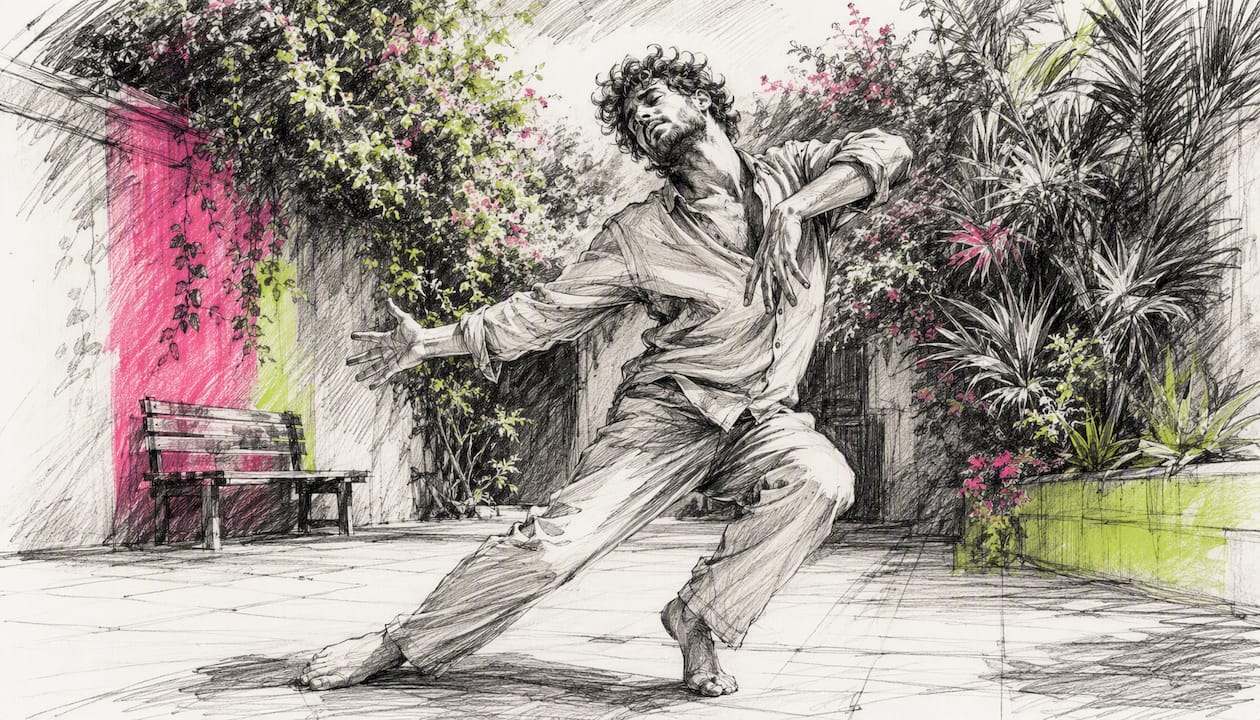
Vocal choices work the same way. Pitch, tempo, and breath pattern change not just how a character sounds but what they're emotionally capable of doing. A character who breathes high and fast can't easily deliver a slow, menacing threat; the voice sets the emotional ceiling.
Point of view ties it together. It's the lens through which this person sees everything: a character who believes the world is conspiring against them will read a compliment as sarcasm. That single organising belief turns scattered behaviour into something coherent.
Drills worth running:
- Walk across the room five different ways, naming the emotional read after each.
- Deliver the same line in three pitches and notice which one changes the character's status.
- Improvise a monologue from one fixed point of view for sixty seconds without breaking it.
Pro Tip: Isolate one lever at a time in practice. Trying to nail physicality, voice, and point of view simultaneously on your first attempt is how characters end up muddy instead of distinct.
Why the 'first unusual thing' beats backstory every time
UCB-trained improvisers work from a principle that changes how character is built: a single behavioural anomaly, the first unusual thing you notice about a person, becomes the seed of the entire character. The game is the character. Everything else is decoration.
Here's how it plays out in a scene. A character enters and, without meaning to, taps the table twice before every sentence. That's the anomaly. The scene partner reacts, maybe mimicking it or naming it. The tapping escalates: now it's three taps, now it's before every word, now it's tied to anxiety about being caught lying. By the end of the scene, the tapping has carried the entire arc without a single line of invented history.
This works because pattern-first characters are self-sustaining. You don't need to remember six invented facts about a childhood; you need to remember one behaviour and heighten it. Backstory-heavy improvisers often stall mid-scene because they're mining memory instead of playing what's in front of them.
- Spot the anomaly early, usually in the first ten seconds of a scene.
- Name it internally (even one word: "tapper", "whisperer", "over-apologiser").
- Escalate it once your partner acknowledges it.
- Resist adding new unrelated quirks. One strong pattern outperforms five weak ones.
The pattern is the character's engine. Everything you do afterwards should be that engine running faster, not a new engine bolted on.
Practical exercises and warm-ups to build the muscle
Actors improving their improv exercises tend to return to the same short list because it covers the ground efficiently. Run these solo or with a partner.
- Stacking — build a character in layers: posture first, then breath, then voice, then one gesture. Two minutes.
- Stations — set up four "stations" around the room, each with a different physical state (tired, alert, defensive, joyful); walk between them and let the character shift with each. Three minutes.
- Walks — cross the space using only your feet and hips to convey age, status, or mood. One minute per walk.
- Emotion drills — deliver a neutral line (“I brought the mail in”) through five different emotional filters. Two minutes.
- Object work — mime handling an imaginary object with texture, weight, and temperature until it feels real. Ninety seconds.
Sequencing matters:
- Start with walks to loosen the body.
- Move to stacking to build specificity.
- Use stations to test range.
- Close with emotion drills to sharpen contrast.
Stacking develops economy, walks develop physical specificity, and emotion drills train escalation. Practise all four regularly and the character work resources used in classroom teaching suggest the combination builds both range and speed noticeably faster than isolated drilling.
Building a personal character library
Save what works. After a rehearsal or class, note four things before the character evaporates: one-line anchor, physical cue, vocal tag, and a short file name.
Use a naming system you'll actually remember. Something like nervous_tapper_status_low or weary_landlord_occupation_authority tags the character by trait, status, and emotional filter simultaneously, so you can search your notes later by any of the three.
- Write the one-line anchor immediately, before details blur.
- Add the physical cue in three words maximum.
- Tag the vocal quality separately from the physical note.
- File it under a consistent naming pattern.
Weekly habits keep the library alive:
- Revisit two old characters out of context, in the shower, on a train, anywhere with no stakes.
- Retire characters that no longer surprise you.
- Add one new anomaly-based character every week, even a rough one.
When characters feel flat: quick fixes
Flat characters usually share one of four faults: no specificity, a weak anchor, conflicting objectives, or too many competing mannerisms stacked on top of each other.
The fix is almost always subtraction, not addition. Tighten the behavioural filter to one clear choice. Raise the stakes of the objective so the character has something urgent to want. Commit fully to a single physical or vocal choice rather than hedging between two.
Test it in a short improvised beat, thirty seconds is enough. If the character becomes more specific and your scene partner reacts differently to you, the fix worked. If nothing changes, you probably fixed the wrong fault.
Author's note: a quick view from a working actress
The template holds up on stage and on camera, though screen work asks for smaller, quieter choices; the anchor still works, it just shrinks. In rehearsal rooms I've found that structured improv, exploring dialogue within fixed blocking, keeps a character alive without derailing the story. Used generously and with respect for your scene partner's choices, improvisation stays a collaborative tool, not a way to dominate a room.
Recommended reading and reputable resources
- Character work — Improv Archive: a clear breakdown of voice, physicality, and point of view as the core levers of character.
- Character through game — The Physics of Connection: the theory behind pattern-first, UCB-style character creation.
- Improv for screen actors — ActorLab blog: how improv skills transfer to auditions and on-set work.
- Ideas for creating and developing characters — BBC Bitesize: stacking, transporting a role, and other classroom-tested exercises.
- Acting techniques: improvisation & character development — Interlochen: a look at how structured programmes teach status and ensemble work.
Actors who want direct coaching or wish to discuss a booking involving character-driven work can find Sofia's portfolio and contact details at Sofia Vicedomini's professional page.
Sources
- Character work — Improv Archive
- Character through game — The Physics of Connection
- Improv for screen actors — ActorLab blog
- Ideas for creating and developing characters — BBC Bitesize
- Acting techniques: improvisation & character development — Interlochen
FAQ
What are the four C's of improvisation?
Definitions vary across schools, but a common version covers commitment, collaboration, communication, and creativity, the habits that keep a scene alive and a character consistent. None of them replace the physical and vocal choices that actually build the character itself.
What is character improvisation?
Character improvisation is the practice of inventing and performing a distinct person on the spot using physical, vocal, and behavioural choices rather than a written script or biography, as outlined by Improv Archive.
How long should it take to build a character in improv?
A workable character can be built in 60 to 90 seconds using an anchor, a behavioural anomaly, an emotional filter, and an objective. Refining beyond that point often costs more spontaneity than it adds.
How do I stop my improvised characters feeling repetitive?
Build a personal character library tagged by status, occupation, and emotional filter, then retire characters once they stop surprising you and add a new anomaly-based one each week.
Does improv training actually help with auditions and on-set work?
Yes. Improv training builds spontaneity, adaptability, and listening, skills that transfer directly to auditions and on-camera responsiveness.