Indie film casting: how to hire the right actor fast

If you need a professional actor for an indie feature, short, commercial or interactive theatre piece, Sofia Vicedomini is a hire-ready fit worth putting on your shortlist today. Her theatrical foundation, range across emotionally complex roles, and adaptability to lean indie shoots make her suited to productions that need someone who arrives prepared and delivers without hand-holding. Indie film casting rarely allows for a long runway, so the fastest route forward is direct contact.
To request availability:
- Email through the booking page with your shoot dates, a one-paragraph project brief, and sides or self-tape guidance if you have them.
- Include your budget range upfront. It saves everyone a week of back-and-forth.
- Ask for reels and headshots in the same message. Sofia's team can turn around a self-tape quickly once sides are in hand.
Key Takeaways
Hiring the right actor for an indie film depends on clear materials, a fast evaluation process, and a contract that names usage, payment, and credit terms explicitly.
| Point | Details |
|---|---|
| Request the full package upfront | Ask for headshot, resume, timecoded reel, and a self-tape in one message to save review cycles. |
| Watch reels strategically | Judge the first 30 seconds and one range-demonstrating scene before committing more review time. |
| Use SAG‑AFTRA agreements correctly | The Micro Budget Agreement applies to productions with budgets of $20,000 or less. |
| Put usage and payment terms in writing | Specify territory, deferred-payment triggers, and credit placement before the shoot starts. |
| Contact Sofia Vicedomini directly | Send project brief, dates, and budget range through her booking page to request availability. |
Table of Contents
- Why Sofia Vicedomini fits indie film casting briefs
- How do you shortlist and test actors for an indie film?
- Engaging and contracting actors on an indie budget
- Managing talent relations through the casting process
- Contractual pitfalls to avoid in indie film deals
- Building diversity and inclusion into your casting process
- What indie producers get wrong about hiring actors
- Booking Sofia Vicedomini for your next indie project
- Sources
- FAQ
Why Sofia Vicedomini fits indie film casting briefs
Indie productions need actors who can do more with less: less rehearsal time, less crew, less margin for error on the day. Sofia Vicedomini's background is built for exactly that pressure. Her theatrical training gives her the discipline to hold a scene without multiple takes, and her range spans contemporary drama, commercial work, and interactive theatre, where she has to read a room in real time rather than rely on a script alone.
She accepts a spread of project types and scales:
- Feature and short films with modest crews and compressed schedules.
- Commercial shoots requiring quick turnaround and brand alignment.
- Interactive theatre and live event work, including hosting and presenting.
- Television guest and supporting roles where character depth matters more than screen time.
A production doesn't need the biggest name attached. It needs the actor who understands the tone of the piece and can carry it in one or two takes because the budget doesn't allow for ten.
That's the standard Sofia works to on every project, indie or otherwise. Producers considering her for a role are welcome to request case studies, prior reel excerpts, and references from past directors, which can be added to any booking conversation on request.
Pro Tip: When you reach out, name one specific scene or role from her portfolio that made you think of your project. A concrete reference lands better than a generic "we love your profile" message and tends to speed up the reply.
How do you shortlist and test actors for an indie film?
Casting teams typically wade through hundreds of submissions per role, and strong, well-formatted materials are usually the first filter that separates a serious candidate from noise. Before you open a single self-tape, decide exactly what you're asking for.
Request these materials, with specs:
- Headshots: one theatrical, one commercial, both current within 12 months.
- Resume: formatted to industry standard, film and theatre credits separated, special skills listed.
- Showreel: 60 to 90 seconds, timecoded, opening with the strongest range clip first.
- Self-tape: natural light or a soft key light, medium close-up framing, MP4 file, named with the actor's surname and role.
A reel is not optional garnish. Casting professionals consistently treat the reel as the single most decisive asset in a submission, and a missing or weak one often ends consideration before the resume is even read properly.
Judge submissions against five criteria:
- Fit for the role — type, natural energy, and age range against the character brief.
- Emotional range — can they shift tone within a single scene without it feeling forced?
- Chemistry — does their energy work against the other cast members you already have?
- Reliability — do they respond promptly, hit deadlines, and show up prepared?
- Digital presence — a working reel, an active portfolio site, and professional social profiles matter more each year as producers cross-reference audience engagement alongside pure performance instinct.
A practical shortlist timeline runs like this: allow two to three days for self-tape review, a day for the director's shortlist meeting, then a chemistry read (in person or on video call) within the following week, followed by an availability hold before any offer goes out.
Watch the first 30 seconds of a reel and one scene that shows range. If those two moments don't convince you, the rest of the reel rarely turns things around, so don't burn time scrubbing through the full three minutes hoping for a save.

Two red flags worth acting on immediately: an actor who can't commit to a hold date without checking three other projects, and a reel padded with unrelated commercial work when you need dramatic range. Neither is disqualifying alone, but both are worth a direct question before you invest more time.
Engaging and contracting actors on an indie budget
Most indie productions choose between union and non-union engagement, and the decision usually comes down to budget bracket rather than preference. The SAG‑AFTRA Micro Budget Agreement covers productions with very low budgets and gives producers an online route to signatory status, which lets you hire union talent compliantly without the overhead of a full studio agreement. For productions above that threshold, tiered low-budget agreements apply, and SAGindie runs workshops and step-by-step guidance specifically for filmmakers navigating these agreements for the first time.
A workable hiring sequence looks like this:
- Offer: verbal or written, naming the role, dates, and fee.
- Verbal hold: actor confirms interest and blocks the dates informally.
- Written agreement: contract or deal memo covering fee, credit, usage, and schedule.
- Deposit or payment schedule: a portion on signing, balance on wrap or per agreed milestones.
- Rehearsal and final confirmation: locked at least one to two weeks before principal photography for lead roles.
Lock your principal cast four to six weeks ahead where possible. Fee shapes vary widely by project scale, but shorts often work on day rates or flat buyouts, while features tend to structure around weekly rates plus deferred or backend arrangements when cash is tight.
Pro Tip: Build travel, per diems, and basic accident insurance into your budget from the outset rather than negotiating them after an actor accepts. It keeps the production compliant and avoids awkward renegotiation mid-shoot.
Managing talent relations through the casting process
Actors remember how they're treated during casting long after the project wraps, and that reputation follows a production into its next round of hiring. Respond to submissions within a few days even if the answer is no. Silence is the single biggest complaint actors raise about indie casting processes, and a short, courteous decline costs you nothing but goodwill.
Be precise about what you're asking for at each stage. If you need a callback, a chemistry read, or a second self-tape, say exactly why and what's changed since the first submission. Vague requests ("just send something else") read as disorganised and cost you strong candidates who have other options.
Keep one point of contact per actor throughout the process. Switching between a casting assistant, a director, and a producer without clear handoffs creates confusion and duplicate messages, which is a fast way to make a talented performer nervous about how the actual shoot will run.
Once you've made an offer, confirm it in writing within 24 hours. A verbal hold that drags on for a week without follow-up is one of the most common reasons actors quietly accept another offer elsewhere.
Contractual pitfalls to avoid in indie film deals
The most common mistake in indie contracts is vague usage language. If your agreement doesn't specify where the footage can be used, festival submission, streaming, paid advertising, you risk a dispute later when the film finds unexpected distribution. Spell out territory, duration, and platform rights in the written agreement before day one of the shoot.
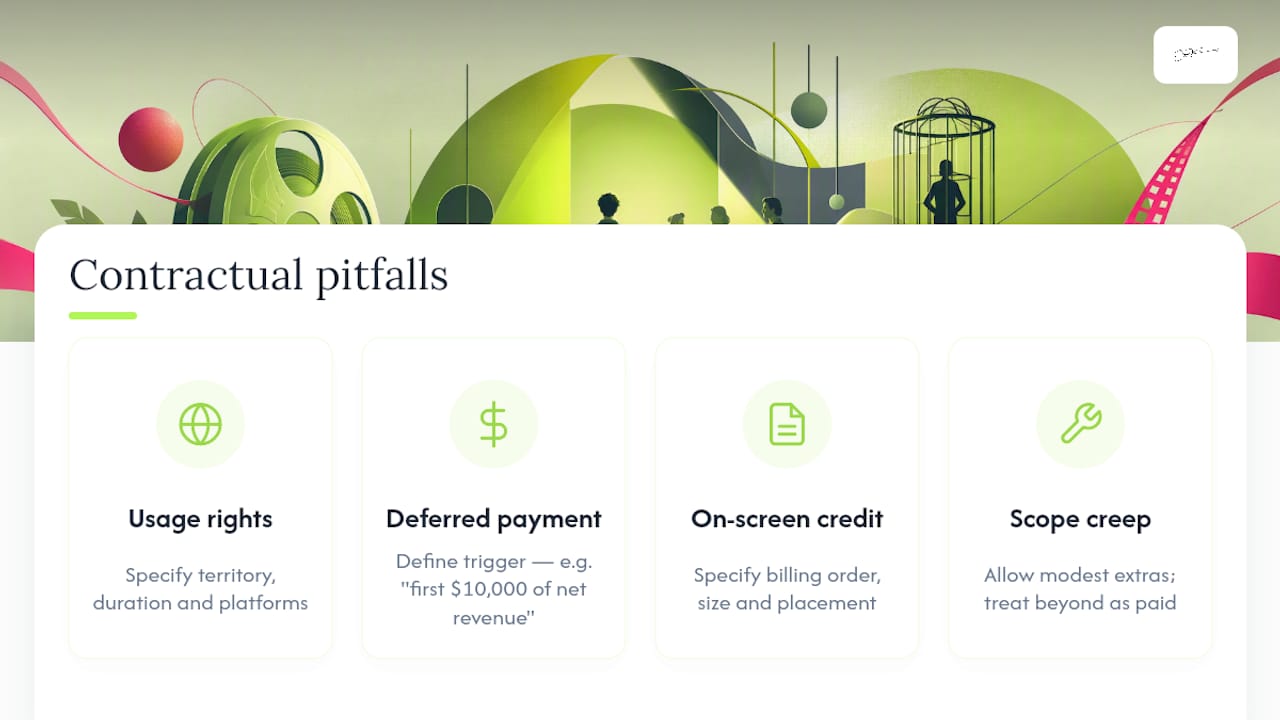
Deferred payment is common on tight budgets, but it needs a clear trigger. "Paid when the film makes money" is not a contract term; "paid from the first $10,000 of net revenue" is. Actors and their representatives will push back on undefined deferrals, and rightly so.
Credit disputes are avoidable with one sentence in the deal memo specifying billing order, size, and placement. Leaving credit to be "worked out later" is a reliable way to create tension in post-production.
Watch for scope creep: reshoots, additional promotional appearances, or extra social content requests that weren't part of the original agreement. Build a modest allowance for reasonable extras into the initial contract, and treat anything beyond that as a separate, paid negotiation rather than an assumed favour.
Building diversity and inclusion into your casting process
Indie film has more room than studio productions to cast against convention, precisely because there's no committee demanding a familiar face for market testing. Use that freedom deliberately rather than defaulting to whoever's easiest to find through your existing network.
Widen your search beyond the usual casting call platforms. Local theatre companies, university drama programmes, and community arts organisations often hold talent that never appears on mainstream casting sites, and reaching out directly tends to surface performers who bring a genuinely different perspective to a role.
Write character breakdowns that describe personality, backstory, and function in the story rather than defaulting to a specific ethnicity, body type, or age unless the role genuinely requires it. An open breakdown widens your applicant pool without lowering your standards, and it often produces a stronger final cast than a narrowly specified one.
Build a diverse cast on purpose, not as an afterthought during a final callback round. That means considering inclusion at the character-breakdown stage, not just when you're choosing between two similarly strong finalists.
What indie producers get wrong about hiring actors
The conventional advice tells producers to chase the biggest name their budget can technically afford. That's backwards for most indie projects. Fit and reliability matter more than recognisability when your entire schedule depends on someone showing up prepared and nailing a scene in two takes rather than ten.
What's underrated is the outreach itself. A message naming a specific scene from an actor's reel and explaining why it maps onto your project converts far better than a generic casting call blast, because it signals you've actually watched their work and thought about the role. Creative vision, not just budget, is often what attracts strong indie talent to a project in the first place.
If there's one thing I'd tell a first-time indie producer to prioritise, it's this: build your evaluation criteria before you post a single casting call, not after submissions start arriving. Knowing exactly what "fit" means for your specific role stops you from wasting a week on chemistry reads with actors who were never right for the part.
— Sofia
Booking Sofia Vicedomini for your next indie project
Sofia Vicedomini brings a theatrical foundation, cross-genre range, and the professionalism indie productions need when there's no room for reshoots or wasted rehearsal days. She typically delivers a rehearsed self-tape on request, availability confirmation within a short turnaround, and promotional assets, headshots and reel clips, that productions can reuse for festival submissions or social promotion once the project wraps.
To start a booking enquiry, send a short project brief covering the role, tone of the piece, and shoot dates, along with your budget range and any sides or self-tape direction you already have prepared. If you're working under a SAG‑AFTRA Micro Budget or low-budget agreement, mention it upfront so the paperwork can be aligned from the first conversation rather than negotiated after an offer is accepted. Head to the Sofia Vicedomini booking page to check availability and send your enquiry directly.
Sources
- How can I work on indie films? — SAG‑AFTRA
- SAGindie — guidance for filmmakers
- How the casting process works — Casting Networks
FAQ
How Fast Can I Book a Professional Actor for an Indie Film?
Availability confirmation typically takes a few days once you send a clear brief with dates and budget range; a written agreement should follow within a week of a verbal hold.
What Is the SAG‑AFTRA Micro Budget Agreement?
It's a union agreement covering productions with total budgets of $20,000 or less, giving producers an online route to signatory status for compliant union hiring.
Do I Need a Casting Director for a Small Indie Film?
Not always, but industry guidance suggests it's a high-return investment even on limited budgets, since a casting director filters volume and surfaces stronger fits faster than self-managed submissions.
What Should I Include in a Booking Enquiry to Sofia Vicedomini?
A short project brief, shoot dates, your budget range, and any sides or self-tape guidance, sent through her booking page.
What's the Biggest Mistake Producers Make in Indie Contracts?
Leaving usage rights and deferred-payment triggers vague. Specify exactly where footage can be used and what revenue threshold triggers deferred pay before the shoot begins.