Networking with casting directors: the UK playbook

The fastest way to convert a professional relationship with a casting director into a paid booking is to present verifiable, role-specific value and a short, tracked outreach cadence that respects CDG and Equity guidance. Here is the immediate checklist:
- Verify first. Confirm any casting notice is legitimate before attending or submitting.
- Prepare materials. A clean Spotlight profile, correctly labelled self-tape, and a one-page CV are non-negotiable.
- Lead with value. Every contact should offer something specific: a relevant credit, a press-night invite, a new skill.
- Track every interaction. Log contacts, dates, and notes in a simple spreadsheet.
- Respect the cadence. Meaningful updates every four to six months; silence is not rejection.
Pro Tip: Target casting assistants and associates first. They compile the initial shortlists, and a warm relationship at that level often opens the door before a senior director ever sees your name.
Key takeaways
Networking with casting directors converts into bookings when outreach is specific, materials are immaculate, and follow-up is tracked and timed to industry cycles.
| Point | Details |
|---|---|
| Verify before you engage | Confirm CDG/CDA membership and check any casting notice against Equity's safeguarding guidance. |
| Materials must be instant to assess | Label files correctly, keep the cover email to two sentences, and keep your Spotlight profile current. |
| Target assistants and associates first | They compile initial shortlists; a warm relationship at that level accelerates access to senior directors. |
| Track every interaction | Use an Ability + Willingness scoring system and schedule follow-ups at a four-to-six-month rhythm. |
| Lead with genuine value | Press-night invites and broadcast links outperform generic "keep me in mind" messages every time. |
Table of Contents
- How should you prepare your materials for casting directors?
- Where do you find and prioritise UK casting contacts?
- What does effective outreach to casting directors actually look like?
- How to build a contacts tracker that actually gets used
- What do casting directors expect from professional outreach and auditions?
- How do you stay visible without over-emailing casting teams?
- How do you handle replies, silence, and follow-ups?
- Sofia's perspective on building real connections with UK casting teams
- Sources
- FAQ
How should you prepare your materials for casting directors?
What a casting director checks first, in order: headshot, top three credits, key skills, and whether you have an active Spotlight profile. Everything else is secondary. Spotlight's own guidance confirms that casting teams search and filter profiles heavily, so an incomplete or outdated profile is a missed opportunity before outreach even begins.
| Element | Self-tape submission | In-person submission |
|---|---|---|
| File format | MP4, labelled: Surname_Firstname_Role.mp4 | Printed one-page CV, headshot attached |
| CV | PDF attached, labelled: Surname_Firstname_CV.pdf | Single A4 page, top credits prominent |
| Showreel | Vimeo or YouTube link, no password | USB or link on CV |
| Spotlight | Profile URL in email signature | Profile URL on CV footer |
| Cover note | Two sentences maximum | Brief verbal introduction |
A submission packet should contain: headshot, CV, Spotlight link, and a single showreel link. Nothing more. The email itself needs one subject line, two sentences, and those links.
Where do you find and prioritise UK casting contacts?
Primary sources worth searching, in order of reliability:
- CDG membership list. The CDG represents casting directors across film, television, theatre, commercials, and games in the UK and Ireland. Membership signals adherence to a professional code of conduct.
- CDA listings. The Casting Directors Association covers additional members and is a parallel trust signal.
- Spotlight. Search by genre and recent project to identify who is actively casting in your area.
- Get Repped. A UK-specific casting database useful for tracking email contacts and spotting newly active offices.
- Production credits. End credits on recent UK productions name the casting director and often the associate.
Assistants and associates deserve their own column in your tracker. They compile the first shortlists, and a respectful, well-timed email to an associate often reaches the senior director's desk faster than a cold submission addressed directly to them. Use public Q&A events, BAFTA panels, and industry talks to spot newly appointed team members; a fresh appointment means a fresh shortlist being built right now.
A simple prioritisation template: score each contact on relevance (do they cast your type and genre?), recent activity (have they posted a project in the last six months?), and openness (do they attend public events or engage on social media?). Contact the highest scorers first.
What does effective outreach to casting directors actually look like?
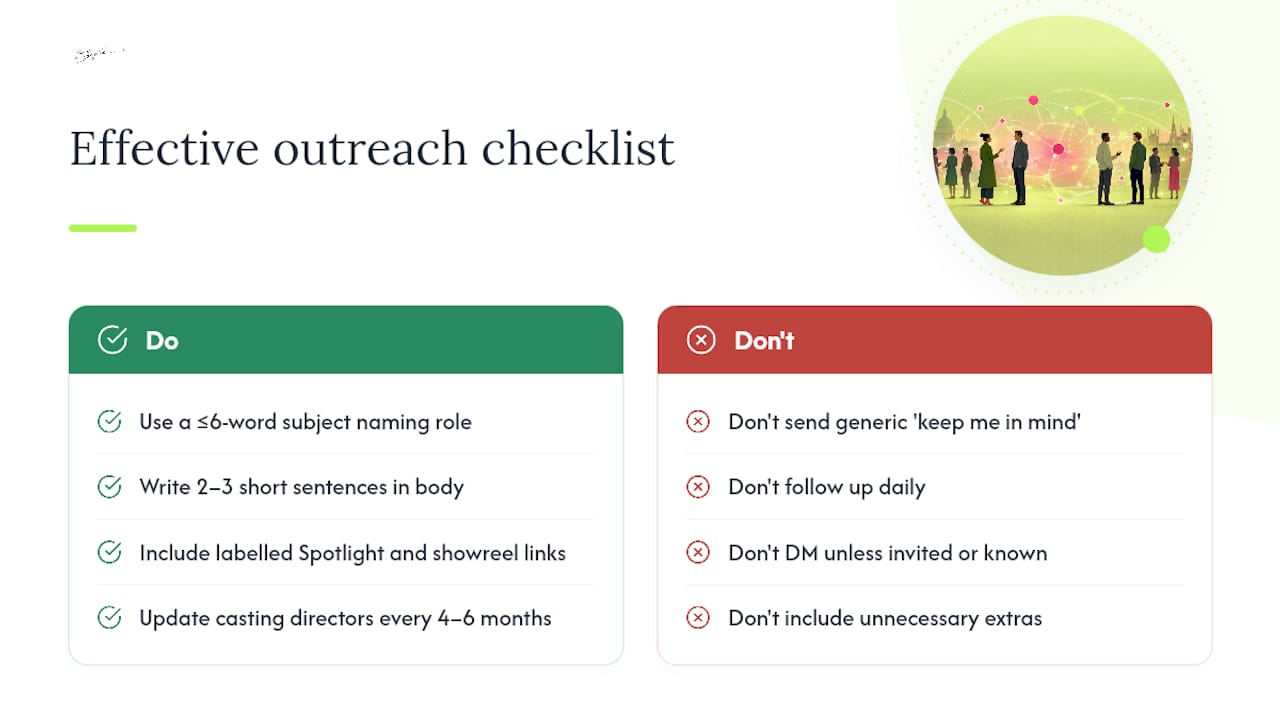
The structure of an email that works: a subject line of six words or fewer naming the role or genre, two to three sentences in the body, and your links. Nothing else.
Subject line example: Theatre actress — new showreel, Spring 2026
Body: "I'm [Name], a [genre] actress based in [city]. I've recently [specific credit or new skill]. My Spotlight profile and showreel are below." Then the links. That is the whole email.
Named casting directors are consistent on this point. Kelly Valentine Hendry, James Pearson, and Brendan McNamara all advise brevity, correct labelling of materials, and selective rather than daily follow-up. Kirsty McGregor and Nina Gold have both noted publicly that generic "keep me in mind" messages carry no weight; a specific, timely reason to make contact is what gets read.
Social media rules of engagement: Follow casting directors on Instagram and Twitter/X, engage genuinely with public posts, and attend open Q&As. Direct messages are acceptable only when a casting director has explicitly invited them or you have an existing professional relationship. LinkedIn is appropriate for initial professional introductions, particularly for commercial and corporate work.
Cadence: Send a first email, then wait. If there is no reply after four to six weeks, that is not a rejection; it is a signal to archive and schedule a future update. A meaningful update every four to six months is the rhythm most practitioners recommend.
How to build a contacts tracker that actually gets used
A tracker works only if it is simple enough to update after every interaction. These are the core fields:
- Full name and role (e.g. Nina Gold, Casting Director)
- Company and primary genre
- Contact email / Spotlight message
- Where and when you met or first contacted them
- Notes (personal detail, shared interest, project they mentioned)
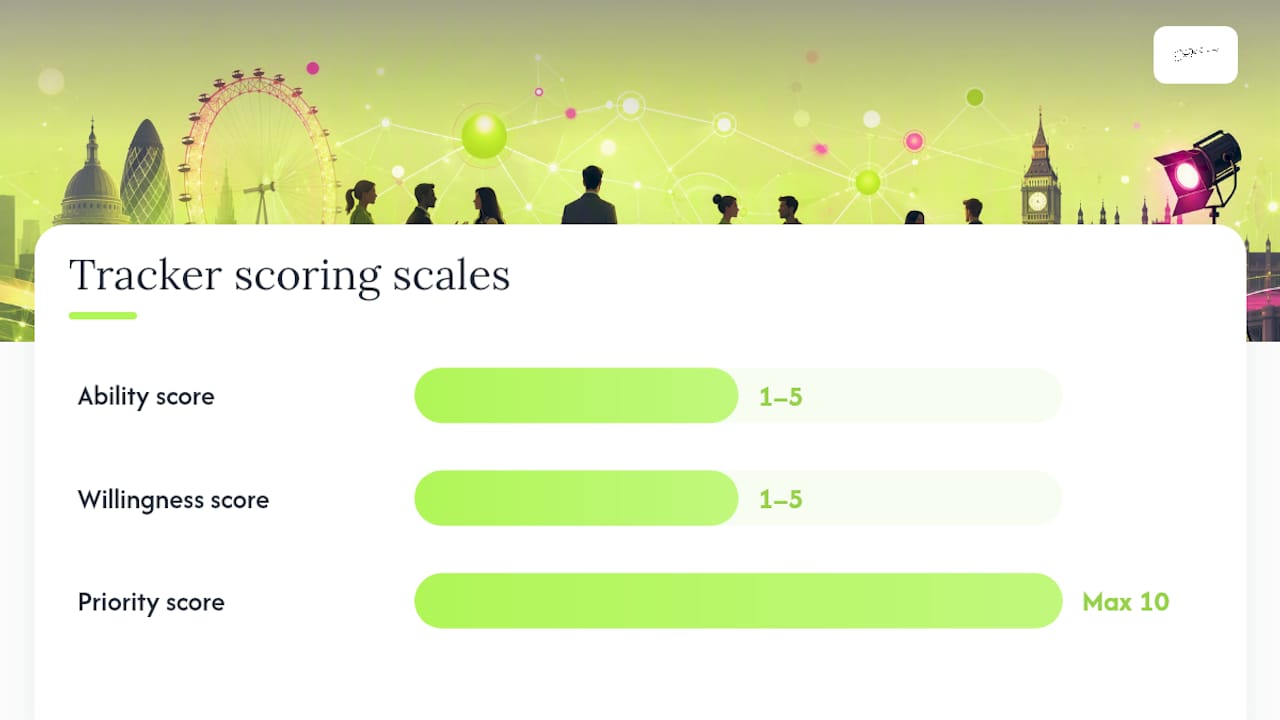
- Ability score (1–5: how likely are they to cast your type?)
- Willingness score (1–5: how open are they to new contacts?)
- Priority score (Ability + Willingness, max 10)
- Next step
- Next contact date
Sort by priority score descending. Contacts scoring 8–10 get your first wave of outreach; 5–7 get a quarterly check-in; below 5 go into an annual review pile.
Suggested cadence:
- Within 24 hours of meeting: Send a brief, warm thank-you referencing something specific from the conversation.
- Every 4–6 months: A meaningful update (new credit, new skill, relevant press).
- Annually: A light check-in or season's greeting if nothing else has prompted contact.
Practitioner guidance recommends treating this log as a professional CRM: record individual contact preferences in the notes field, for example whether someone prefers email over social, or dislikes unsolicited phone calls.
What do casting directors expect from professional outreach and auditions?
The CDG code of conduct requires members to provide essential audition information, consider access needs, avoid one-to-one private meetings in non-professional settings, and prioritise performers' safety and wellbeing. That is the baseline. Any casting notice that cannot confirm these standards is worth questioning before you attend.
Verification checklist before attending or submitting:
- Does the notice name a production company you can verify independently?
- Is the casting director listed on the CDG or CDA membership pages?
- Does the brief include a clear deadline, location, and point of contact?
- Are you being asked to pay for anything? (A legitimate casting office will not charge performers.)
- If something feels wrong, contact Equity for support before proceeding.
Audition etiquette: arrive prepared, take direction without argument, and follow up with a single, brief thank-you. Callbacks are a positive signal; silence after a callback is not unusual and does not warrant repeated contact.
How do you stay visible without over-emailing casting teams?
The most effective visibility tactic is letting casting directors see your work rather than telling them about it. Get Repped's guidance is clear: practice-focused contact, such as a press-night invite or a link to a recent broadcast, outperforms any generic "keep me in mind" message.
- Invite casting directors to press nights with a short, specific note on the production.
- Share a private screening link when a project you are proud of becomes available.
- Post professional updates on Instagram and LinkedIn that reflect genuine activity, not self-promotion.
- Attend public industry events, BAFTA screenings, and CDG-affiliated Q&As where casting teams are present.
Pro Tip: Align your updates with known casting cycles. Television drama tends to cast in January to March and September to October; theatre seasons open casting windows in spring and autumn. A well-timed update lands when a director is actively building lists.
How do you handle replies, silence, and follow-ups?
A reply deserves a response within 24 hours: warm, brief, and specific to what they said. Log the outcome in your tracker and set the next contact date.
No reply after four to six weeks means archive and schedule. It rarely means no forever; it usually means not right now. Practitioner commentary confirms that calibrated, infrequent updates preserve professional trust far better than repeated chasing.
Three short templates:
Thank-you (send within 24 hours): "Thank you for taking the time to meet me at [event]. I really valued [specific detail]. I'll keep you updated on my work."
Six-month update: "I wanted to share a quick update: I've recently [new credit/skill]. My Spotlight profile and showreel are below if useful."
Archive-to-active trigger (when a relevant project is announced): "I noticed you're casting [project type]. I've recently [directly relevant credit]. I'd love to be considered."
Log every reply, non-reply, and outcome in your tracker. When a contact moves from low priority to high (a new project announcement, a genre shift), update their score and move them up the list.
Sofia's perspective on building real connections with UK casting teams
Building professional relationships with UK casting teams as an Italian actress has taught me that specificity is everything. A generic email disappears; a message that references a specific production, a shared event, or a precise skill lands differently. I keep a tracker for every casting professional I meet, and I update it after every interaction, no matter how brief.
The connection that has meant most to me professionally came not from a cold submission but from a conversation after a Q&A event. I followed up the next morning with a single, specific email referencing what we had discussed. That one exchange led to a booking months later, because I had stayed visible in a way that felt genuine rather than persistent.
My honest advice: implement the tracker this week, send three targeted emails to your highest-priority contacts, and then step back. The cadence does the work. You do not need to be everywhere; you need to be memorable to the right people at the right moment.
Sources
- The CDG
- Major casting directors: how to get on their radar
- How to get auditions without an agent
- UK actors: how to build lasting relationships with casting directors
FAQ
How often should you contact a casting director?
A meaningful update every four to six months is the rhythm most practitioners recommend; daily or weekly contact is actively discouraged by named casting directors including Kelly Valentine Hendry and James Pearson.
What should a first outreach email to a casting director include?
A subject line of six words or fewer, two to three sentences naming a specific recent credit or skill, and links to your Spotlight profile and showreel. Nothing more.
How do you verify a casting notice is legitimate?
Check whether the casting director is listed on the CDG or CDA membership pages, confirm the production company independently, and consult Equity's vetting guidance if anything seems unclear.
Why should you target casting assistants and associates?
Assistants and associates compile the initial shortlists that senior casting directors review; building a relationship at that level often surfaces your name before a direct submission would.
Does silence from a casting director mean rejection?
No. Silence typically means "not right now." Archive the contact, schedule a future update in your tracker, and return with a specific, relevant reason to reconnect in four to six months.