Physical objectives for actors: practical scene drills

A physical objective is a tangible thing you want the other actor to do with their body — and you can feel it working quickly. Try this now: stand opposite a partner, and without speaking, pursue one silent goal: get them to sit down. Notice how your body immediately finds ways to coax, persuade, or pressure. That instinct is your physical objective in action, and it is the engine behind Stanislavski's Method of Physical Actions. Two quick examples to anchor the idea: "get my partner to put their arm around me" or "get my partner to move away from the door." Both are specific, testable, and aimed at another person — which is exactly what makes them work.
Key takeaways
A physical objective is the single most practical tool for keeping performance specific, alive, and repeatable across every run.
| Point | Details |
|---|---|
| Define it physically | Write your objective as a tangible, visible outcome in the other person's body, not an internal state. |
| Use the cap as your compass | Know what success looks like before the scene begins; the cap keeps your pursuit honest. |
| One objective per scene | Simplicity sharpens pursuit; use one objective per scene or per scene-half for longer scenes. |
| Consent is non-negotiable | Any objective involving touch requires explicit partner agreement before every rehearsal session. |
| Body and intention must align | Your nonverbal cues, action verb, and physical objective should all point in the same direction. |
Table of Contents
- What is a physical objective in acting?
- Why Stanislavski's method makes physical action so powerful
- How to choose and lock in a physical objective for a scene
- Partner and solo drills to build instinctive use of physical objectives
- A ready-to-use bank of physical objectives by scene tone
- How to fold physical objectives into rehearsal and performance continuity
- Common problems with physical objectives and how to fix them
- Sofia's micro-routines and rehearsal notes
- How character motivation shapes the right physical objective
- Adapting physical objectives for improv versus scripted work
- How body language and nonverbal cues support your physical objective
- Why physical objectives changed how I work
- Sources
- FAQ
What is a physical objective in acting?
Precise terminology unlocks rehearsal. Here are the four terms you will use constantly:
- Physical objective: a tangible, testable outcome you want from another person or the environment — something you can see happen in their body. "Get her to lower her eyes" is a physical objective. "Feel loved" is not.
- Objective: what your character wants in a scene, stated as an active desire ("I want X to forgive me"). The physical objective is often a concrete expression of this.
- Super-objective: the character's overarching want across the whole play or film — the through-line that every scene objective feeds.
- Tactic: the specific action verb you use to pursue your objective moment to moment. You might charm, then challenge, then plead — each is a tactic in service of the same objective.
- Beat: a unit of action that ends when a tactic shifts. Actioning assigns one active verb per beat so every line has a clear physical intention.
- Cap: the moment the objective is achieved or abandoned — the scene's natural turning point.
- Test in the other person: the visible change in your partner that confirms your tactic is landing.
The working relationship is simple: your super-objective governs the whole piece; your scene objective serves it; your physical objective makes it concrete and playable; your tactics are how you fight for it beat by beat.
Why Stanislavski's method makes physical action so powerful
Stanislavski's system rests on a liberating insight: pursue the right physical action truthfully and the emotion follows. Actors who chase a feeling first often lock up — the body tightens, the performance becomes self-conscious. Physical actions bypass that trap. When you are genuinely trying to get someone to embrace you, your nervous system recruits real desire, real strategy, real disappointment when it fails.
The through-line of action connects every scene objective back to the super-objective, giving the performance an internal spine. Break that spine into scene-sized physical objectives and you have choices that are both repeatable across every performance and alive to the partner in front of you. That combination — reproducibility and spontaneity — is what the method was designed to produce.
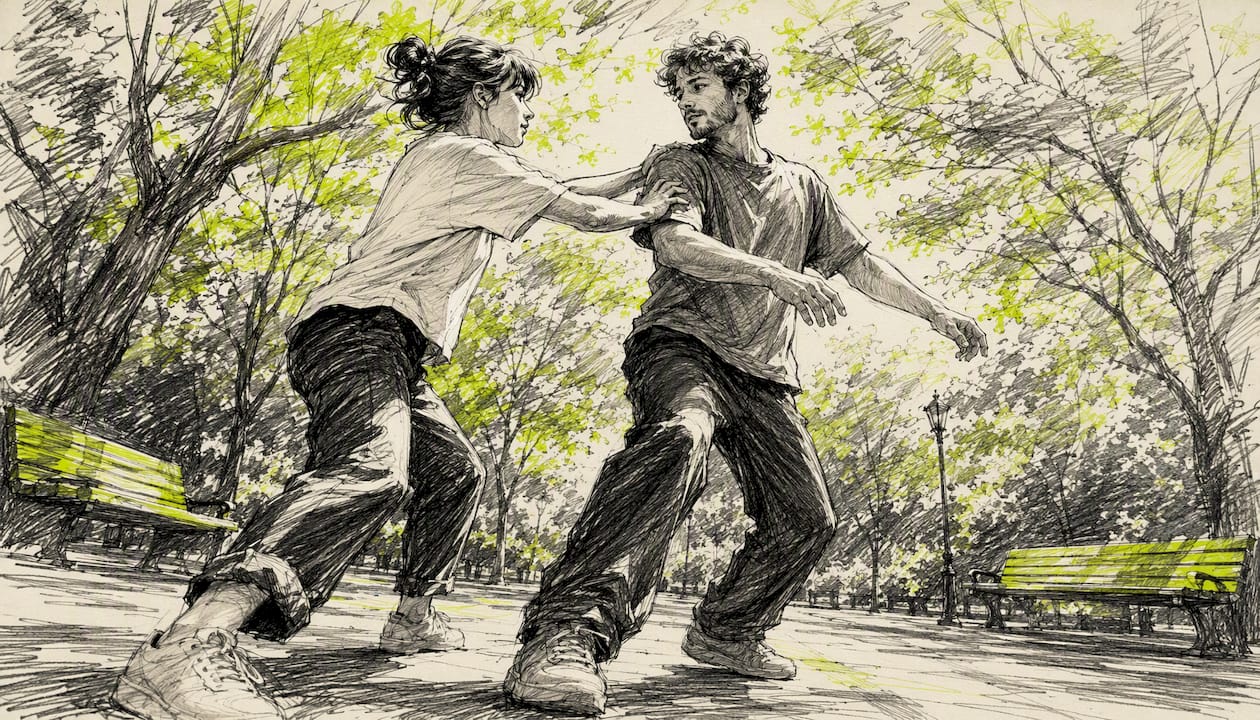
Avoiding the "feeling-first" trap is perhaps the most practical gift of this approach. Physical objectives act as a shortcut: by focusing on a desired physical response from your partner, your body discovers the necessary actions and the emotion arrives naturally, without being manufactured.
How to choose and lock in a physical objective for a scene
Work through this checklist before each rehearsal or audition run:
- Identify the super-objective. Ask: what does this character want more than anything across the whole story?
- Define the scene objective. Write it as: I want [name] to [do something] — because [stake]. Keep it one sentence. This format keeps stakes alive and prevents routine performances.
- Convert to a physical objective. Make it tangible and testable: "I want Jamie to move closer to me" rather than "I want Jamie to feel comfortable."
- Choose your opening tactic. Pick one action verb — invite, provoke, soothe, challenge — and commit to it until the partner responds or you shift.
- Mark your beats. Read through the script and draw a line wherever your tactic changes. One verb per beat. Script mark-up keeps this visible at a glance.
- Set the cap. Decide what the physical achievement looks like — your partner crosses the room, breaks eye contact, laughs — and know when you have reached it.
- Test in rehearsal. Run the scene and check: is the cap visible? Is your partner actually responding? If not, the objective or tactic needs adjusting, not more effort.
Pro Tip: Pick a physical objective that is genuinely fun to pursue. If you are not a little excited by the chase, the audience will not be either. The best objectives feel slightly risky — just specific enough to be playable, just ambitious enough to keep you honest.
Partner and solo drills to build instinctive use of physical objectives
These exercises move from simple to complex. Run them in warm-up or at the start of a new scene unit.
- 60-second silent pursuit (pairs, 1 minute): One actor holds a single physical objective — get your partner to sit, stand, or turn away — using only movement and eye contact. No words. Switch after sixty seconds. Debrief: what tactics emerged naturally?
- Secret objective swap (pairs, 5–10 minutes): Each actor writes their physical objective on a card without showing their partner. Play a short improvised scene. Afterwards, guess each other's objective. Mismatches reveal where the pursuit was unclear.
- Tactic ladder (pairs, 5 minutes): Choose one objective and cycle through five different action verbs in sequence — coax, dare, flatter, ignore, demand — without stopping the scene. Notice how the partner's response shifts with each tactic.
- Pursuit and avoid (group, 10 minutes): Half the group pursues a shared physical objective (get someone to make eye contact); the other half avoids it. Rotate. This builds awareness of how physical objectives create scene tension organically.
- Solo imagination run (solo, 5 minutes): Sit quietly, close your eyes, and run the scene in your imagination with a clear physical objective. Rehearse the cap moment vividly. Integrating objectives through imaginative rehearsal builds consistency before you ever step onstage.
Safety and consent note: any physical objective that involves touch — embracing, guiding, restraining — requires explicit agreement from your scene partner before rehearsal begins. Establish a clear signal to pause (a raised hand or the word "hold") and honour it immediately. Stage work carries real physical demands including coordination, balance, and contact work; treat rehearsal etiquette as non-negotiable.
A ready-to-use bank of physical objectives by scene tone
Adapt these to your character and context. They are starting points, not scripts.
- Romantic: get your partner to reach for your hand; get them to lean in closer; get them to hold your gaze for five full seconds.
- Comic: get your partner to laugh despite themselves; get them to look away in embarrassment; get them to move out of your seat.
- Confrontational: get your partner to back away; get them to lower their voice; get them to break eye contact first.
- Power shift: get your partner to stand when you enter; get them to hand you an object; get them to defer to your choice.
- Neutral/exploratory: get your partner to sit beside you; get them to mirror your posture; get them to stop what they are doing.
Selecting appropriately: match the physical objective to the character's status, age, and relationship to the other person. A high-status character might pursue get them to bow their head; a low-status character might pursue get them to notice me at all. Always check that the objective aligns with the playwright's intention for the scene.
Consent flag: objectives involving physical contact (embracing, restraining, guiding) require explicit partner agreement before every rehearsal session, not just the first one.
How to fold physical objectives into rehearsal and performance continuity
Consistency across runs is where physical objectives earn their keep. A strong choice made in week one can dissolve by opening night if you have no system to preserve it.
Before each run, spend one minute reviewing your scene-note card: objective, main obstacle, opening tactic, and cap. This simple structure takes less than sixty seconds and re-anchors your choices before the adrenaline of performance takes over.
Use your blocking marks as objective reminders. When a cue-line or a cross is tied to a tactic shift, the physical movement itself triggers the new action verb. Blocking and objective work reinforce each other rather than competing.
For touring or long runs, do a brief partner-check before each show: confirm that both actors still agree on the physical objectives in shared scenes. Productions drift; a thirty-second conversation prevents a month of misaligned performances.
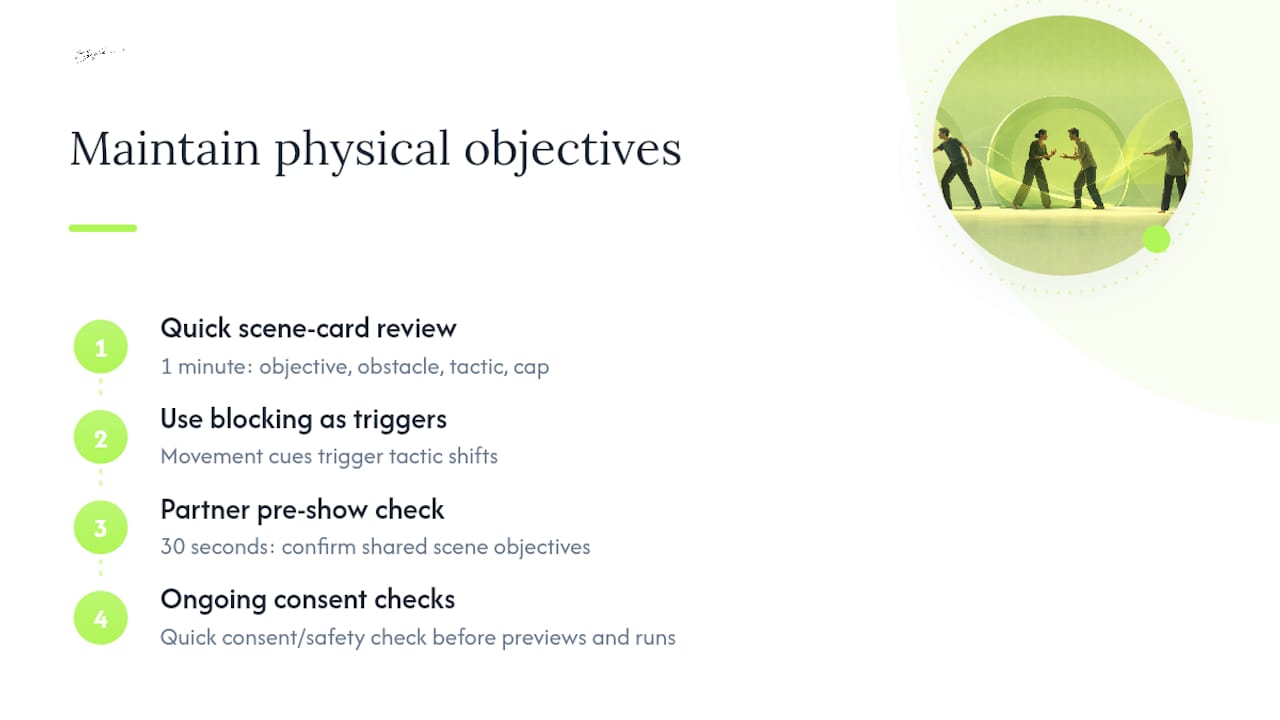
Safety in runs and previews: keep the consent conversation alive throughout the run, not just in early rehearsal. Bodies tire, adrenaline spikes, and physical choices can intensify unintentionally. A quick "are we still good with the contact in scene three?" before a preview is professional, not precious.
Common problems with physical objectives and how to fix them
- The objective is too vague. "Get them to feel better" has no visible cap. Fix: add a physical test — "get them to smile" or "get them to unclench their hands."
- The action feels forced. You are playing the result rather than pursuing the objective. Fix: drop back to the tactic and ask what you would actually do to get that response from a real person.
- Your partner is not responding. Either the tactic is not landing or the objective is not genuinely aimed at them. Fix: change the tactic first; if that fails, check whether the objective is really about the partner or secretly about yourself.
- The objective becomes an errand. You are going through the motions mechanically. Fix: raise the stakes by asking "what happens if I never get this?" A good physical objective, as Acting Studio Chicago notes, is physically do-able, specific, has its test in the other person, and is not an errand.
- Too many objectives at once. Complexity collapses into confusion. Fix: choose one objective per scene, or one per scene-half for longer scenes. Simplicity sharpens pursuit.
Sofia's micro-routines and rehearsal notes
My pre-show ritual is brief and non-negotiable: three minutes before each scene, I write my physical objective on a scrap of paper, read it once, and put it in my pocket. That small act shifts me from thinking about the character to wanting something as the character. The difference is immediate.
Between scenes, I do a ten-second reset: one breath, one physical objective stated silently, one image of the cap moment. It clears the residue of the previous scene and opens me to the next one.
Do: write your objective in the first person and in the present tense ("I want Marco to look at me"). Do: choose an objective that slightly unsettles you — comfort is the enemy of live performance. Don't: choose an objective that is entirely internal ("I want to feel powerful") — there is no test in the other person, and the scene will drift. Don't: change your objective mid-scene without a clear dramatic reason; instability reads as confusion, not spontaneity.
How character motivation shapes the right physical objective
The most useful physical objective sits at the intersection of what the character desperately wants and what the scene's given circumstances make difficult. Start with motivation: what does this person need from the other character right now, and why does it matter urgently? Then ask what physical evidence of that need would look like in the other person's body.
Status, relationship history, and emotional temperature all filter the choice. A character who has just been humiliated will pursue a very different physical objective from one who holds all the power, even if both want the same outcome. Let the character's specific circumstances narrow the field before you commit to a tactic.
Adapting physical objectives for improv versus scripted work
In scripted performance, you set your physical objective during preparation and carry it into the run, adjusting tactics as the partner responds but keeping the destination fixed. The script gives you the beats; your job is to pursue the objective through the given words.
Improvisation inverts this slightly. You arrive with an opening physical objective, but you must stay genuinely responsive to where the scene goes. If your partner's choices make your original objective implausible, shift it rather than forcing it. The discipline is the same — always want something specific from the other person — but the objective itself can evolve. Think of it as holding the objective lightly: specific enough to generate real behaviour, flexible enough to honour the scene's live discoveries.
Actioning is particularly useful in scripted work for assigning a verb to each line; in improv, you carry a palette of action verbs mentally and reach for them as the scene demands.
How body language and nonverbal cues support your physical objective
Your physical objective is communicated almost entirely through nonverbal channels before a word is spoken. Performers use body language, facial expression, eye contact, and movement quality to signal intention and status — and each of these becomes a tactic in service of your objective.
Eye contact is one of the most direct tools. Holding a partner's gaze while pursuing "get them to look away" creates immediate, readable tension. Posture communicates status shifts: leaning in signals pursuit; turning away signals withdrawal or a tactic change. Micro-expressions — the tiny flickers of surprise, pleasure, or discomfort — tell your partner whether their tactics are landing, which feeds their response and keeps the exchange alive.
The key is alignment: your physical objective, your action verb, and your nonverbal behaviour should all point in the same direction. When they diverge, the performance reads as confused rather than complex. Complexity comes from conflicting objectives between characters, not from an actor whose body and intention are out of sync.
Why physical objectives changed how I work
Working in Italian theatre and on international productions, I have found that physical objectives cut through the noise of over-preparation faster than almost any other tool. When I am in a new rehearsal room, sometimes in a language that is not my first, having a clear physical objective grounds me immediately. I am not searching for a feeling; I am pursuing a specific, visible response from the person opposite me.
For camera work, the scale shifts but the principle holds. On a close-up, "get them to soften their eyes" is just as playable as "get them to cross the room" on a stage. The objective simply becomes more intimate, more precise. That adaptability is what makes the method so durable across formats.
If you want to explore how these techniques translate into professional performance work, you can find more about my approach at Sofiavicedomini.

Sources
These are the core readings behind this article, each worth returning to as your practice deepens.
- Physical Action | Acting Studio Chicago
- Actioning in Acting: A Guide to the Technique | Backstage
- A Physical Objective - Acting Coach Scotland
- Acting Objectives and Tactics: A Scene Method | HitCue Blog
FAQ
What are some good objectives for acting?
Good objectives are active, specific, and aimed at another person — for example, "get my partner to apologise," "get them to laugh," or "get them to leave the room." The best ones have a visible cap you can test by watching the other actor's body.
What are the physical demands of acting?
Stage acting typically requires coordination, balance, stamina, and the ability to perform safe contact work with partners. Physical fitness supports vocal projection, movement range, and the sustained energy that long runs demand.
What are the seven physical skills in drama?
Physical skills in drama commonly include body language, facial expression, eye contact, gesture, movement, posture, and proximity. Each can serve as a tactic when pursuing a physical objective in performance.
What are the five C's of acting?
Definitions vary across training traditions; one widely used version names concentration, confidence, commitment, creativity, and collaboration as core acting principles. These are not a standardised framework with a single canonical source, so check the specific curriculum or tutor using the term for their intended meaning.