The TV casting process explained for UK actors in 2026

What does the TV casting process actually involve?
The TV casting process is the structured series of steps a production uses to identify, evaluate, and select actors for specific roles. Far from being a single audition, it is a multi-stage funnel that begins long before anyone steps in front of a camera and involves far more decision-makers than most aspiring performers realise.
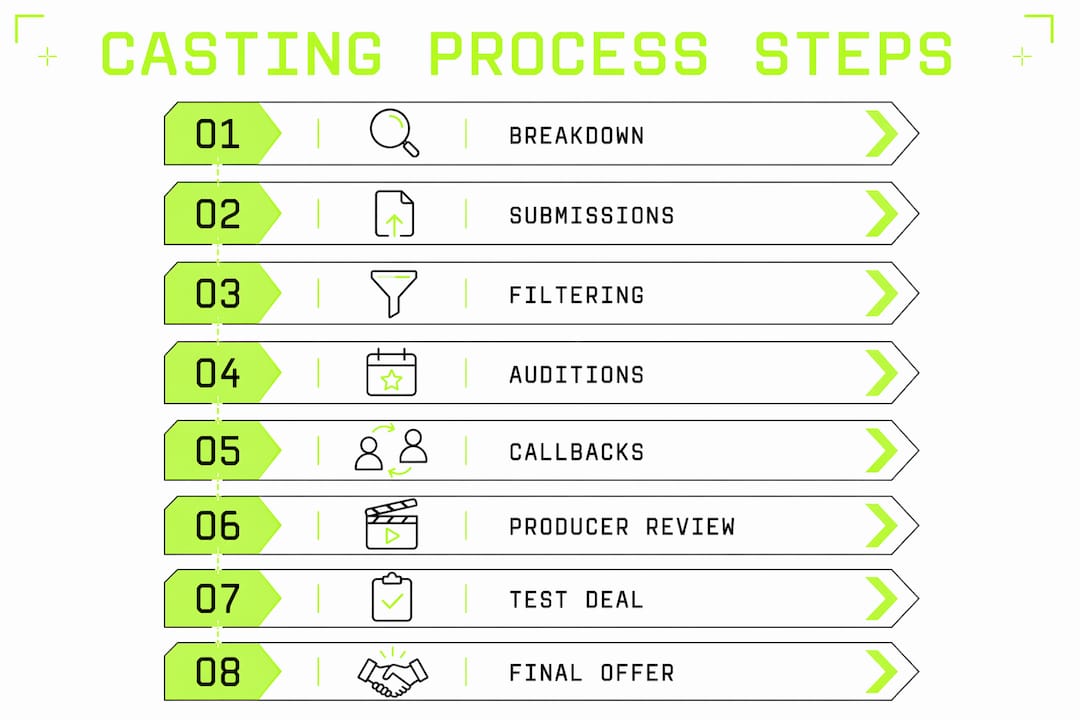
At its core, the process moves through these key stages:
- Character breakdown: The production creates detailed descriptions of each role, outlining age range, physical type, personality, and any specific skills required.
- Submission and initial filtering: Breakdowns are distributed to agents and casting platforms. Casting directors eliminate most applicants before a single audition takes place, making the audition itself the final stage of a lengthy selection funnel.
- Auditions: Actors are invited to read for the role, either in person or via self-tape submission.
- Callbacks: Shortlisted performers return for further rounds, which may include chemistry reads with other cast members or sessions with producers.
- Final selection: The casting director, showrunner, producers, and sometimes network executives make the ultimate decision.
Two additional factors shape every stage in the UK specifically. First, Equity membership is an early filter; union status affects contractual eligibility and insurance requirements on most professional productions. Second, chemistry and creative fit carry as much weight as raw talent. The best actor for a role in isolation may not be the best actor for that production's ensemble.
Table of Contents
- How the TV casting process unfolds step by step
- Who actually makes casting decisions in UK TV?
- How to prepare for TV auditions and conduct yourself professionally
- What timeline should you expect from the casting process?
- What casting directors know that most actors don't
- Handling rejection and feedback after auditions
- Key takeaways
- FAQ
How the TV casting process unfolds step by step
1. The character breakdown goes out
Every casting begins with a breakdown document. Written by the casting director in collaboration with the showrunner or producer, it describes each character's age, physical appearance, personality traits, and any specialist skills. In the UK, breakdowns are typically distributed through platforms such as Spotlight, the industry's primary casting database, as well as directly to agents representing suitable talent.
2. Agents and platforms submit candidates

Once agents receive the breakdown, they submit clients whose profiles match the requirements. Unrepresented actors may access some breakdowns through Spotlight or Casting Call Pro, though the majority of professional TV work flows through agents. This is why securing representation remains one of the most practical steps an actor can take early in their career.
3. Casting directors filter submissions
This is where the funnel narrows sharply. The casting director reviews headshots, showreels, and CVs, filtering by union status, experience, and physical type before a single actor is contacted. Equity membership signals professional standing and ensures the production meets contractual obligations. Actors who do not match the breakdown's core requirements are typically set aside at this stage, regardless of talent.
4. First-round auditions (in-person or self-tape)
Shortlisted actors are invited to audition. In-person auditions usually take place at the casting director's office or a hired studio. Self-tape requests have become standard practice across UK TV productions, particularly for co-star and supporting roles. The casting director provides sides (selected script pages), and the actor submits a recorded performance within a set deadline, often 24–48 hours.

5. Callbacks and chemistry reads
Actors who impress at the first round are called back for further evaluation. Callbacks may involve reading opposite another shortlisted actor to test chemistry, or presenting the work directly to the showrunner and producers in what is known as a producer session. At this stage, the creative team is assessing not just performance but how the actor fits within the show's world and alongside existing cast.
6. Producer and network sessions
For series regular roles on major productions, the process extends further. Producers and, on larger projects, network executives attend sessions to approve the final shortlist. In the US system, this stage is called a network test; UK productions follow a broadly similar model, though the terminology and formality vary by broadcaster and production company.
7. Test deals and holding periods
Once a preferred actor is identified for a significant role, the production may issue a test deal. This is a preliminary contract that holds the actor exclusively during the decision period, preventing them from accepting other work. This holding period typically lasts 5–7 business days after network testing, giving all stakeholders time to confirm the decision.
8. Final offer and confirmation
With approvals secured, the casting director communicates the offer to the actor's agent. Negotiations around fee, billing, and scheduling follow before contracts are signed. The actor is officially cast only when the deal is closed.
9. Role categorisation shapes the timeline
Not every role follows the same path. Co-star and under-five roles are often cast quickly via self-tape with short turnaround, sometimes within days. Guest star roles involve more rounds. Series regular casting can span months, with multiple audition stages, callbacks, and executive approvals layered throughout.
Who actually makes casting decisions in UK TV?
The casting director is the creative and logistical engine of the process, but they are rarely the sole decision-maker. Understanding who holds influence at each stage helps actors read the room more accurately.
- Casting directors develop the brief, source talent, conduct auditions, and advocate for their preferred choices to the wider team. They are creative collaborators, not gatekeepers acting in isolation.
- Showrunners and writers hold significant creative authority, particularly on drama series. Their vision for a character shapes every casting decision from the breakdown onwards.
- Producers balance creative preferences against budget, scheduling, and the practicalities of production. A casting director's recommendation still needs producer sign-off.
- Studio and network executives become involved for series regular roles and high-profile projects, adding another layer of approval that can extend the timeline considerably.
- Agents represent actors' interests in negotiations and maintain ongoing relationships with casting directors, which directly influences which clients get submitted for which roles.
- Equity sets the contractual framework within which professional casting operates in the UK, covering minimum rates, working conditions, and eligibility requirements.
Diversity and inclusivity have become genuine priorities rather than afterthoughts in UK TV casting. Broadcasters including the BBC and Channel 4 have published on-screen diversity targets, and casting directors increasingly work to ensure breakdowns do not unnecessarily restrict submissions by ethnicity, disability, or background.
Casting agencies in the UK range from boutique operations specialising in specific genres to larger companies handling multiple simultaneous productions. Their relationships with agents and their understanding of individual showrunners' tastes are what make them effective. A casting director who has worked repeatedly with a particular writer will know instinctively which actors that writer responds to.
How to prepare for TV auditions and conduct yourself professionally
Preparation is where most actors either build or lose their opportunity before they even walk into the room. Here is what actually matters.
Understand the role and the show. Read the sides carefully, but also research the production. Knowing the tone, genre, and style of a show shapes every creative choice you make in the room. Arriving without this context signals to a casting director that you are not genuinely invested.
Self-tape with precision. Self-taped auditions require a clean, neutral background, a clear eye-line to the camera, and an off-camera reader. No music, no filters, no overproduction. An overly produced self-tape actively works against you; it suggests a misunderstanding of what casting directors are looking for, which is the performance, not the production value.
Pro Tip: When you receive a redirect during a work session, treat it as the most valuable part of the audition. Casting directors often prefer a strong response to direction over a flawless initial take. Showing that you can shift quickly and without ego is one of the clearest signals of professional readiness.
Common behaviours that casting directors value:
- Arriving on time (or submitting self-tapes before the deadline)
- Knowing the material without being rigidly locked to it
- Taking direction without defensiveness
- Being warm and professional in the room, not performatively eager
- Following submission instructions exactly, including file format and labelling
Pitfalls to avoid:
- Overproducing your self-tape with elaborate sets or heavy editing
- Arriving unprepared and hoping to "find it in the room"
- Ignoring the brief and playing the character as you imagine them rather than as described
- Being difficult or precious about redirection
- Contacting casting directors directly without an agent, unless explicitly invited to do so
The ability to take direction effectively often outweighs a perfect initial take. Casting directors prefer work sessions over cold reads precisely because they reveal how an actor thinks and adapts, not just how they perform when fully prepared.
What timeline should you expect from the casting process?
Timing in TV casting is rarely predictable, but there are patterns worth knowing. The table below outlines typical durations for each stage, though these vary significantly by production scale and broadcaster.
| Stage | Typical duration | Notes |
|---|---|---|
| Breakdown to first submissions | 1–3 days | Faster on urgent productions |
| Initial filtering by casting director | 1–5 days | Depends on submission volume |
| First-round audition or self-tape | 24–48 hours' notice | Self-tapes often due within 48 hours |
| Callback notification | 3–7 days after first round | Can be longer on larger productions |
| Producer/network session | 1–3 weeks after callback | Varies by broadcaster involvement |
| Test deal and holding period | 5–7 business days | Standard for series regular roles |
| Final offer and contract | 1–2 weeks after approval | Subject to negotiation |
Pilot season, which in the UK tends to cluster around autumn and spring commissioning cycles, compresses these timelines considerably. Productions racing to meet table read or shoot dates may expect self-tape submissions within 24 hours and callbacks within days rather than weeks.
Actors should also know that silence is not always rejection. Productions frequently hold shortlists while other roles are confirmed, and an actor may remain under consideration for weeks without receiving any communication. The absence of a "no" is not a "yes," but it is also not necessarily a door closed.
Feedback after auditions is rarely detailed. Most casting directors do not have the capacity to provide individual notes to every actor seen, and agents often receive only a brief indication of why a client was not progressed. When feedback does arrive, treat it as genuinely useful intelligence rather than a personal verdict.
What casting directors know that most actors don't
The most experienced casting professionals think about their work differently from how it is often portrayed. A few insights from inside the industry illuminate what really drives decisions.
That framing matters. It means that not getting a role is rarely a verdict on your talent. It is more often a reflection of fit, timing, or chemistry with actors already attached.
- Unknown actors get cast regularly. Casting directors welcome unknown talent when performers demonstrate specific skills relevant to the production's style. For fast-paced or immersive shows, technical versatility is often valued above classical training or a long CV.
- Reputation compounds over time. Actors who establish a reputation for reliability, preparation, and responsiveness to direction are considered safe bets. Casting directors advocate for actors they trust, which means a strong audition today can open doors on a production two years from now.
- Digital platforms have widened the talent pool. The rise of self-tape submissions means casting directors can now draw from a genuinely national pool of talent rather than being limited to actors based in London or near major production hubs.
- Tiered casting strategies mean different rules for different roles. Co-star roles move fast and require minimal rounds; series regular casting is a different process entirely, with far more stakeholders and a longer runway.
- Adaptability is the skill casting directors most want to see. Actors who master responding to direction during work sessions demonstrate the agility that TV production demands. A static, over-rehearsed performance rarely wins the room.
The casting director's role as advocate is worth understanding clearly. They are not neutral arbiters; they are creatively invested in finding the right person and will argue for their preferred choice to producers and executives. Building a genuine professional relationship with a casting director, through consistent preparation and conduct, is one of the most durable assets an actor can develop.
Handling rejection and feedback after auditions
Rejection is the most consistent experience in an acting career, and how you handle it shapes your longevity in the industry more than almost anything else.
Most of the time, you will not hear why you were not cast. Casting directors see dozens or hundreds of actors for a single role, and detailed individual feedback is simply not feasible within production timelines. Your agent may receive a brief note ("not quite right for this one," "went in a different direction"), but substantive critique is the exception rather than the rule.
When feedback does arrive, receive it without defensiveness. A note about physicality, accent, or energy is not a personal attack; it is information about what the production needed at that moment. File it, consider whether it points to something worth developing, and move on.
The more useful reframe is this: every audition is a chance to be seen by a casting director, not just a chance to get the role. Casting directors remember actors who impressed them even when they were not right for a particular part. A strong, professional audition for a role you do not get can still result in a call for the next production that casting director works on.
Practically, after an audition: thank your agent, note what felt strong and what you would refine, and resist the urge to follow up directly with the casting office. Chasing decisions is one of the fastest ways to mark yourself as difficult to work with. Trust the process, keep working on your craft, and let your agent manage the relationship.
Key takeaways
The TV casting process in the UK is a structured, multi-stage funnel where preparation, professionalism, and adaptability carry as much weight as raw talent.
| Point | Details |
|---|---|
| Casting is a funnel, not a single event | Most actors are filtered before auditions; the audition is the final stage of a long selection process. |
| Self-tape quality matters from the first second | Keep backgrounds neutral, eye-lines clear, and avoid overproduction; casting directors focus on performance, not production value. |
| Test deals hold actors for a typical business-day holding period | Series regular roles involve a holding period after network approval before a final offer is made. |
| Equity membership is an early filter in UK casting | Union status affects contractual eligibility and is assessed before audition invitations go out. |
| Adaptability outweighs a perfect first take | Casting directors value actors who respond well to direction during work sessions above those who deliver a flawless but rigid performance. |
FAQ
How does TV casting work in the UK?
The process begins with a character breakdown distributed to agents and platforms such as Spotlight. Casting directors filter submissions by Equity membership, physical type, and experience before inviting actors to audition, either in person or via self-tape. Callbacks, producer sessions, and final approvals follow before an offer is made.
What are the steps of the casting process?
The main steps are: character breakdown, agent submissions, initial filtering, first-round auditions (in-person or self-tape), callbacks and chemistry reads, producer or network sessions, test deals, and final offer. Series regular roles involve all stages; co-star roles may move from self-tape to offer within days.
How long does the TV casting process take?
It varies significantly by role. Co-star roles can be cast within a week. Series regular roles on major productions can take several months, with a test deal holding period of 5–7 business days near the end of the process. Pilot season compresses timelines across the board.
What are red flags to watch out for in casting?
Legitimate casting calls never ask actors to pay a fee to audition, purchase specific headshots from a named photographer, or sign contracts without agent involvement. Any casting notice that requests upfront payment or promises guaranteed roles in exchange for money should be treated with serious caution.
What do casting directors look for beyond performance?
Reliability, professionalism, and the ability to take direction are consistently cited as decisive factors. Casting directors act as advocates for actors they trust, so a reputation for being prepared, punctual, and responsive to redirection makes an actor a safer recommendation to producers and executives.