Usage fees for commercials: how advertisers licence and pay for talent

Usage fees are the licence payments that let you run a produced commercial across specific media, territories and timeframes; they sit apart from the production fee you already paid to make the thing. Before you commission or repurpose a single frame of content, do three things. Record your intended media, territory and term now, while the brief is still fresh. Ask upfront whether your talent or creator will grant paid-media rights, not just organic ones. Then budget a separate usage line rather than folding it into the production cost. SAG‑AFTRA's 2025–2027 contract indexes rate rises year on year, paid social windows commonly run in multi-week blocks, and as an actress who works both sides of this negotiation, Sofia Vicedomini sees the same budgeting mistakes repeat across markets.
Key Takeaways
Usage fees are separately negotiated licences priced by media, territory, term and exclusivity, and budgeting them upfront prevents expensive retrospective disputes.
| Point | Details |
|---|---|
| Session and usage are different | Session fees pay for shoot time; usage fees pay for where and how long the content runs. |
| Paid social needs its own line | Organic repost rights rarely include paid-media rights; negotiate them separately. |
| Rates rise year on year | Indexed union increases mean last year's rate sheet will underestimate current costs. |
| Option clauses save money later | Agree renewal and extension pricing before launch, not after a campaign succeeds. |
| Sofia Vicedomini offers clarity from the brief | Bookings come with itemised usage terms and invoices covering media, territory and term. |
Table of Contents
- What do usage fees for commercials actually cover?
- How are usage fees calculated?
- What do sample rate sheets and indexed increases look like?
- How do you budget usage fees into a campaign?
- What negotiation levers and contract clauses should you use?
- What documentation do you need before you launch a campaign?
- What do performers actually want marketing teams to understand?
- Booking Sofia Vicedomini for your next commercial
- Where to check current rates and legal detail
- Sources
- FAQ
What do usage fees for commercials actually cover?
A usage fee buys permission. A session fee (sometimes called a production fee) pays for the performer's time, the shoot day, and the deliverables handed over at the end of it. A usage fee, or commercial licensing fee, is something else entirely: it buys the right to actually run that footage, in which media, for how long, and where in the world.
Confusing the two is the single most expensive mistake advertisers make. Paying a creator or actor to shoot content, and having the right to repost it organically, does not hand you commercial advertising rights over that same footage. That distinction gets missed constantly, and industry guidance on influencer usage rights confirms paid-media rights need a separate negotiation from organic posting rights.
The media category you choose changes the licence value considerably:
- Broadcast television, still the benchmark for national campaigns
- Streaming platforms, which now command their own premium tiers
- Traditional digital display and pre-roll
- Paid YouTube placement
- Paid social advertising (Meta, TikTok, and similar)
- Out-of-home and print
Organic reposting is frequently bundled into a base fee. Paid amplification of that same asset, on any platform, usually is not. Get that written down before you brief the edit team.
How are usage fees calculated?
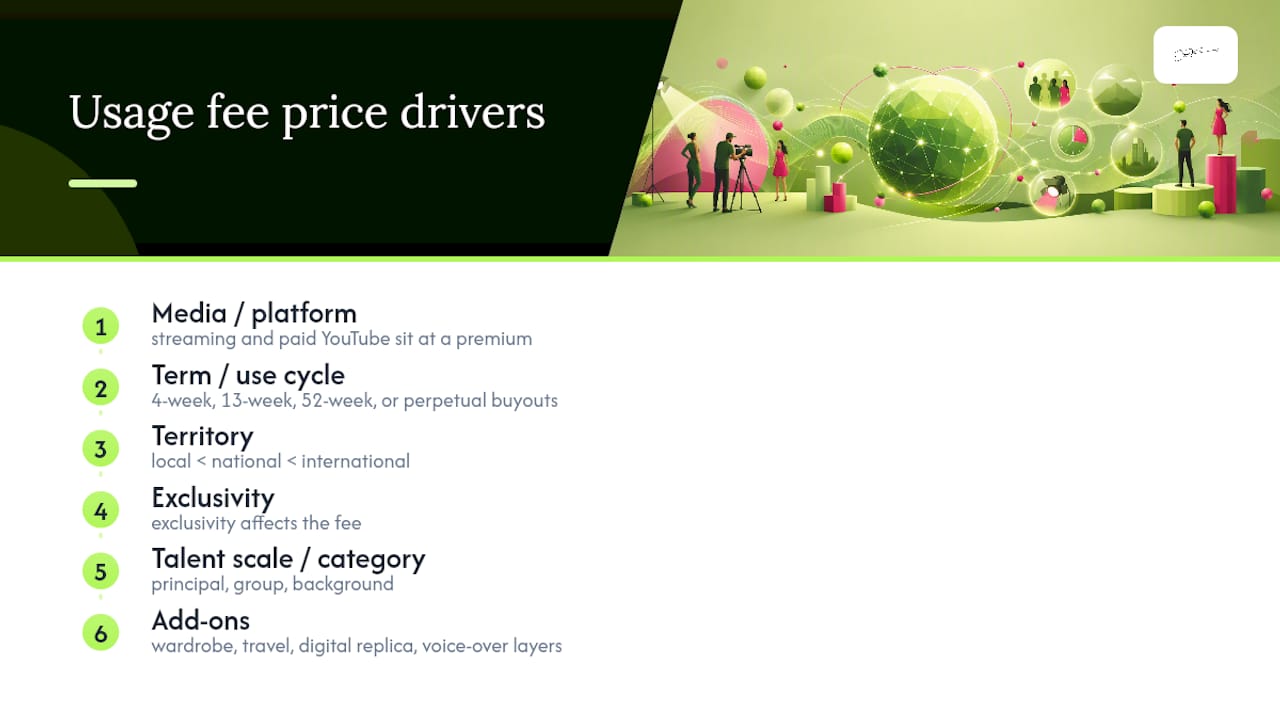
Six variables move the price, and once you can name them, you can price almost anything. Media and platform matter most, because streaming and paid YouTube tend to sit at a premium above traditional digital. Term or use cycle comes next, typically structured as 4-week, 13-week, 52-week, or perpetual buyouts. Territory follows: a local Italian campaign costs less than a national one, which costs less again than international rights. Then there's exclusivity, talent scale and category (principal, group, background), and finally add-ons like wardrobe, travel, digital replica rights, or voice-over layers.

The pricing shape depends on who you're working with. Influencer and creator content is usually priced as a percentage premium on the base creator fee, often banded by duration. Union talent tends to work on flat per-use or per-cycle caps, set out in published rate sheets. Voice-over work runs on a session-plus-usage model, where the recording is billed separately from the licence to broadcast it, a structure explained clearly in voice-over invoicing guidance.
Pro Tip: Always write usage as a three-part line on the budget and the invoice: media, territory, term. Add an option clause covering post-publication buys, so if the campaign performs and you want to extend it, you're paying a pre-agreed rate rather than negotiating from a position of obvious desperation.
Rates also move over time. SAG‑AFTRA's current contract builds in indexed increases of 5% from April 2025, 4% from April 2026, and 3% from April 2027, with streaming and certain digital tiers rising faster than the base rate. A budget built on last year's rate card will simply be wrong.
What do sample rate sheets and indexed increases look like?
Published 2025 rate sheets set out concrete per-cycle figures for principals and groups across streaming, traditional digital, cable and national broadcast, structured around the familiar 4-week, 13-week and 52-week tiers. Streaming and Traditional Digital tiers that include paid YouTube placement tend to carry the higher year-on-year rises, reflecting how much viewing has migrated there.
The practical meaning of a "use cycle" catches a lot of marketers out. If you licence a spot for a 13-week cycle and then decide six months later you want it running for another year, you don't get that extension for free. You pay the difference between what you already secured and what the longer cycle costs, calculated from the same rate structure.
Treat every figure here as illustrative rather than gospel. Rates vary by union jurisdiction, by production type, and by local agreement, so confirm current numbers with the relevant talent union, agent, or legal counsel in Italy or wherever the campaign runs before you commit a number to a client budget.
How do you budget usage fees into a campaign?
Forecasting usage costs accurately comes down to three steps, done in order rather than backwards.
- Map your media plan by channel and expected term. List every platform the spot will run on and how long it needs to stay live, before you even think about price.
- Pick a pricing model that fits your talent type. For creator content, apply the published percentage premium bands, commonly tiered around 30, 90 and 365-day paid social windows. For union talent, anchor your estimate to the per-cycle caps in the current rate sheet.
- Layer in exclusivity, add-ons and a renewal contingency. Exclusivity clauses, wardrobe, travel and digital replica rights all add percentage premiums on top of the base licence.
Build in a contingency buffer for renewals, because campaigns that work almost always outlive their original licence term. One-time buyouts suit short bursts of activity; ongoing campaigns are usually cheaper over time if you negotiate a renewal rate upfront rather than relicensing from scratch each cycle.
What negotiation levers and contract clauses should you use?
Good usage negotiations happen before the shoot, not after the edit is locked and the client is already excited about a cut that only has organic rights attached.
A few levers consistently work in the advertiser's favour: propose an option clause for future paid amplification rather than buying every right upfront; ask for separate, itemised pricing for paid social versus organic; negotiate tranche pricing for term extensions so the cost of extending is agreed before you need it; and be explicit about non-exclusive versus exclusive licensing, since exclusivity carries its own premium schedule.
Your contract, or the usage rider attached to it, should define media, territory, term, exclusivity, renewal terms and payment timing without ambiguity. It should also specify delivery formats, permitted cutdowns, and addressable or regionally-edited versions, and require proof of release for any third-party elements in the frame, music, locations, other people's likenesses.
Before you sign anything, ask the talent or creator directly:
- Do you grant paid-social rights for a defined number of days, and how many?
- Is paid YouTube placement included, or priced separately?
- What territory does this licence actually cover?
- Will you accept option pricing for future amplification, rather than renegotiating from scratch?
Pro Tip: Put the option clause in writing even if you think you'll never use it. It costs you nothing today and saves a frantic, expensive renegotiation the moment a campaign takes off and legal wants proof you're covered for the extra spend.
What documentation do you need before you launch a campaign?
Clearance is the unglamorous part of the job, and it's exactly where disputes start. Before launch, confirm the signed usage licence or rider matches what's actually in the media plan, check the territory and term line up with the buy you've placed, secure timestamped copies of the final deliverable, and log the renewal date somewhere your team will actually see it.
Collect four documents as standard: the signed talent release, a usage invoice with its own clearly separated usage line, proof of agreed payment terms, and any model or property clearances the asset needs. Guidance on usage rights is consistent on this point: running content without a proper licence risks fines, takedown demands, and reputational damage that costs far more than the licence would have.
- Confirm the licence or rider matches the media buy exactly.
- Verify territory and term against the actual campaign plan.
- File deliverable files with timestamps and note the renewal date.
Using the asset on a new platform, for longer, or in a new territory always requires a fresh licence, not a favour.
What do performers actually want marketing teams to understand?
Separating session and usage fees isn't paperwork for its own sake, it protects a performer's livelihood and their reputation in a small industry where word travels fast. When a brief asks me to "just be flexible" on usage, what's usually being asked is whether I'll work for less than the licence is worth, and that's a conversation worth having honestly rather than around the edges.
What speeds approval, every time, is a clear request: name the media, the term, the creative context, and offer option pricing if the brand thinks the campaign might expand. That single structure tells me the person on the other end understands what they're actually buying.
Treat usage as a negotiable licence, not a favour extended by a grateful performer, and you'll find disputes fall away and the same talent wants to work with you again.
Booking Sofia Vicedomini for your next commercial
If this guide has made one thing clear, it's that vague usage terms cost advertisers money and goodwill later. Sofia Vicedomini books commercial and modelling work across film, television and live event formats, and supplies clear, itemised usage terms and invoices from the first conversation, so your legal and finance teams aren't chasing paperwork after the shoot.
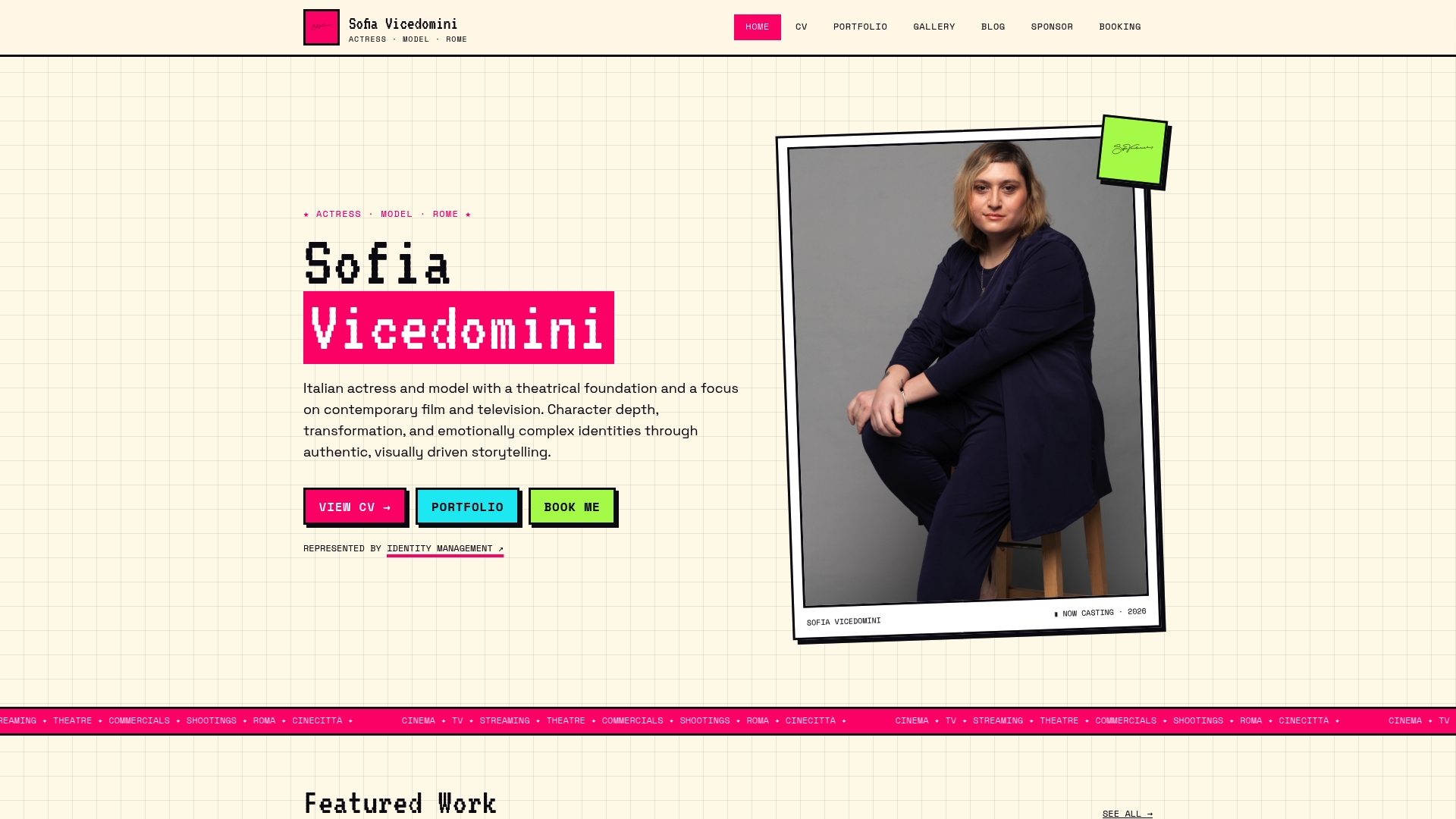
When you brief in an enquiry, include three things: your intended media and term (broadcast, streaming, paid social, or a mix), your target territory, and your preferred exclusivity and start date. That's all it takes to get an accurate quote back quickly. Visit Sofia Vicedomini's booking page to check availability and start the conversation before your production schedule locks in.
Where to check current rates and legal detail
Confirm figures directly before locking a budget: SAG‑AFTRA's contract summary and rate sheets, the union's explainer on max use and holding fees, Mailchimp's usage rights guidance, and invoicing practice for voice-over usage lines.
- Check the publication date on any rate sheet before applying it
- Localise for Italy or your operating jurisdiction, since these examples are largely US union figures used illustratively
This article is general information, not a substitute for advice from a qualified lawyer. Consult a qualified legal professional about your own circumstances before acting on anything here.
Sources
- How much to charge for usage rights (influencer)
- 2025 commercials contracts summary (SAG‑AFTRA)
- 2025 SAG‑AFTRA commercials contract rates effective 4/1/25 - 3/31/26
- Usage rights (Mailchimp resource)
FAQ
What is the difference between a session fee and a usage fee?
A session fee pays for the shoot itself, the performer's time and labour. A usage fee, or commercial licensing fee, pays separately for the right to run that footage in specific media, territories and timeframes.
Do organic social rights include paid advertising rights?
No. Organic reposting is often bundled into a base fee, but running the same content as paid social advertising almost always requires a separate, negotiated licence.
How much do usage fees typically increase each year?
Under SAG‑AFTRA's current contract, indexed increases run at 5% in 2025, 4% in 2026 and 3% in 2027, with streaming and certain digital tiers rising faster still.
What happens if I use a commercial beyond its agreed usage term?
Running content on a new platform, in a new territory, or for longer than the licensed term requires a fresh licence and payment; it is not covered by the original agreement.
How can I get accurate usage terms when booking talent?
Ask for a clear breakdown of media, territory, term and exclusivity upfront. Sofia Vicedomini supplies itemised usage terms and invoices as standard when booking commercial work.